MSI MAG 346CQDF E20: Specs, Price, Pros & Cons
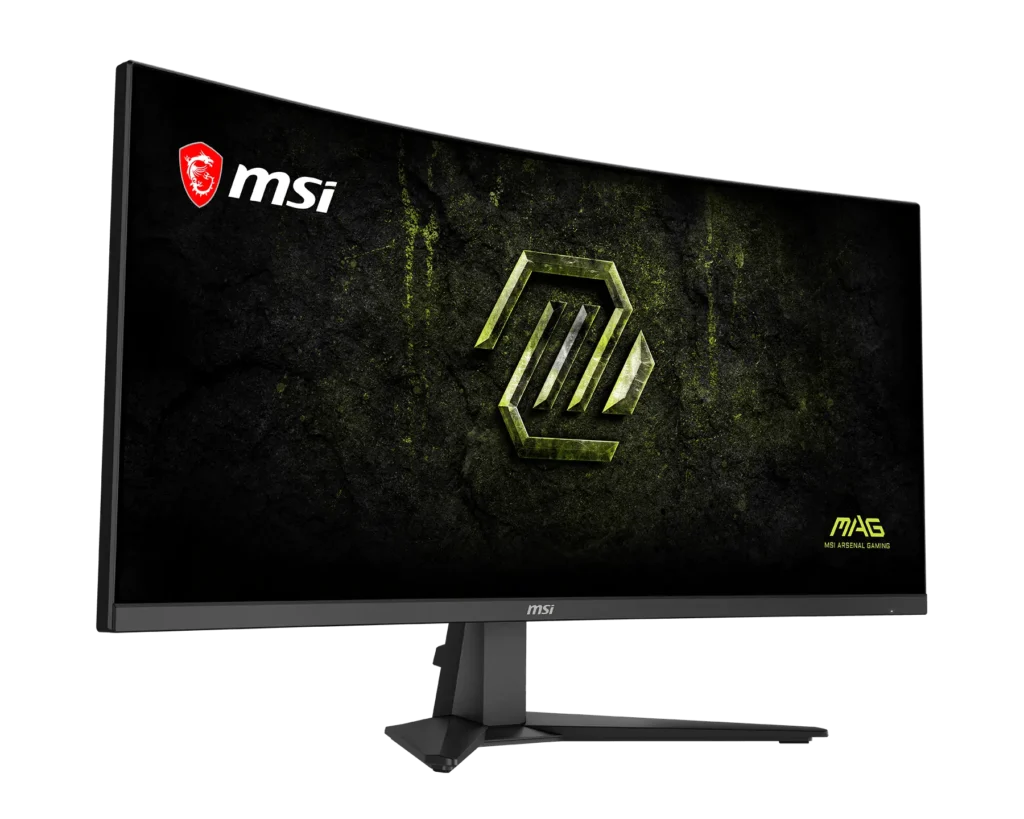
A 34-inch curved ultrawide built around a fast VA panel rather than the QD-OLED its similar-sounding sibling uses, and that single choice explains most of what follows.
The panel is a 1500R Rapid VA at 3440 x 1440, rated at 200 Hz with a 0.5 ms gray-to-gray minimum and a 4000:1 native contrast. That contrast figure is the VA advantage: dark scenes hold their depth in a way IPS panels at this price do not, while the refresh and response are fast enough that the old VA smearing complaint is largely addressed on paper. MSI adds a dual-mode trick (drop the resolution to 1720 x 720 and the panel runs at up to 400 Hz), along with FreeSync Premium from 48 Hz up to the full refresh, and picture-in-picture and picture-by-picture for two sources. Color is quoted at 95 percent DCI-P3, good for a monitor without wide-gamut marketing, but brightness is a modest 300 nits and the HDR Ready label means the monitor accepts an HDR signal rather than displaying one convincingly.
Connectivity is the budget part. One DisplayPort 1.4a carries the full rate, while the two HDMI 2.0b ports top out at 100 Hz at native resolution, which console and laptop owners should know going in. There is no USB-C, no USB hub, no KVM and no speakers, just a headphone jack. The stand tilts and does nothing else, though the 100 x 100 VESA pattern makes an arm an easy fix, and at 5.6 kg without the stand it is manageable on most mounts.
The shape, the contrast and the price are the pitch, and the extras are where the money was saved.
Category strengths
Where the MSI MAG 346CQDF E20 beats the median
- Has picture-by-picture ?
- A higher refresh rate ?200 Hz vs 172.5 Hz (median)
- A higher contrast ratio ?4000:1 vs 3500:1 (median)
Where the MSI MAG 346CQDF E20 trails the median
- Lower peak brightness ?300 nits vs 400 nits (median)
- No height adjustment ?
- No swivel adjustment ?
- No USB hub ?
How this VS Score was computed
Score 46: each known spec is measured against the median of VA gaming monitors, 32 inches and up (6 products), then weighted; 50 means level with that median. In classes of six or more, a value beyond the class’s 10th–90th percentile range counts as that limit, so one extreme product cannot set the scale. 72% of the scoreable weight could be used; unknown values, features not applicable to this class and proxies (battery capacity where a rated life exists) add or remove nothing.
| Specification | This product | Cohort median | Score weight | Points moved |
|---|---|---|---|---|
| Height adjustment | No | 50% of the class have it | 0.4 | −19.2 |
| HDR | None | HDR10 | 0.5 | −12.5 |
| Local dimming | No — held to half its range (class of fewer than six) | 40% of the class have it | 0.4 | −10.0 |
| Peak brightness | 300 | 400 | 0.8 | −9.6 |
| Swivel | No | 50% of the class have it | 0.2 | −9.6 |
| Refresh rate | 200 | 172.5 | 1.2 | +9.6 |
| Picture-by-picture | Yes — held to half its range (class of fewer than six) | 33% of the class have it | 0.2 | +5.0 |
| Contrast ratio | 4,000 | 3,500 | 0.6 | +4.2 |
| USB hub | No | 50% of the class have it | 0.05 | −2.2 |
| Pivot | No | 33% of the class have it | 0.02 | −1.0 |
| Screen size | 34 | 34 | 1.2 | +0.0 |
| Resolution | 1440p | 1440p | 1.2 | +0.0 |
| Panel type | VA | VA | 0.8 | +0.0 |
| Color depth | 10 | 10 | 0.3 | +0.0 |
| Response time | 0.5 — capped at the class’s lower range (1) | 1 | 0.8 | +0.0 |
| DCI-P3 coverage | 95 | 95 | 0.6 | +0.0 |
| Pixel density | 110 | 110 | 0.5 | +0.0 |
| Adaptive sync | FreeSync | FreeSync | 0.6 | +0.0 |
| HDMI ports | 2 | 2 | 0.4 | +0.0 |
| DisplayPort inputs | 1 | 1 | 0.4 | +0.0 |
Not scored: Local dimming zones (unknown: not scored); Variable refresh rate (standard for the class (100% have it)); Motion blur reduction (unknown: not scored); Input lag (unknown: not scored); Tilt (standard for the class (100% have it)); USB-C (not applicable: only 0% of this class have it); USB-C power delivery (unknown: not scored); Built-in speakers (not applicable: only 0% of this class have it); Headphone output (standard for the class (80% have it)); KVM switch (not applicable: only 0% of this class have it); Webcam (not applicable: only 0% of this class have it); Microphone (not applicable: only 0% of this class have it); Ethernet (not applicable: only 0% of this class have it).
Editor’s note
The 346CQDF E20 is the ultrawide I would recommend to someone who wants the immersion and contrast of a curved panel at a price well under the OLED alternatives, and who will drive it from a desktop over DisplayPort.
In use, the deep native contrast is what you notice, and in a dim room it is most of the OLED experience for a fraction of the money. What you give up against the OLED sibling is per-pixel light control, true black and any meaningful HDR. Treat it as an SDR monitor and it flatters everything you put on it.
The dual-mode switch is more useful than it sounds for one specific person: someone who plays a single competitive shooter seriously and everything else at native resolution. The low-resolution mode is coarse, but frame rate beats detail in that genre, and switching costs nothing.
Plan around two limits. The HDMI inputs run at half the panel's rate, so a console or a laptop without DisplayPort wastes what you paid for. This is a desktop monitor in practice. And the tilt-only stand will probably annoy you within a week. An arm is cheap and fixes it.
Against the MAG 341CQP QD-OLED, the choice is simple: the OLED buys true black, real HDR and per-pixel response for noticeably more money, and this buys the same shape and most of the contrast feel for less. Buy the VA if the room is dim and the budget is firm, the OLED if HDR films share the desk with the games.
Specifications
Quality bars show where each figure sits between the lowest and highest of the 6 VA gaming monitors, 32 inches and up this VS Score is measured against.
Picture
Gaming
Ergonomics & design
Connectivity
Features
Sources and verification
Where the specifications come from
- Official product pagemsi.com
- Retailer listing (cross-check)amazon.com
Verification
- First published
- Specifications last checked
- Sheet completeness
- 38 of 42 specifications verified; the rest show as Unknown and are never estimated or scored
- Page type
- Product specification page — Compiled from the manufacturer’s published specifications and the cited sources; this is not a hands-on test.
- Basis
- Research-based: specifications and editorial text were compiled from the documents listed here and the manufacturer’s published data. We have not tested this unit ourselves; where independent measurements are mentioned they belong to the linked publication.
Where to buy
Prices and availability may change. Check the retailer before buying. We may earn a commission on purchases.
Price history
Monitors with similar specs to the MSI MAG 346CQDF E20
Ratings & reviews
No reviews yet. Be the first to share your experience.
The bottom line
The MSI MAG 346CQDF E20 earns a VS Score of 46, below the median of the 6 VA gaming monitors, 32 inches and up it is measured against (a score of 50 is level with that median).
- Who it’s for
- Gamers who want the immersion and deep contrast of a curved ultrawide without paying OLED prices, driven from a desktop over DisplayPort.
- Who should look elsewhere
- Anyone needing USB-C, a KVM, height adjustment or convincing HDR, and console players, whose input runs at half the panel's rate.
- The trade-off that matters
- Most of the contrast feel of an OLED for much less money, paid for with modest brightness, an HDR label that is only a label, and a bare feature list.
- The main alternative
- MSI MAG 341CQP QD-OLED: the same shape with true black and real HDR, for noticeably more.
The VS Score is calculated from the weighted specifications above, each measured against the median of comparable VA gaming monitors, 32 inches and up — a shortlisting guide, not a substitute for your own priorities. See how we score.