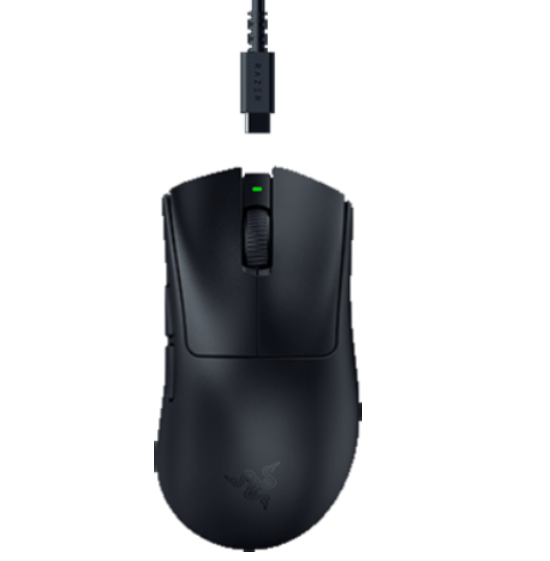
Razer DeathAdder V3 HyperSpeed: Specs, Features, Pros & Cons
This is the cheapest wireless way into the DeathAdder, Razer's long-running right-handed shape, and it sits one step below the V3 Pro in the same generation. Both share the idea of a tall, sculpted body that fills the palm. The Pro spends its extra money on a faster-tracking sensor, and this model keeps the outline while trimming almost everything around it.
The trimming shows on the spec sheet. There is no lighting of any kind, no horizontal scroll, one onboard profile and six buttons. The sensor still reaches 26,000 DPI, more than any player sets, while the Pro's sensor keeps tracking at faster swipes. Players who would run into that limit are the audience for the Pro.
HyperSpeed is the name Razer gives its 2.4 GHz receiver link, and it is the only radio in the mouse. There is no Bluetooth, so a laptop has to spare a USB port for the dongle. The charging cable doubles as a wired connection, which gives the mouse two ways to connect and keeps it working on a flat battery while it charges.
Rated battery life is the modest part of the package, and the fast-polling dongle Razer sells separately shortens it further.
The buyer it suits has a medium or large right hand and already knows the DeathAdder feel, or wants to try it without paying for the Pro. Small hands, fingertip grips and left-handers are outside the brief by design, and Razer's Viper and Cobra shapes suit them better. The hump that fills a palm is the same curve that makes the body feel long under fingertips, and no software setting changes a shape.
Category strengths
Where the Razer DeathAdder V3 HyperSpeed beats the median
- A lighter build ?55 g vs 89 g (median)
- A higher switch lifespan ?90 million clicks vs 80 million clicks (median)
- A slightly higher max sensitivity ?26,000 DPI vs 25,600 DPI (median)
Where the Razer DeathAdder V3 HyperSpeed trails the median
- Shorter battery life ?100 h vs 150 h (median)
- A lower max tracking speed ?500 IPS vs 650 IPS (median)
- A lower max acceleration ?40 G vs 50 G (median)
How this VS Score was computed
Score 50: each known spec is measured against the median of all mice (81 products), then weighted; 50 means level with that median. In classes of six or more, a value beyond the class’s 10th–90th percentile range counts as that limit, so one extreme product cannot set the scale. 62% of the scoreable weight could be used; unknown values, features not applicable to this class and proxies (battery capacity where a rated life exists) add or remove nothing.
| Specification | This product | Cohort median | Score weight | Points moved |
|---|---|---|---|---|
| Weight | 55 | 89 | 1 | +31.0 |
| USB-C charging | Yes | 67% of the class have it | 0.3 | +15.0 |
| Battery life | 100 | 150 | 0.8 | −13.6 |
| Max tracking speed | 500 | 650 | 0.8 | −9.6 |
| Horizontal scrolling | No | 45% of the class have it | 0.2 | −9.6 |
| RGB lighting | No | 46% of the class have it | 0.2 | −9.6 |
| Max acceleration | 40 | 50 | 0.4 | −4.0 |
| Switch lifespan | 90 | 80 | 0.2 | +1.2 |
| Max sensitivity | 26,000 | 25,600 | 1 | +1.0 |
| Buttons | 6 | 6 | 0.6 | +0.0 |
| Connection | 2 | 2 | 0.8 | +0.0 |
| Wireless polling rate | 1,000 | 1,000 | 0.5 | +0.0 |
Not scored: Polling rate (unknown: not scored); Adjustable lift-off distance (unknown: not scored); Grip styles (unknown: not scored); Free-spin scroll wheel (unknown: not scored); Click latency (unknown: not scored); Debounce adjustment (unknown: not scored); Battery capacity (unknown: not scored); Quick charge (unknown: not scored); Wireless charging (unknown: not scored); Onboard memory (standard for the class (86% have it)); Software customization (standard for the class (97% have it)); Adjustable weights (unknown: not scored).
Editor’s note
The DeathAdder V3 HyperSpeed is the affordable way into Razer's most successful shape. The DeathAdder ergonomic body has been refined over a decade, and this version weighs 55 g, lighter than any previous DeathAdder and lighter than most mice its size, at 122 mm long.
Razer got there by removing things. There is no RGB lighting at all, which on a mouse this focused is a feature rather than a loss: nothing to configure, and nothing draining the battery. Onboard profiles are cut to one from five, and the buttons stop at six.
What stayed is the part that matters. The Focus X 26K sensor tracks to 500 IPS and 40G, the Gen-3 optical switches are rated at 90 million clicks, and battery life is 100 hours at 1,000 Hz over HyperSpeed wireless. Charging is over USB-C with the supplied cable, which also works as a wired mode.
The shape is firmly right-handed and ergonomic, with a pronounced hump that suits palm grip and larger hands. If you use a fingertip grip or have small hands, this is the wrong mouse and the Viper or Cobra line is the right one.
The 8,000 Hz polling in the marketing needs the HyperPolling dongle, sold separately, and running it there cuts battery life to about 20 hours.
Buy it if you want the classic DeathAdder feel, wireless, at a sensible price and without lighting you do not need. Skip it if you want RGB, more buttons, or a smaller ambidextrous shape.
Specifications
Quality bars show where each figure sits between the lowest and highest of the 81 mice this VS Score is measured against.
Sensor & tracking
Design & handling
Switches & latency
Connectivity
Battery
Features
Sources and verification
Where the specifications come from
- Official product pagerazer.com
- Independent testingrtings.com
Verification
- First published
- Specifications last checked
- Sheet completeness
- 24 of 34 specifications verified; the rest show as Unknown and are never estimated or scored
- Page type
- Product specification page — Compiled from the manufacturer’s published specifications and the cited sources; this is not a hands-on test.
- Basis
- Research-based: specifications and editorial text were compiled from the documents listed here and the manufacturer’s published data. We have not tested this unit ourselves; where independent measurements are mentioned they belong to the linked publication.
Mice with similar specs to the Razer DeathAdder V3 HyperSpeed
Ratings & reviews
No reviews yet. Be the first to share your experience.
The bottom line
The Razer DeathAdder V3 HyperSpeed earns a VS Score of 50, level with the median of the 81 mice it is measured against.
- Who it’s for
- Palm-grip players with a medium or large right hand who want the classic DeathAdder feel, wireless and light, without paying flagship prices.
- Who should look elsewhere
- Small hands and fingertip grips, and anyone after lighting or extra buttons.
- The trade-off that matters
- The fast polling in the ads needs a separate dongle and drains the battery quickly, so as sold this is an ordinary-rate mouse.
- The main alternative
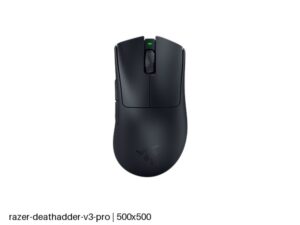
- Razer DeathAdder V3 Pro: the premium DeathAdder with a faster-tracking sensor for very low sensitivity
The VS Score is calculated from the weighted specifications above, each measured against the median of comparable mice — a shortlisting guide, not a substitute for your own priorities. See how we score.