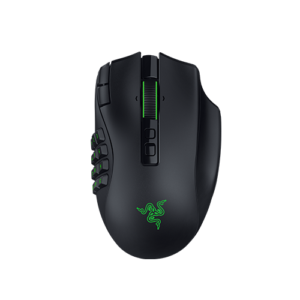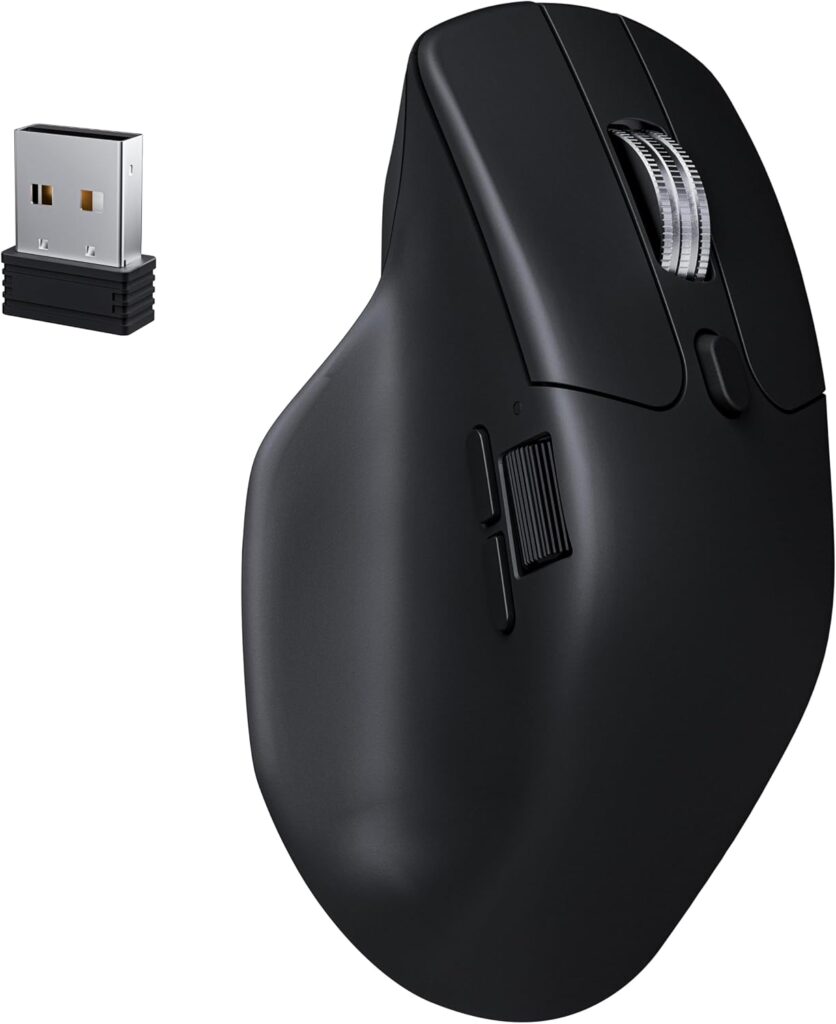
Keychron M6 8K: Specs, Price, Pros & Cons
The M6 8K is the version of Keychron's ergonomic mouse that reports at 8,000 Hz over its 2.4 GHz receiver as well as over the cable, and it is the only M6 Keychron lists as tracking on glass. The right-handed shell, the second wheel under the thumb for sideways scrolling and the choice of cable, receiver or Bluetooth carry over from the cheaper versions.
The sensor is PixArt's PAW3950, a newer part than the PAW3395 in the 1K and 4K models, and lift-off distance gains a lowest step the others lack. Every 8K unit gets the metal Premium Wheel, which Keychron says reads its position through a Hall-effect sensor with no contacts to wear. A button behind the wheel switches it between notched scrolling and free spin for long documents. Bluetooth is version 5.3 here, as on the other metal wheel models, where the original M6 with the plastic wheel uses 5.1.
One name covers three switch choices. The all-silent version quiets every button, the silent version only the left and right clicks, and the clicky version keeps an audible click everywhere. Read the SKU before ordering: in black, M6S-A23 is the all-silent unit, M6-A23 the silent one and M6-A31 the clicky one.
Keychron pitches the report rate at players with fast screens, while the side wheel, Bluetooth pairing for up to three computers and onboard profiles are office features. Logitech's G PRO X SUPERLIGHT 2, a lightweight 8K mouse built only for games, has neither the side wheel nor Bluetooth, and it is a much lighter shell to push around.
Category strengths
Where the Keychron M6 8K beats the median
- A much higher polling rate ?8,000 Hz vs 1,000 Hz (median)
- A much higher wireless polling rate ?8,000 Hz vs 1,000 Hz (median)
- More connection options ?
- Has horizontal scrolling ?
- Has free-spin scroll wheel ?
- A higher max sensitivity ?30,000 DPI vs 25,600 DPI (median)
- A higher max tracking speed ?750 IPS vs 650 IPS (median)
- A slightly lighter build ?86 g vs 89 g (median)
Where the Keychron M6 8K trails the median
- Shorter battery life ?120 h vs 150 h (median)
How this VS Score was computed
Score 70: each known spec is measured against the median of all mice (81 products), then weighted; 50 means level with that median. In classes of six or more, a value beyond the class’s 10th–90th percentile range counts as that limit, so one extreme product cannot set the scale. 63% of the scoreable weight could be used; unknown values, features not applicable to this class and proxies (battery capacity where a rated life exists) add or remove nothing.
| Specification | This product | Cohort median | Score weight | Points moved |
|---|---|---|---|---|
| Polling rate | 8,000 | 1,000 | 0.8 | +40.0 |
| Wireless polling rate | 8,000 | 1,000 | 0.5 | +25.0 |
| Connection | 3 | 2 | 0.8 | +20.0 |
| Adjustable lift-off distance | Yes | 61% of the class have it | 0.3 | +15.0 |
| USB-C charging | Yes | 67% of the class have it | 0.3 | +15.0 |
| Horizontal scrolling | Yes | 45% of the class have it | 0.2 | +10.0 |
| Free-spin scroll wheel | Yes | 34% of the class have it | 0.2 | +10.0 |
| RGB lighting | No | 46% of the class have it | 0.2 | −9.6 |
| Max sensitivity | 30,000 | 25,600 | 1 | +9.0 |
| Battery life | 120 | 150 | 0.8 | −8.0 |
| Max tracking speed | 750 | 650 | 0.8 | +6.4 |
| Weight | 86 | 89 | 1 | +2.0 |
Not scored: Max acceleration (unknown: not scored); Buttons (unknown: not scored); Grip styles (unknown: not scored); Click latency (unknown: not scored); Switch lifespan (unknown: not scored); Debounce adjustment (unknown: not scored); Battery capacity (capacity is a proxy; the rated battery life is scored instead); Quick charge (unknown: not scored); Wireless charging (not applicable: only 14% of this class have it); Onboard memory (standard for the class (86% have it)); Software customization (standard for the class (97% have it)); Adjustable weights (not applicable: only 2% of this class have it).
Editor’s note
Keychron rates the M6 8K at up to 120 hours of battery, but that figure is measured at 1,000 Hz. At 4,000 Hz it falls to 50 hours and at 8,000 Hz to 35, a little over four eight-hour days. The report rate button underneath changes the setting without software, so a working week at the low rate and evenings at 8,000 Hz is a sensible pattern. Left at the top setting, it will need the cable before the working week is out.
Keychron's case for the rate is a latency figure it credits to LTT Labs, 0.43 ms over the receiver, which it sets against other ergonomic flagships. That measures the radio link. Keychron publishes no click latency figure next to it, and nothing in it describes how the sensor tracks.
The clicky Huano switches in this model are rated at 120 million clicks and the silent ones at 20 million. On an office desk the silent units still have years of margin, but for a mouse bought partly for games I would take the clicky version.
At 86 g it is eight grams heavier than the original M6 with the plastic wheel, which is the metal wheel showing up on the scale. Against the 1K Premium Wheel model, with the same wheel, shell and weight, the 8K adds the newer sensor, glass tracking and the higher rates. On a 60 Hz office screen, only the glass tracking changes anything.
Specifications
Quality bars show where each figure sits between the lowest and highest of the 81 mice this VS Score is measured against.
Sensor & tracking
Design & handling
Switches & latency
Connectivity
Battery
Features
Sources and verification
Where the specifications come from
- Official product pagekeychron.com
- Independent testingrtings.com
Verification
- First published
- Specifications last checked
- Sheet completeness
- 24 of 34 specifications verified; the rest show as Unknown and are never estimated or scored
- Page type
- Product specification page — Compiled from the manufacturer’s published specifications and the cited sources; this is not a hands-on test.
- Basis
- Research-based: specifications and editorial text were compiled from the documents listed here and the manufacturer’s published data. We have not tested this unit ourselves; where independent measurements are mentioned they belong to the linked publication.
Where to buy
Prices and availability may change. Check the retailer before buying. We may earn a commission on purchases.
Price history
Mice with similar specs to the Keychron M6 8K
Ratings & reviews
No reviews yet. Be the first to share your experience.
The bottom line
The Keychron M6 8K earns a VS Score of 70, above the median of the 81 mice it is measured against (a score of 50 is level with that median).
- Who it’s for
- Someone with a high refresh monitor who wants one mouse for games and spreadsheets, or who works on a glass desk and would rather skip the pad.
- Who should look elsewhere
- Players who want a light shooter mouse, since this shell is built around office comfort, and anyone who expects to charge rarely while running at 8,000 Hz.
- The trade-off that matters
- Long battery life and 8,000 Hz cannot be had at once. Left at that rate, it becomes a mouse you charge every week.
- The main alternative
- Razer DeathAdder V4 Pro: another right-handed 8K mouse, far lighter, without the side wheel or Bluetooth.
The VS Score is calculated from the weighted specifications above, each measured against the median of comparable mice — a shortlisting guide, not a substitute for your own priorities. See how we score.