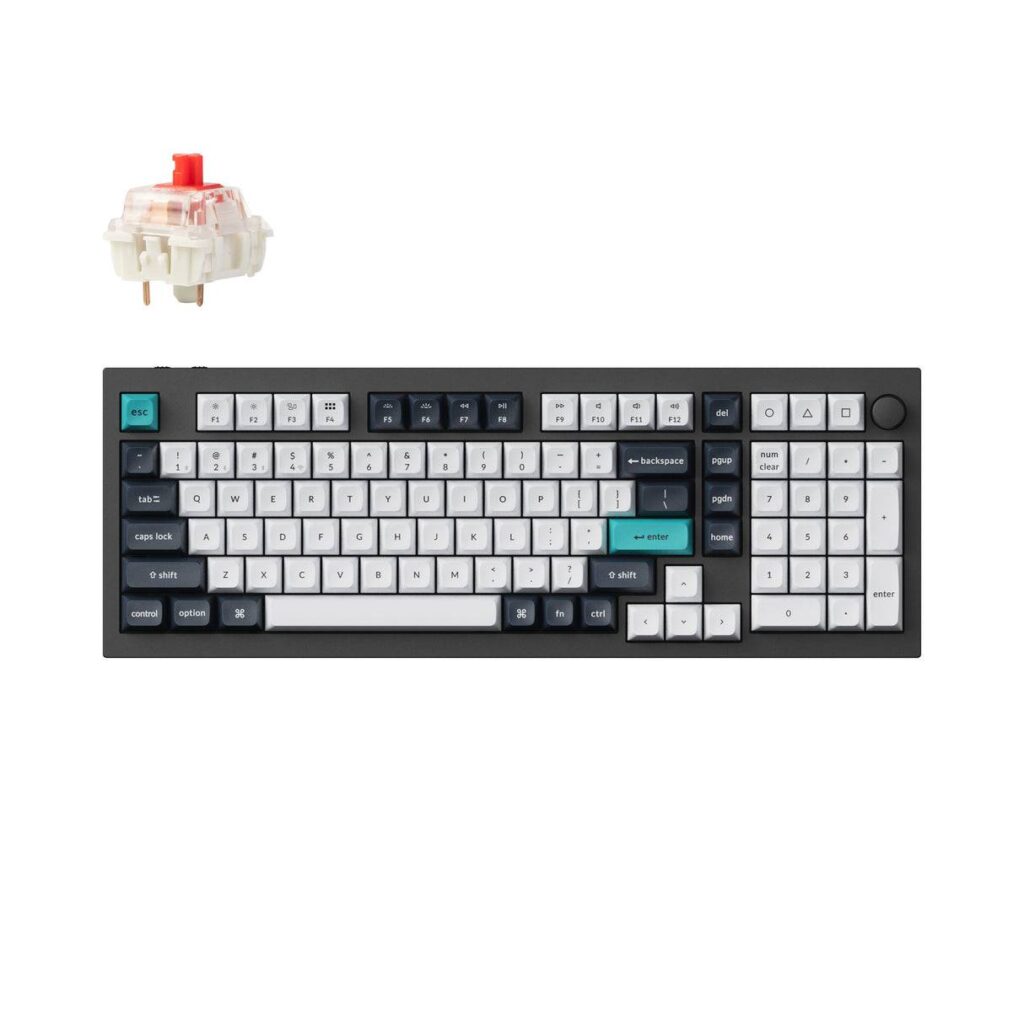
Keychron Q5 Max: Specs, Features, Pros & Cons
The heaviest keyboard on this site, and the weight is the feature rather than a statistic. A full aluminium case on a gasket mount, with a polycarbonate plate and screw-in stabilisers, is the recipe enthusiast boards use to control sound and feel.
The mass stops the board shifting under fast typing, the gasket lets keystrokes land softly instead of crashing into a rigid frame, and the plate flexes slightly to soften them further. The result is the deep, quiet sound people buy these boards for — and a keyboard nobody would call portable.
Category strengths
Where the Keychron Q5 Max beats the average
- Has hot-swappable switches ?
- Has rotary knob ?
- Has n-key rollover ?
- Has sound dampening ?
- Has onboard profiles ?
- A bigger battery ?4,000 mAh vs 3,479.78 mAh (avg)
- Has configuration software ?
- Has media controls ?
- Has programmable keys ?
Where the Keychron Q5 Max trails the average
- Much shorter battery life ?180 h vs 1,427.96 h (avg)
- A much lower polling rate ?1,000 Hz vs 3,902.44 Hz (avg)
- Fewer connection options ?
- No adjustable actuation ?
- No analog input ?
- A slightly higher front height ?22.6 mm vs 21.72 mm (avg)
- No USB passthrough ?
- Fewer Bluetooth devices ?3 vs 3.07 (avg)
Editor’s note
The Q5 Max is the heaviest keyboard in this catalogue at 2,215 g, and that figure is a feature rather than a statistic.
A full aluminium case on a gasket mount, with a polycarbonate plate and screw-in PCB stabilisers, is the recipe enthusiast boards use to control sound and feel. The mass stops the board moving under fast typing, the gasket isolates the plate so keystrokes land softly rather than crashing into a rigid frame, and the polycarbonate plate flexes slightly to soften it further. The result is the deep, quiet typing sound people buy these boards for.
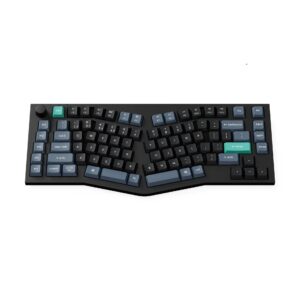
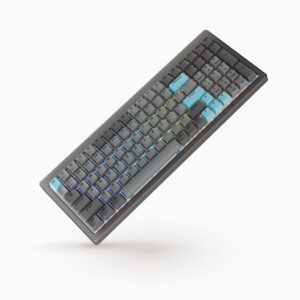
The layout is 96% — a full numeric pad squeezed against the main cluster, giving you every key of a full-size board in roughly the width of a TKL plus a pad. There is a rotary knob and media controls, PBT keycaps, hot-swappable Gateron Jupiter switches, per-key RGB and QMK-style configuration.
It is wireless over 2.4 GHz with three Bluetooth devices and a quoted 180 hours of battery.
What it does not have is any gaming-specific sensing: no Hall effect, no adjustable actuation, no rapid trigger, no analog input, and 1,000 Hz polling. That is not a criticism — it is a different product.
Buy it if you type for a living and want the best-feeling keyboard on this list, and you have desk space and no intention of carrying it anywhere. Buy the V5 Max for most of the same layout at a fraction of the weight and price.
Specifications
Quality bars are generated automatically against 100 other keyboards.
Switches & typing
Performance
Layout & size
Connectivity
Build & sound
Features
Sources and verification
Where the specifications come from
- Official product pagekeychron.com
- Independent testingrtings.com
Verification
- First published
- Specifications last checked
- Sheet completeness
- 30 of 34 specifications verified; the rest show as Unknown and are never estimated or scored
- Basis
- Research-based: specifications and editorial text were compiled from the documents listed here and the manufacturer’s published data. We have not tested this unit ourselves; where independent measurements are mentioned they belong to the linked publication.
Keyboards with similar specs to the Keychron Q5 Max
Ratings & reviews
No reviews yet. Be the first to share your experience.
The bottom line
The Keychron Q5 Max earns a VS Score of 40, trailing most of the 101 keyboards we compare here, at least on the spec sheet. It stands out for hot-swappable switches, rotary knob and n-key rollover. Just be aware of much shorter battery life and a much lower polling rate before you buy. Weigh those trade-offs against what matters most to you.
The VS Score is calculated from the weighted specifications above, compared with every other keyboard we track — a shortlisting guide, not a substitute for your own priorities. See how we score.