Rongta F11: Specs, Features, Pros & Cons
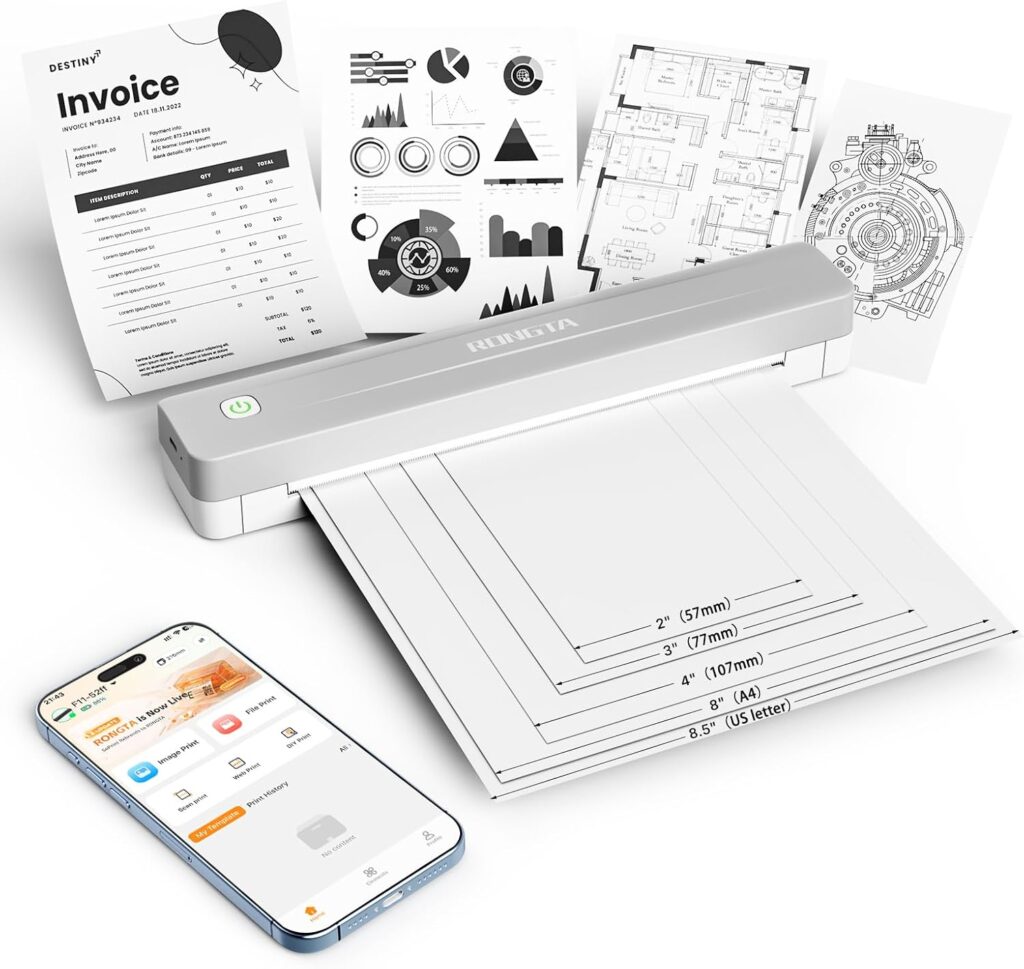
Rongta builds point-of-sale hardware (receipt printers for shop counters, kitchens and warehouses) and this is that expertise pointed at a different problem. Direct thermal printing, the technology behind every till receipt, has been scaled up here to full document width. A head heats coated paper and the paper darkens wherever it is touched, which means there is no ink, no toner and no ribbon anywhere in the machine.
The consequences of that single decision define the product. The printer is a bar not much longer than a rolled-up magazine, runs from its own battery, and cannot dry out between uses, which is the failure that quietly kills inkjets left in a drawer for a month. Paper is the only thing you ever buy, and it has to be coated thermal stock in Letter or A4 (ordinary copier paper will not work), fed a sheet at a time or drawn from a fanfold stack.
What it gives up comes from the technology itself. Thermal output is monochrome, its resolution belongs to the receipt world it came from, and a thermal page is chemically temporary: heat and daylight carry on darkening it long after printing. This is a printer for paper that gets used and discarded, not paper that gets filed.
Printing runs over Bluetooth through Rongta's own application, or over a cable from a computer. There is no wireless networking and no AirPrint, so a phone cannot discover it the way it finds a household printer, and everything routes through that one app.
It suits a van, a market stall, a site office or a suitcase: anywhere paper is needed occasionally and hauling a conventional printer would be absurd. As the only printer in a house, it would be a strange choice.
Category strengths
Where the Rongta F11 trails the median
- No color printing ?
- No automatic duplex printing ?
- No all-in-one ?
- No automatic document feeder ?
- No Wi-Fi ?
- No ethernet ?
- No Apple AirPrint ?
- A much lower print resolution ?203 dpi vs 4,800 dpi (median)
- No Wi-Fi Direct ?
How this VS Score was computed
Score 3: each known spec is measured against the median of all printers (65 products), then weighted; 50 means level with that median. In classes of six or more, a value beyond the class’s 10th–90th percentile range counts as that limit, so one extreme product cannot set the scale. 59% of the scoreable weight could be used; unknown values, features not applicable to this class and proxies (battery capacity where a rated life exists) add or remove nothing.
| Specification | This product | Cohort median | Score weight | Points moved |
|---|---|---|---|---|
| Color printing | No | 88% of the class have it | 1.5 | −72.0 |
| Automatic duplex printing | No | 73% of the class have it | 1 | −48.0 |
| All-in-one | No | 85% of the class have it | 1 | −48.0 |
| Automatic document feeder | No | 55% of the class have it | 1 | −48.0 |
| Wi-Fi | No | 97% of the class have it | 1 | −48.0 |
| Supertank / refillable ink | No | 30% of the class have it | 0.5 | −24.0 |
| Duplex scanning | No | 23% of the class have it | 0.5 | −24.0 |
| Ethernet | No | 54% of the class have it | 0.5 | −24.0 |
| Apple AirPrint | No | 97% of the class have it | 0.5 | −24.0 |
| Touchscreen display | No | 45% of the class have it | 0.5 | −24.0 |
| Print resolution | 203 — capped at the class’s lower range (1,200) | 4,800 | 0.5 | −18.5 |
| Wi-Fi Direct | No | 90% of the class have it | 0.3 | −14.4 |
| Fax | No | 35% of the class have it | 0.2 | −9.6 |
Not scored: Print speed (black) (unknown: not scored); Print speed (color) (unknown: not scored); Monthly duty cycle (unknown: not scored); ADF capacity (unknown: not scored); Input tray capacity (unknown: not scored); Output tray capacity (unknown: not scored); USB (standard for the class (100% have it)); Mobile app printing (standard for the class (100% have it)); Weight (unknown: not scored).
Editor’s note
The Rongta F11 is a printer reduced to its survival essentials: a bar barely longer than a rolled-up magazine that prints full Letter and A4 pages with no ink, no toner, no ribbon, ever. It's direct thermal, the receipt-printer technology, scaled up to document width. You feed it thermal paper one sheet at a time (or fanfold stacks), it darkens the page, done.
The use case is narrower than the marketing suggests, and it's worth being precise. Thermal printing is monochrome, tops out here at 203 dpi, and (the part nobody advertises) fades with heat and time, so it's wrong for anything archival. What it's good at is transient paper: shipping labels on plain sheets, packing lists, travel documents, waivers, homework printed in a car. For those jobs, the freedom from ink is transformative, and the battery figures are the strongest part: Rongta rates roughly 200 pages per two-hour charge with 60 hours of standby.
Connectivity is Bluetooth through Rongta's own app (the rebranded SoPrint) or USB-C from a computer. There is no Wi-Fi and no AirPrint, so every print goes through their software. Speed is a leisurely 16 mm per second, call it half a minute per full page. And a naming quirk worth documenting: the listing title carries no model at all, its Model row reads F11, archived pages show F11A and F11B, and Rongta's own site now badges the same spec sheet F11D. Same family, same figures.
At its street price, it's a specialist tool that costs less than most ink refills. Buy it for mobile, disposable printing. Skip it if your pages need to be permanent, in color, or produced in stacks: a budget mono laser crushes it at a desk.
Specifications
Quality bars show where each figure sits between the lowest and highest of the 65 printers this VS Score is measured against.
Printing
Scanning & copying
Paper handling
Connectivity
Design
Sources and verification
Where the specifications come from
- Official product pagerongtaglobal.com
- Datasheet or manualcdn.shopify.com
- Retailer listing (cross-check)amazon.com
Verification
- First published
- Specifications last checked
- Sheet completeness
- 17 of 24 specifications verified; the rest show as Unknown and are never estimated or scored
- Page type
- Product specification page — Compiled from the manufacturer’s published specifications and the cited sources; this is not a hands-on test.
- Basis
- Research-based: specifications and editorial text were compiled from the documents listed here and the manufacturer’s published data. We have not tested this unit ourselves; where independent measurements are mentioned they belong to the linked publication.
Printers with similar specs to the Rongta F11
Ratings & reviews
No reviews yet. Be the first to share your experience.
The bottom line
The Rongta F11 earns a VS Score of 3, below the median of the 65 printers it is measured against (a score of 50 is level with that median).
- Who it’s for
- Mobile and transient printing (labels, packing lists, travel documents, field paperwork) where never buying ink again matters far more than whether the page is still legible next year.
- Who should look elsewhere
- Anything archival, anything in color, or desk duty in volume: it feeds one sheet at a time through Rongta's own app, with no wireless networking and no AirPrint.
- The trade-off that matters
- Zero consumables versus impermanence: the freedom from ink is real, but the pages themselves are temporary by chemistry, so know that before it prints anything that matters.
- The main alternative
- Phomemo M08F: the best-known A4 thermal portable at similar money. The Rongta counters with its battery rating and point-of-sale pedigree.
The VS Score is calculated from the weighted specifications above, each measured against the median of comparable printers — a shortlisting guide, not a substitute for your own priorities. See how we score.