Sceptre C275B-FW180T: Specs, Price, Pros & Cons
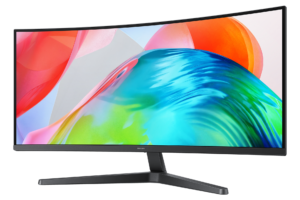
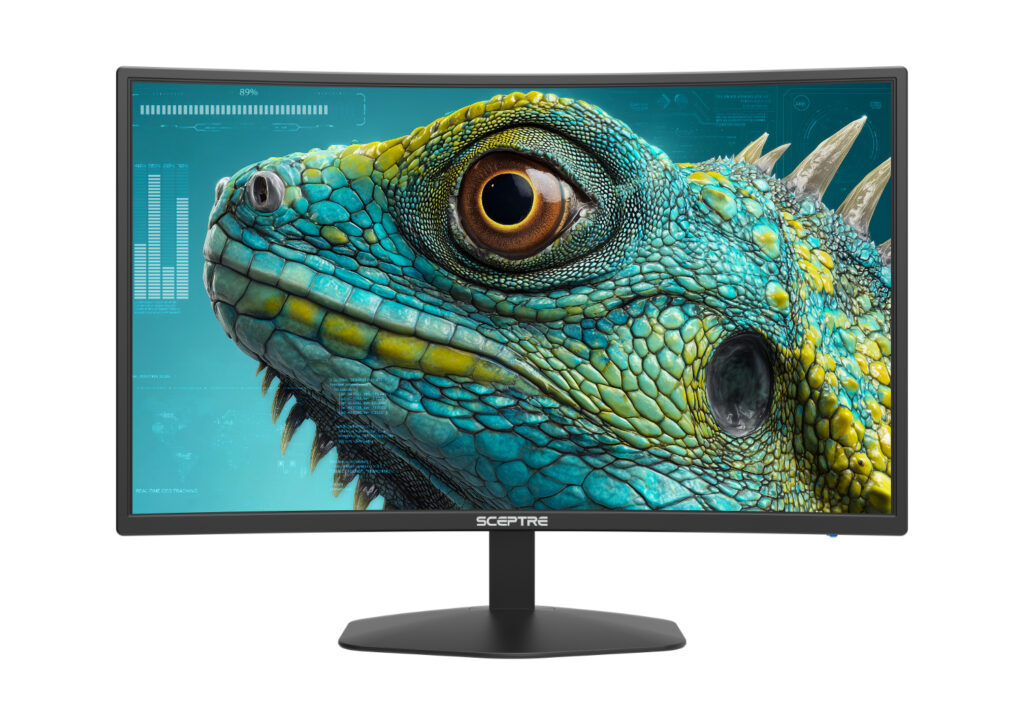
Sceptre builds this monitor in two shapes, and the C in the model name marks the curved one. Its flat sibling, the E275B-FW180T, follows a very similar recipe, so choosing this version is mostly a decision about whether you want the screen to wrap toward you. At this size the bend is deep enough to pull the edges of a racing game or a flight cockpit closer to your peripheral vision, while documents still read normally once your eyes adjust.
The brand explains the rest. Sceptre is a Californian company that sells almost entirely through the big online retailers and competes on how much screen it can put on a desk for the least money. Here the budget went into the panel and the back plate: a VA screen that keeps dark scenes dark, and a full row of fast video inputs. The savings came out of the stand and everything that is not a video signal.
It suits a first gaming setup, a shared desk where a console and a PC take turns, and anyone who plays in the evening with the lights down and wants the picture to look deep. Someone moving up from an old office screen will find motion far smoother than they are used to.
The catch is sharpness. The resolution is the one normally found on much smaller screens, and stretched this wide it leaves text and interface edges visibly coarse at a normal viewing distance. Its stand only tilts, and there is no USB of any kind, so it cannot act as a hub for a laptop. Writers, coders and anyone who lives in spreadsheets will be happier with a smaller or sharper panel.
Category strengths
Where the Sceptre C275B-FW180T beats the median
- More DisplayPort inputs ?2 vs 1 (median)
- Has built-in speakers ?
- A higher contrast ratio ?4000:1 vs 3500:1 (median)
Where the Sceptre C275B-FW180T trails the median
- A much slower response time ?5 ms vs 1 ms (median)
- A lower pixel density ?82 ppi vs 93 ppi (median)
How this VS Score was computed
Score 39: each known spec is measured against the median of VA gaming monitors, 27 to 31 inches (11 products), then weighted; 50 means level with that median. In classes of six or more, a value beyond the class’s 10th–90th percentile range counts as that limit, so one extreme product cannot set the scale. 69% of the scoreable weight could be used; unknown values, features not applicable to this class and proxies (battery capacity where a rated life exists) add or remove nothing.
| Specification | This product | Cohort median | Score weight | Points moved |
|---|---|---|---|---|
| Resolution | 1080p | 1440p | 1.2 | −57.6 |
| Response time | 5 | 1 | 0.8 | −32.0 |
| DisplayPort inputs | 2 | 1 | 0.4 | +20.0 |
| Local dimming | No | 29% of the class have it | 0.4 | −19.2 |
| Height adjustment | No | 45% of the class have it | 0.4 | −19.2 |
| Built-in speakers | Yes | 30% of the class have it | 0.2 | +10.0 |
| Swivel | No | 36% of the class have it | 0.2 | −9.6 |
| Picture-by-picture | No | 33% of the class have it | 0.2 | −9.6 |
| Motion blur reduction | Yes — held to half its range (class of fewer than six) | 75% of the class have it | 0.3 | +7.5 |
| HDR | None | HDR10 | 0.5 | −6.0 |
| Contrast ratio | 4,000 | 3,500 | 0.6 | +4.2 |
| Pixel density | 82 | 93 | 0.5 | −3.0 |
| Pivot | No | 36% of the class have it | 0.02 | −1.0 |
| Screen size | 27 | 27 | 1.2 | +0.0 |
| Panel type | VA | VA | 0.8 | +0.0 |
| Peak brightness | 300 | 300 | 0.8 | +0.0 |
| Adaptive sync | FreeSync | FreeSync | 0.6 | +0.0 |
| Refresh rate | 180 | 180 | 1.2 | +0.0 |
| HDMI ports | 2 | 2 | 0.4 | +0.0 |
Not scored: Color depth (unknown: not scored); DCI-P3 coverage (unknown: not scored); Local dimming zones (unknown: not scored); Variable refresh rate (standard for the class (100% have it)); Input lag (unknown: not scored); Tilt (standard for the class (100% have it)); USB-C (not applicable: only 0% of this class have it); USB-C power delivery (unknown: not scored); USB hub (not applicable: only 20% of this class have it); Headphone output (standard for the class (91% have it)); KVM switch (not applicable: only 0% of this class have it); Webcam (not applicable: only 0% of this class have it); Microphone (not applicable: only 0% of this class have it); Ethernet (not applicable: only 0% of this class have it).
Editor’s note
Two things make this monitor unusual at under a hundred dollars, and one thing decides whether you should buy it at all.
The good parts first. It is a VA panel with a 4,000:1 static contrast ratio, roughly three to four times what a budget IPS manages, so dark games and night scenes look properly black. And the back panel carries two DisplayPort 1.2 inputs and two HDMI 2.0 inputs, all four capable of the full 1920×1080 at 180 Hz. Four full-rate inputs at this price is rare. Most rivals give you one DisplayPort and one HDMI, with the second HDMI capped at 60 Hz. A gaming PC, a work laptop and a console can all stay plugged in.
The 1500R curve is aggressive enough to notice, well past the token bend some 27-inch monitors ship with.
Now the deciding factor: 1080p across 27 inches works out to about 82 pixels per inch. Text and interface elements look visibly chunky at normal desk distance. For fast competitive games, where you want frames more than sharpness, that is a fair trade. For reading, writing or code it is the wrong monitor. No refresh rate fixes it.
Two more caveats worth knowing. The advertised refresh is an overclock: Sceptre's own wording is "up to 180 Hz with Overclock", and it does not publish the native rate. And there is no USB of any kind: four video inputs and no way to move a keyboard and mouse between them, so this is not a laptop dock.
The stand tilts and nothing else, but there is a proper 100×100 VESA mount, so an arm solves that cheaply. Ignore the much higher list price on Sceptre's own site. The real price is under a hundred, and at that price this is a lot of monitor.
Specifications
Quality bars show where each figure sits between the lowest and highest of the 11 VA gaming monitors, 27 to 31 inches this VS Score is measured against.
Picture
Gaming
Ergonomics & design
Connectivity
Features
Sources and verification
Where the specifications come from
- Official product pagesceptre.com
- Retailer listing (cross-check)amazon.com
Verification
- First published
- Specifications last checked
- Sheet completeness
- 35 of 42 specifications verified; the rest show as Unknown and are never estimated or scored
- Page type
- Product specification page — Compiled from the manufacturer’s published specifications and the cited sources; this is not a hands-on test.
- Basis
- Research-based: specifications and editorial text were compiled from the documents listed here and the manufacturer’s published data. We have not tested this unit ourselves; where independent measurements are mentioned they belong to the linked publication.
Where to buy
Prices and availability may change. Check the retailer before buying. We may earn a commission on purchases.
Price history
Monitors with similar specs to the Sceptre C275B-FW180T
Ratings & reviews
No reviews yet. Be the first to share your experience.
The bottom line
The Sceptre C275B-FW180T earns a VS Score of 39, below the median of the 11 VA gaming monitors, 27 to 31 inches it is measured against (a score of 50 is level with that median).
- Who it’s for
- Budget gamers running fast competitive titles who want deep blacks and a wrapped curve, and anyone juggling a PC, a laptop and a console who needs every video input to run at full rate rather than just the first one.
- Who should look elsewhere
- Anyone who reads, writes or codes for hours, because the pixel density across a panel this size is visibly coarse. Also wrong for color work, for HDR, and for laptop owners wanting a single-cable desk, since there is no USB port at all.
- The trade-off that matters
- Screen size and refresh rate bought at the cost of sharpness. That is the right call for competitive gaming and the wrong one for a desktop you read all day.
- The main alternative
- Sceptre C248B-FW180T: the smaller version of the same monitor, where the identical resolution lands at a far more sensible pixel density.
The VS Score is calculated from the weighted specifications above, each measured against the median of comparable VA gaming monitors, 27 to 31 inches — a shortlisting guide, not a substitute for your own priorities. See how we score.