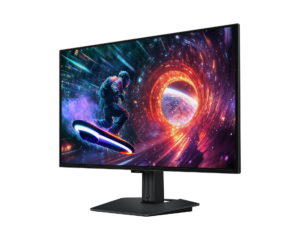
Samsung Odyssey 3D G90XF S27FG900X: Specs, Pros & Cons
The Odyssey 3D G90XF shows depth without glasses, and nothing else in mainstream monitors at this size works the same way. A lenticular layer over the panel sends slightly different images to each eye, while a camera in the bezel follows where you are sitting and steers those images to your position. The result is a stereoscopic effect for one viewer at a time, with no headset and no special eyewear.
That approach answers the main complaint about the 3D televisions of the last decade, which needed shutter glasses and faded from the market within a few years. It also inherits their central problem: content. Depth appears only in games Samsung has adapted through its own software, plus video converted by its processing, so the value of the purchase rests on a library that is still short and could change with any update.
With the 3D mode off, the G90XF behaves as an ordinary flat, high-resolution gaming monitor with a fast panel, adaptive sync, console-ready video inputs, a USB hub and built-in speakers. That is a respectable baseline, but it is also a baseline you can buy for much less without the lens and tracking hardware. Samsung lists no headphone output, so check how wired headphones would connect before buying.
This is best understood as an enthusiast's curiosity with a sound conventional monitor underneath. It suits someone who already plays the supported titles, is willing to judge the effect within the return window, and has a graphics card strong enough to feed a sharp screen at speed. People who want a fast, crisp display, or who often have someone watching over their shoulder, are paying for a feature they will rarely see.
Category strengths
Where the Samsung Odyssey 3D G90XF S27FG900X beats the median
- Has built-in speakers ?
- Has USB hub ?
Where the Samsung Odyssey 3D G90XF S27FG900X trails the median
- No headphone output ?
- A slightly lower refresh rate ?165 Hz vs 180 Hz (median)
How this VS Score was computed
Score 50: each known spec is measured against the median of IPS gaming monitors, 27 to 31 inches (29 products), then weighted; 50 means level with that median. In classes of six or more, a value beyond the class’s 10th–90th percentile range counts as that limit, so one extreme product cannot set the scale. 58% of the scoreable weight could be used; unknown values, features not applicable to this class and proxies (battery capacity where a rated life exists) add or remove nothing.
| Specification | This product | Cohort median | Score weight | Points moved |
|---|---|---|---|---|
| USB-C | No | 24% of the class have it | 0.5 | −24.0 |
| Height adjustment | Yes | 79% of the class have it | 0.4 | +20.0 |
| Resolution | 4K | 1440p | 1.2 | +15.6 |
| Built-in speakers | Yes | 31% of the class have it | 0.2 | +10.0 |
| Headphone output | No | 86% of the class have it | 0.2 | −9.6 |
| HDR | HDR10 | DisplayHDR 400 | 0.5 | −6.0 |
| Refresh rate | 165 | 180 | 1.2 | −4.8 |
| USB hub | Yes | 50% of the class have it | 0.05 | +2.3 |
| Pivot | Yes | 75% of the class have it | 0.02 | +1.0 |
| Screen size | 27 | 27 | 1.2 | +0.0 |
| Panel type | IPS | IPS | 0.8 | +0.0 |
| Response time | 1 | 1 | 0.8 | +0.0 |
| Contrast ratio | 1,000 | 1,000 | 0.6 | +0.0 |
| Adaptive sync | G-Sync Compatible | G-Sync Compatible | 0.6 | +0.0 |
| HDMI ports | 2 | 2 | 0.4 | +0.0 |
| DisplayPort inputs | 1 | 1 | 0.4 | +0.0 |
Not scored: Color depth (unknown: not scored); Peak brightness (unknown: not scored); DCI-P3 coverage (unknown: not scored); Pixel density (unknown: not scored); Local dimming (unknown: not scored); Local dimming zones (unknown: not scored); Variable refresh rate (standard for the class (100% have it)); Motion blur reduction (unknown: not scored); Input lag (unknown: not scored); Tilt (standard for the class (100% have it)); Swivel (unknown: not scored); USB-C power delivery (unknown: not scored); KVM switch (unknown: not scored); Webcam (unknown: not scored); Microphone (unknown: not scored); Ethernet (unknown: not scored); Picture-by-picture (unknown: not scored).
Editor’s note
The 27-inch Odyssey 3D G90XF is a niche 4K gaming monitor with glasses-free stereoscopic display hardware. Eye tracking and view mapping create depth for supported games through Samsung's 3D Hub, while the underlying IPS panel still operates as a conventional 4K 165 Hz display for ordinary PC use. That makes it less restrictive than a 3D-only novelty, but software support is the deciding factor.
Not every game becomes 3D, and compatibility, viewing position, head movement, frame rate, and individual visual comfort affect the result. Buyers prone to eye strain should try the effect before committing. The 3D processing hardware adds cost without improving unsupported content, and 27-inch 4K often needs desktop scaling. A powerful GPU is required even before stereoscopic overhead is considered.
Official regional specifications list an IPS panel, 3840×2160 resolution, 1 ms GtG, 350-nit typical brightness, HDR10+, G-Sync compatibility, FreeSync Premium, and a fully adjustable stand. Exact USB, HDMI, DisplayPort, audio, and 3D Hub requirements should be checked for LS27FG900X. Supported-game lists can change, so an old launch list is not enough.
Choose the G90XF for enthusiasts specifically interested in its supported glasses-free 3D library and who still want a capable flat 4K gaming display. Skip it if predictable compatibility, competitive value, or broad console use matters more. The S27FG900X is not part of the standard Odyssey G9 or OLED G8 families.
The glasses-free 3D effect is the purchasing reason, so compatibility and personal viewing comfort should be tested before the return period ends. Supported titles, head position, and individual eyesight can affect the result. Buyers primarily seeking excellent conventional 4K gaming can find broader value in a standard high-refresh display.
Specifications
Quality bars show where each figure sits between the lowest and highest of the 29 IPS gaming monitors, 27 to 31 inches this VS Score is measured against.
Picture
Gaming
Ergonomics & design
Connectivity
Features
Sources and verification
Where the specifications come from
- Official product pagesamsung.com
- Independent testingrtings.com
Verification
- First published
- Specifications last checked
- Sheet completeness
- 24 of 42 specifications verified; the rest show as Unknown and are never estimated or scored
- Page type
- Product specification page — Compiled from the manufacturer’s published specifications and the cited sources; this is not a hands-on test.
- Basis
- Research-based: specifications and editorial text were compiled from the documents listed here and the manufacturer’s published data. We have not tested this unit ourselves; where independent measurements are mentioned they belong to the linked publication.
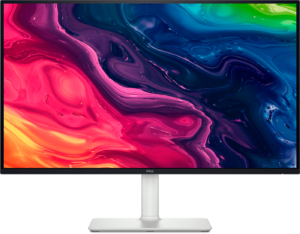
Monitors with similar specs to the Samsung Odyssey 3D G90XF S27FG900X
Ratings & reviews
No reviews yet. Be the first to share your experience.
The bottom line
The Samsung Odyssey 3D G90XF S27FG900X earns a VS Score of 50, level with the median of the 29 IPS gaming monitors, 27 to 31 inches it is measured against.
- Who it’s for
- Players who already own supported titles and want glasses-free depth at a desk. Outside the depth mode it is still a capable, sharp gaming screen with speakers.
- Who should look elsewhere
- Anyone buying mainly for conventional high-resolution gaming, shared viewing or console play. The depth hardware adds cost and only helps one viewer in adapted games.
- The trade-off that matters
- A new way to see games, tied to a short and changeable software library and a clear extra cost over ordinary monitors.
- The main alternative
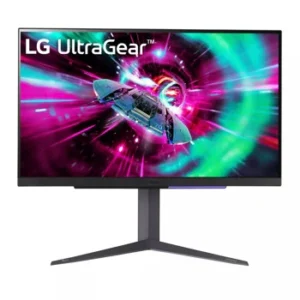
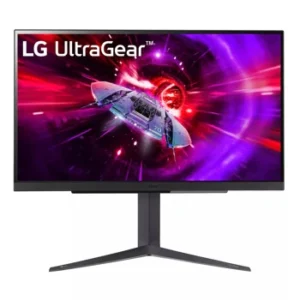
- LG UltraGear 27GR93U-B: a conventional high-resolution gaming monitor of the same size for considerably less, if depth effects are not the point.
The VS Score is calculated from the weighted specifications above, each measured against the median of comparable IPS gaming monitors, 27 to 31 inches — a shortlisting guide, not a substitute for your own priorities. See how we score.