Corsair GALLEON 100 SD: Specs, Features, Pros & Cons
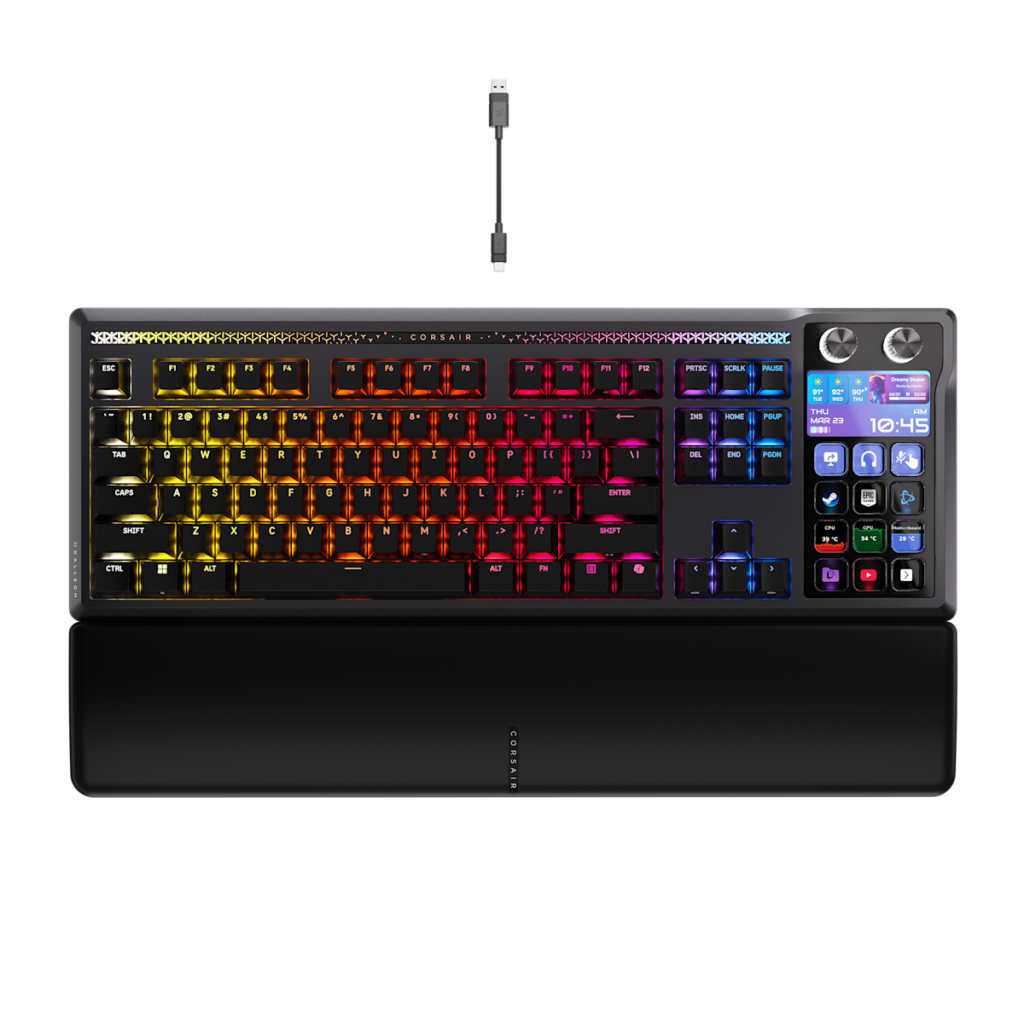
Above the function row of the GALLEON 100 SD sits a bank of LCD keys, two dials and a screen, and together they form a Stream Deck built into the top of a Corsair keyboard. Elgato's own software runs that section, the same program that drives the standalone panels.
A Stream Deck is a set of programmable keys whose labels are drawn on small screens, each tied to an action in the software you broadcast or edit with. Corsair has fused that panel to an extended full-size board, so one wide chassis carries the letters, the number pad, the arrows and the deck.
The keyboard underneath is a serious one. The switches sit in hot-swap sockets, the case is gasket mounted with sound dampening, and it adds two things few boards in the category have: a polling rate well beyond the usual gaming figure, and a USB port on the keyboard itself for a dongle or a headset cable. It loses a point on connections, since this is a wired board with no receiver and no Bluetooth.
The buyer it was designed around streams or produces video from one desk and would otherwise have placed a separate deck beside the keyboard. That person saves a cable and a patch of desk, while anyone who never planned to own a deck pays for screens and dials that will sit idle. What it asks in return is width, since the extended layout pushes the mouse further out than a tenkeyless would, and a second program running beside Corsair's own software. Setting up the deck keys is work you do once, in Elgato's app, before any of them do anything.
Category strengths
Where the Corsair GALLEON 100 SD beats the median
- A much higher polling rate ?8,000 Hz vs 1,000 Hz (median)
- Has USB passthrough ?
Where the Corsair GALLEON 100 SD trails the median
- Fewer connection options ?
How this VS Score was computed
Score 56: each known spec is measured against the median of all keyboards (101 products), then weighted; 50 means level with that median. In classes of six or more, a value beyond the class’s 10th–90th percentile range counts as that limit, so one extreme product cannot set the scale. 47% of the scoreable weight could be used; unknown values, features not applicable to this class and proxies (battery capacity where a rated life exists) add or remove nothing.
| Specification | This product | Cohort median | Score weight | Points moved |
|---|---|---|---|---|
| Polling rate | 8,000 | 1,000 | 0.7 | +35.0 |
| Hot-swappable | Yes | 61% of the class have it | 0.6 | +30.0 |
| Connection | 1 | 3 | 0.8 | −26.4 |
| Rapid trigger | No | 25% of the class have it | 0.5 | −24.0 |
| Adjustable actuation | No | 24% of the class have it | 0.4 | −19.2 |
| Sound dampening | Yes | 76% of the class have it | 0.3 | +15.0 |
| USB passthrough | Yes | 4% of the class have it | 0.2 | +10.0 |
| Rotary knob | Yes | 53% of the class have it | 0.2 | +10.0 |
| Switch technology | Mechanical | Mechanical | 1 | +0.0 |
| Backlight | RGB | RGB | 0.3 | +0.0 |
Not scored: Actuation force (unknown: not scored); N-key rollover (standard for the class (85% have it)); Analog input (not applicable: only 14% of this class have it); Wired latency (unknown: not scored); Wireless latency (unknown: not scored); Front height (unknown: not scored); Bluetooth devices (unknown: not scored); Battery life (unknown: not scored); Battery capacity (unknown: not scored); Keycap material (unknown: not scored); Programmable keys (standard for the class (99% have it)); Media controls (standard for the class (97% have it)); Onboard profiles (standard for the class (89% have it)); Configuration software (standard for the class (95% have it)).
Editor’s note
The GALLEON 100 SD answers a question a lot of streamers have quietly been asking: why am I buying a keyboard and a Stream Deck when they sit side by side anyway? This is both, in one chassis: LCD keys, dials and a screen, all driven by the same Elgato software that runs a standalone Stream Deck.
That integration is the whole value case, and it is worth doing the arithmetic. If a Stream Deck is already on your shopping list, the combined price starts looking reasonable. If it is not, you are paying a lot extra for hardware you will not use, and a conventional keyboard will serve you better for a third of the money.
Typing was not treated as an afterthought. The board is gasket-mounted and packs six layers of sound-dampening foam, which is enthusiast-keyboard territory. The MLX Pulse linear switches come pre-lubed and the PCB is hot-swappable for 3-pin and 5-pin switches. Polling reaches 8,000 Hz, and there is a working USB 2.0 passthrough port, something most keyboards at any price have quietly dropped.
The practical costs are size and weight. This is an extended full-size layout at 1.39 kg, so it commands real desk space and your mouse hand gets pushed further right. It also means running two programs, Corsair's software and the Stream Deck app.
One more caveat: as a very recent release, it is thin on independent long-term testing, and the dials and screen are the sort of hardware whose value depends heavily on software support continuing.
Buy it if you stream or produce and want the deck built in. Skip it if you just want a good keyboard.
Specifications
Quality bars show where each figure sits between the lowest and highest of the 101 keyboards this VS Score is measured against.
Switches & typing
Performance
Layout & size
Connectivity
Build & sound
Features
Sources and verification
Where the specifications come from
- Official product pagecorsair.com
- Independent testingrtings.com
Verification
- First published
- Specifications last checked
- Sheet completeness
- 20 of 34 specifications verified; the rest show as Unknown and are never estimated or scored
- Page type
- Product specification page — Compiled from the manufacturer’s published specifications and the cited sources; this is not a hands-on test.
- Basis
- Research-based: specifications and editorial text were compiled from the documents listed here and the manufacturer’s published data. We have not tested this unit ourselves; where independent measurements are mentioned they belong to the linked publication.
Keyboards with similar specs to the Corsair GALLEON 100 SD
Ratings & reviews
No reviews yet. Be the first to share your experience.
The bottom line
The Corsair GALLEON 100 SD earns a VS Score of 56, above the median of the 101 keyboards it is measured against (a score of 50 is level with that median).
- Who it’s for
- A streamer or video producer who was going to put a Stream Deck beside the keyboard anyway and would rather have one device and one cable.
- Who should look elsewhere
- Pure typists should skip it, since the deck hardware is most of the cost. Small desks will struggle with its width.
- The trade-off that matters
- Two programs run one keyboard, Corsair's and Elgato's, and the screen and dials are only as useful as the software support behind them.
- The main alternative
- Corsair VANGUARD 96: hot-swap typing hardware with the number pad in less width, for buyers who never needed the deck.
The VS Score is calculated from the weighted specifications above, each measured against the median of comparable keyboards — a shortlisting guide, not a substitute for your own priorities. See how we score.