Epson ET-2410: Specs, Price, Pros & Cons
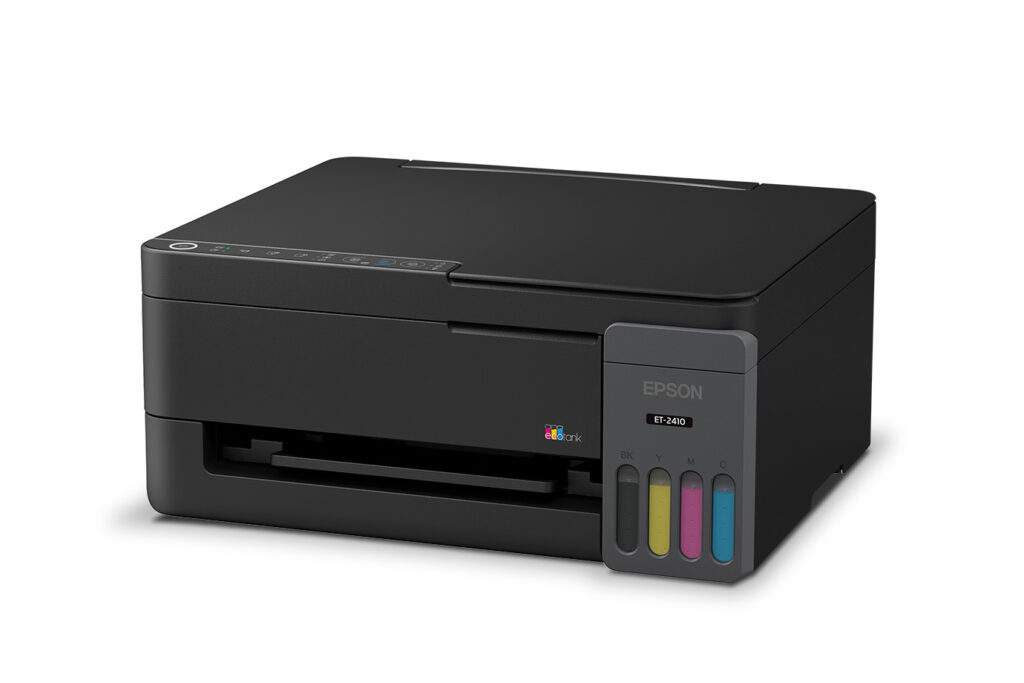
Epson sells the ET-2410 with no screen at all – not a touchscreen, not even the small monochrome panel some EcoTank siblings get. There is a row of buttons and status lights on the lid, and everything else lives in the Smart Panel phone app. That one decision explains most of this printer: Epson has stripped the chassis down to the parts that put ink on paper, and spent what it saved on the tanks.
The tanks are the whole argument. Four 65 ml bottles of 522 ink come in the box, rated by Epson at roughly 3,600 black and 6,500 colour pages, and a replacement set is rated higher still. For a household that prints in bursts and resents cartridges, that changes the arithmetic of ownership far more than anything else on the table below.
What you give up is everything around the printing. There is no automatic duplex, so two-sided documents mean flipping the stack yourself. There is no document feeder, so the flatbed takes one page at a time. There is no Ethernet, and the wireless is Wi-Fi 4 rather than anything newer. Paper comes from a single rear feed holding a hundred sheets and lands in an output tray that holds thirty, which is the real ceiling on a long job.
Epson leads with a print resolution of 5760 by 1440 dpi, and it is worth knowing what that describes: how finely the head places drops, not how much detail the scanner captures. The scanning figure is 1200 by 2400 dpi optical, and that is the one that matters if you are digitising paperwork. Epson's own recommended monthly volume is about eight hundred pages against a duty cycle of five thousand, and the distance between those two numbers is a fair description of the buyer this machine was designed around.
Category strengths
Where the Epson ET-2410 beats the average
- Has supertank / refillable ink ?
- A much lighter build ?4.1 kg vs 7.94 kg (avg)
- A higher print resolution ?5,760 dpi vs 4,800 dpi (avg)
Where the Epson ET-2410 trails the average
- No automatic duplex printing ?
- No automatic document feeder ?
- A lower print speed (black) ?11 ppm vs 15.5 ppm (avg)
- No ethernet ?
- A lower print speed (color) ?6 ppm vs 9 ppm (avg)
- A lower input tray capacity ?100 sheets vs 150 sheets (avg)
- A much lower monthly duty cycle ?5,000 pages vs 10,000 pages (avg)
- A much lower output tray capacity ?30 sheets vs 60 sheets (avg)
How this VS Score was computed
Score 28: each known spec is measured against the median of all printers (64 products, medians winsorised to the 10th–90th percentile), then weighted. 63% of the scoreable weight could be used; unknown values, features not applicable to this class and proxies (battery capacity where a rated life exists) add or remove nothing.
| Specification | This product | Cohort median | Score weight | Points moved |
|---|---|---|---|---|
| Automatic duplex printing | 0 | 1 | 1 | −48.0 |
| Automatic document feeder | 0 | 1 | 1 | −48.0 |
| Print speed (black) | 11 | 15.5 | 2 | −30.0 |
| Supertank / refillable ink | 1 | 0 | 0.5 | +25.0 |
| Duplex scanning | 0 | 0 | 0.5 | −24.0 |
| Ethernet | 0 | 1 | 0.5 | −24.0 |
| Touchscreen display | 0 | 0 | 0.5 | −24.0 |
| Print speed (color) | 6 | 9 | 1 | −17.0 |
| Input tray capacity | 100 | 150 | 1 | −17.0 |
| Weight | 4.1 | 7.94 | 0.3 | +14.1 |
| Fax | 0 | 0 | 0.2 | −9.6 |
| Monthly duty cycle | 5,000 | 10,000 | 0.3 | −7.5 |
| Output tray capacity | 30 | 60 | 0.3 | −7.5 |
| Print resolution | 5,760 | 4,800 | 0.5 | +5.0 |
Not scored: Color printing (standard for the class (89% have it)); All-in-one (standard for the class (84% have it)); ADF capacity (unknown: not scored); Wi-Fi (standard for the class (97% have it)); Wi-Fi Direct (standard for the class (90% have it)); USB (standard for the class (100% have it)); Apple AirPrint (standard for the class (97% have it)); Mobile app printing (standard for the class (100% have it)).
Editor’s note
The question with any EcoTank is whether you print enough to earn back the premium, and at this end of the range the answer is less obvious than the marketing suggests. The ET-2410 costs meaningfully more than a cartridge all-in-one of similar speed, and the payback arrives as ink you may not finish for two or three years. Print a handful of pages a month and a cheap cartridge machine genuinely costs you less over that period.
Where I think it earns its place is the household that prints unpredictably – school work, forms, an occasional batch of photos – and has been caught out by a cartridge that dried up between jobs. Tanks do not fail that way, and because the MicroPiezo head is permanent rather than built into a consumable, there is no printhead to ruin through neglect.
Two of the omissions would give me pause. The missing automatic duplex is the one you will feel weekly if you print anything longer than a couple of pages, and Epson's own EcoTank ET-3950 fixes it while adding a document feeder, a colour screen and Ethernet. If you print documents rather than pages, pay the difference. The other is Wi-Fi 4, which is a corner cut on a 2026 product and will be the first thing to feel slow on a busy home network.
The limitation nobody mentions is the thirty-sheet output tray. Send forty pages and you are standing over the printer. Colour is where this machine is genuinely hard to beat on running cost, so if your printing is photo-heavy, or your children print in colour without asking, it makes obvious sense. For anything that looks like office work it is the wrong end of the EcoTank line, and the money is better spent further up.
Specifications
Quality bars are generated automatically against 63 other printers.
Printing
Scanning & copying
Paper handling
Connectivity
Design
Sources and verification
Where the specifications come from
- Official product pageepson.com
- Datasheet or manualepson.com
- Retailer listing (cross-check)amazon.com
Verification
- First published
- Specifications last checked
- Sheet completeness
- 23 of 24 specifications verified; the rest show as Unknown and are never estimated or scored
- Page type
- Product specification page — Compiled from the manufacturer’s published specifications and the cited sources; this is not a hands-on test.
- Basis
- Research-based: specifications and editorial text were compiled from the documents listed here and the manufacturer’s published data. We have not tested this unit ourselves; where independent measurements are mentioned they belong to the linked publication.
Where to buy
Prices and availability may change. Check the retailer before buying. We may earn a commission on purchases.
Price history
Printers with similar specs to the Epson ET-2410
Ratings & reviews
No reviews yet. Be the first to share your experience.
The bottom line
The Epson ET-2410 earns a VS Score of 28, trailing most of the 64 printers we compare here, at least on the spec sheet.
- Who it’s for
- Households that print unpredictably and in colour, and are tired of finding a cartridge dried out on the one evening they actually need it. The included bottles last long enough that the printer effectively runs free for its first couple of years.
- Who should look elsewhere
- Anyone who prints multi-page documents as a matter of routine. No automatic duplex, no document feeder and a thirty-sheet output tray turn ordinary paperwork into hand-flipping and babysitting – look further up the range instead.
- The trade-off that matters
- You pay up front for cheap ink and get a deliberately bare machine in return. Screen, duplex, feeder and wired networking have all been removed to hit the price, and the tanks are the only place the money went.
- The main alternative
- Epson EcoTank ET-3950 – the same refillable tank system with automatic two-sided printing, an auto document feeder, a 2.4-inch colour display, Ethernet and a 250-sheet tray, for anyone whose printing is documents rather than the odd page.
The VS Score is calculated from the weighted specifications above, compared with every other printer we track — a shortlisting guide, not a substitute for your own priorities. See how we score.