NuPhy Halo96 V2: Specs, Features, Pros & Cons
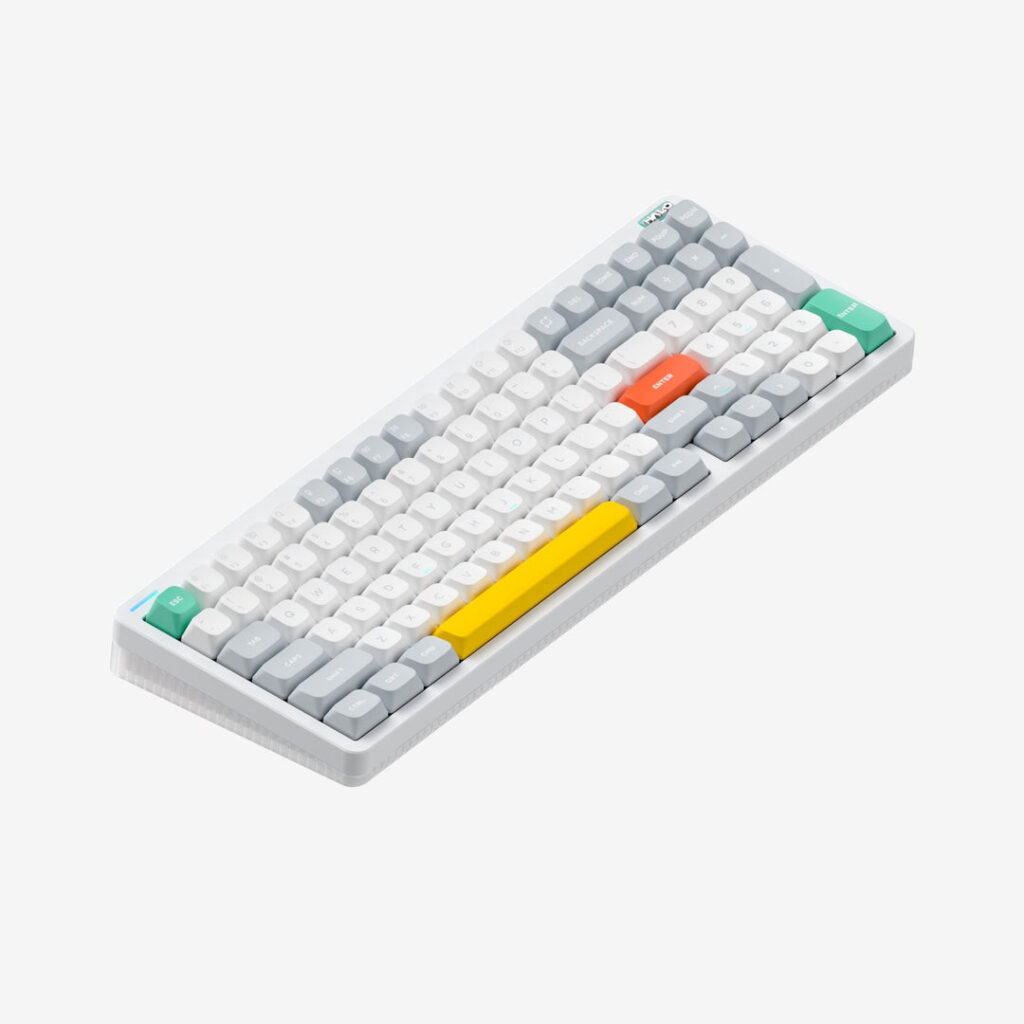
Take a full-size keyboard, close up the gaps around the arrows, the navigation keys and the number pad, and you have the arrangement the Halo96 V2 uses. The result keeps almost every key of a standard board in a noticeably narrower case, which hands a little desk width back to the mouse without giving up numeric entry.
Inside NuPhy's range it is the largest member of the Halo V2 family. It shares its high-profile case, gasket mounting, layered dampening and Halolight lighting with the compact Halo75 V2, and the only real difference is the keypad and the width it adds. Switch, keycap bundle and color are picked at purchase, and the switch shapes both sound and feel. Its connections cover a mixed desk. A cable, a receiver and Bluetooth are all supported, hot-swap sockets take replacement switches without soldering, and QMK and VIA open up every key to remapping. Media shortcuts and full n-key rollover are standard.
The tight arrangement is also the thing to learn. Delete, Insert and some navigation keys may not sit where a full-size board puts them, and the arrows press up against the keypad, so the first days bring a few wrong presses. The case is tall and heavy, the front edge is slightly taller than most, and the lighting takes a large share of the battery. No rotary knob is fitted.
Evening games and daytime figures, in accounts, data entry or spreadsheets, are the mix it was designed for, on one enthusiast board. Someone who rarely types figures would get more mouse room from the smaller Halo, and anyone moving the board between desks every week will find it cumbersome.
Category strengths
Where the NuPhy Halo96 V2 trails the median
- No rotary knob ?
- Slightly shorter battery life ?307 h vs 325 h (median)
- A slightly higher front height ?21.3 mm vs 20.2 mm (median)
How this VS Score was computed
Score 48: each known spec is measured against the median of all keyboards (101 products), then weighted; 50 means level with that median. In classes of six or more, a value beyond the class’s 10th–90th percentile range counts as that limit, so one extreme product cannot set the scale. 53% of the scoreable weight could be used; unknown values, features not applicable to this class and proxies (battery capacity where a rated life exists) add or remove nothing.
| Specification | This product | Cohort median | Score weight | Points moved |
|---|---|---|---|---|
| Hot-swappable | Yes | 61% of the class have it | 0.6 | +30.0 |
| Rapid trigger | No | 25% of the class have it | 0.5 | −24.0 |
| Adjustable actuation | No | 24% of the class have it | 0.4 | −19.2 |
| Sound dampening | Yes | 76% of the class have it | 0.3 | +15.0 |
| Rotary knob | No | 53% of the class have it | 0.2 | −9.6 |
| Battery life | 307 | 325 | 0.6 | −1.8 |
| Front height | 21.3 | 20.2 | 0.2 | −0.6 |
| Switch technology | Mechanical | Mechanical | 1 | +0.0 |
| Polling rate | 1,000 | 1,000 | 0.7 | +0.0 |
| Connection | 3 | 3 | 0.8 | +0.0 |
| Backlight | RGB | RGB | 0.3 | +0.0 |
Not scored: Actuation force (unknown: not scored); N-key rollover (standard for the class (85% have it)); Analog input (not applicable: only 14% of this class have it); Wired latency (unknown: not scored); Wireless latency (unknown: not scored); Bluetooth devices (unknown: not scored); Battery capacity (capacity is a proxy; the rated battery life is scored instead); USB passthrough (not applicable: only 4% of this class have it); Keycap material (unknown: not scored); Programmable keys (standard for the class (99% have it)); Media controls (standard for the class (97% have it)); Onboard profiles (standard for the class (89% have it)); Configuration software (standard for the class (95% have it)).
Editor’s note
The NuPhy Halo96 V2 is the number-pad version of NuPhy's high-profile Halo V2 platform. Its compact 96-percent arrangement keeps nearly all full-size functions while reducing the gaps between the main keys, arrows, navigation controls, and numeric pad. That makes it attractive for anyone who combines gaming with spreadsheets or data entry but still wants to reclaim some desk width.
The board targets enthusiasts who prefer a finished product rather than a kit. A gasket-mounted structure, hot-swap support, layered sound treatment, bright Halolight effects, and QMK/VIA customization provide considerable room to change feel, sound, lighting, and key assignments. Wired USB-C, Bluetooth, and 2.4 GHz connections support a mixed desktop and multi-device setup.
The compressed layout is not automatically easier than a standard full-size keyboard. Closely packed clusters can cause accidental presses until muscle memory adjusts, and the heavy high-profile case is not suited to frequent travel. Lighting also has a large effect on battery runtime. Buyers should compare switch choices carefully because spring weight and sound will shape the daily experience more than cosmetic color.
Halo96 V2 is best for someone who needs a number pad but wants custom-keyboard features and wireless flexibility. People who rarely use numeric entry will gain more mouse room from the Halo75 V2. Minimalist office typists may prefer a quieter low-profile board. Confirm the exact V2 model, switch, keycap set, and included receiver before ordering, because Halo generations and sizes are not interchangeable.
Also check how the compact number pad interacts with your most-used shortcuts. Some 96-percent layouts relocate Delete, Insert, or navigation functions, and a few days of adaptation is normal. A wrist rest may be worthwhile because of the high-profile case, but budget for one only after confirming the board's exact front height and your preferred typing angle.
Specifications
Quality bars show where each figure sits between the lowest and highest of the 101 keyboards this VS Score is measured against.
Switches & typing
Performance
Layout & size
Connectivity
Build & sound
Features
Sources and verification
Where the specifications come from
- Official product pagenuphy.com
Verification
- First published
- Specifications last checked
- Sheet completeness
- 29 of 34 specifications verified; the rest show as Unknown and are never estimated or scored
- Page type
- Product specification page — Compiled from the manufacturer’s published specifications and the cited sources; this is not a hands-on test.
- Basis
- Research-based: specifications and editorial text were compiled from the documents listed here and the manufacturer’s published data. We have not tested this unit ourselves; where independent measurements are mentioned they belong to the linked publication.
Keyboards with similar specs to the NuPhy Halo96 V2
Ratings & reviews
No reviews yet. Be the first to share your experience.
The bottom line
The NuPhy Halo96 V2 earns a VS Score of 48, below the median of the 101 keyboards it is measured against (a score of 50 is level with that median).
- Who it’s for
- A gamer who also lives in spreadsheets and wants a keypad on an enthusiast-grade build without the width of a traditional full-size board.
- Who should look elsewhere
- Typists after a flat, quiet office keyboard should look elsewhere, and so should anyone who moves a board between desks. It is tall and heavy.
- The trade-off that matters
- The keypad and arrows sit tight against the main block, so expect stray presses around the arrows and the right-hand column until your hands learn the gaps.
- The main alternative
- NuPhy Halo75 V2: the same case and switches without the keypad, which returns more mouse room if you rarely enter numbers.
The VS Score is calculated from the weighted specifications above, each measured against the median of comparable keyboards — a shortlisting guide, not a substitute for your own priorities. See how we score.