EPOMAKER RT98: Specs, Features, Pros & Cons
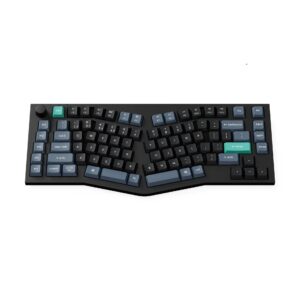
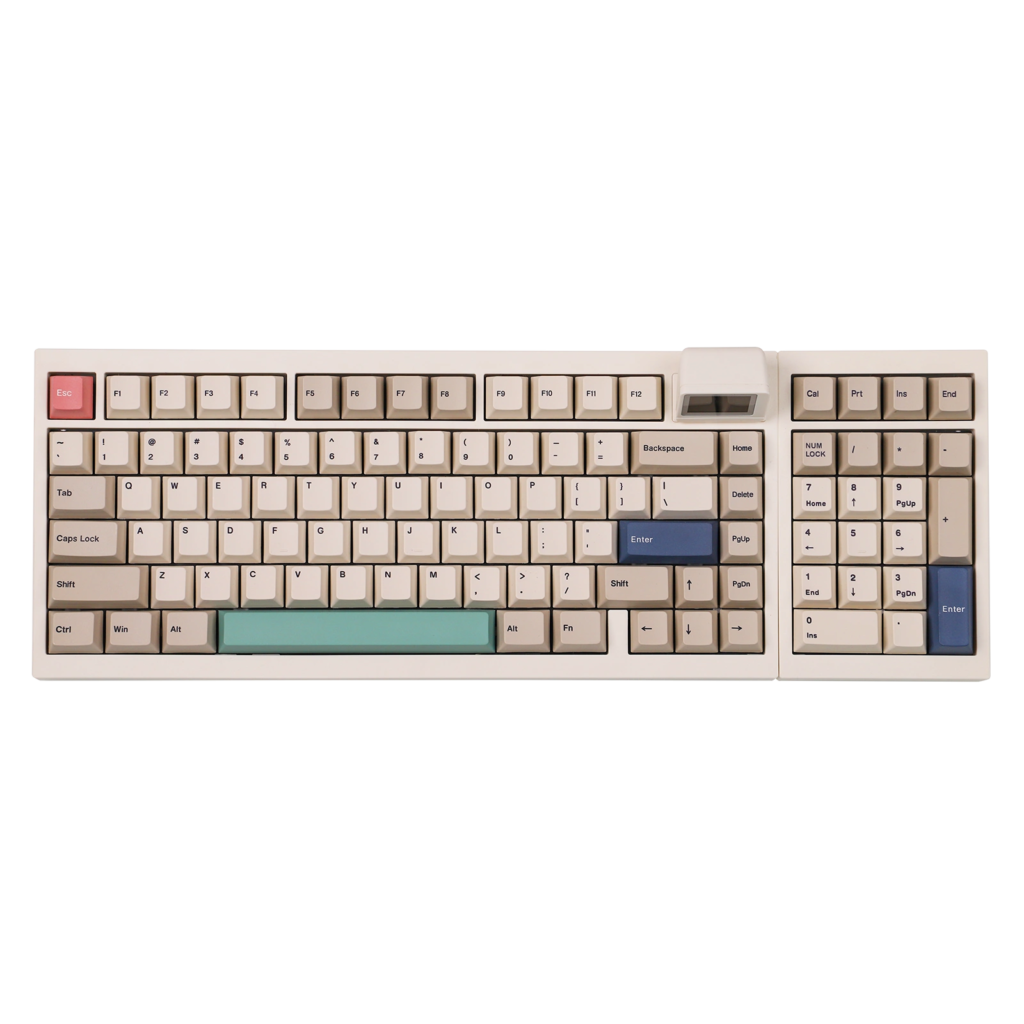
The number block on the RT98 unbolts and moves to the left side of the board, a southpaw arrangement that gives a right-handed mouse more room without taking the keypad away.
EPOMAKER dresses it as a retro terminal in beige and blue, with a small magnetic screen on the top edge, and fills it with parts from the enthusiast list: a gasket mount with layered foam, factory-lubed switches in hot-swap sockets, PBT keycaps and remapping through VIA. The layout is a compressed full-size one, with every key of a standard board packed closer together, and every key can be remapped.
Its latency figures set it apart from gaming boards, and not in a good way. EPOMAKER lists 3 ms over the cable and 5 ms wireless, slow next to fast gaming boards. The keyboard connects three ways, over a cable, a receiver or Bluetooth, and its rated battery life is long, though it has no rotary knob. None of those figures will be felt in writing, spreadsheets or code. They do show in the fastest games, where players now expect magnetic switches and much quicker polling than this board has.
Plastic forms the shell and the stabilizers clip to the plate, so EPOMAKER spent on sound and looks more than on the frame. It suits someone who writes, codes or designs all day and wants a desk piece that looks like nothing else in the office, sounds soft under the fingers, and puts the keypad on whichever side suits the mouse hand.
Category strengths
Where the EPOMAKER RT98 trails the median
- A much higher wired latency ?3 ms vs 0.13 ms (median)
- No rotary knob ?
- Slightly shorter battery life ?300 h vs 325 h (median)
How this VS Score was computed
Score 44: each known spec is measured against the median of all keyboards (101 products), then weighted; 50 means level with that median. In classes of six or more, a value beyond the class’s 10th–90th percentile range counts as that limit, so one extreme product cannot set the scale. 62% of the scoreable weight could be used; unknown values, features not applicable to this class and proxies (battery capacity where a rated life exists) add or remove nothing.
| Specification | This product | Cohort median | Score weight | Points moved |
|---|---|---|---|---|
| Hot-swappable | Yes | 61% of the class have it | 0.6 | +30.0 |
| Wired latency | 3 — capped at the class’s upper range (0.39) | 0.13 | 0.8 | −27.2 |
| Rapid trigger | No | 25% of the class have it | 0.5 | −24.0 |
| Adjustable actuation | No | 24% of the class have it | 0.4 | −19.2 |
| Sound dampening | Yes | 76% of the class have it | 0.3 | +15.0 |
| Rotary knob | No | 53% of the class have it | 0.2 | −9.6 |
| Battery life | 300 | 325 | 0.6 | −2.4 |
| Switch technology | Mechanical | Mechanical | 1 | +0.0 |
| Polling rate | 1,000 | 1,000 | 0.7 | +0.0 |
| Connection | 3 | 3 | 0.8 | +0.0 |
| Keycap material | PBT | PBT | 0.4 | +0.0 |
| Backlight | RGB | RGB | 0.3 | +0.0 |
Not scored: Actuation force (unknown: not scored); N-key rollover (standard for the class (85% have it)); Analog input (not applicable: only 14% of this class have it); Wireless latency (too few comparable peers (2, need 3)); Front height (unknown: not scored); Bluetooth devices (unknown: not scored); Battery capacity (capacity is a proxy; the rated battery life is scored instead); USB passthrough (not applicable: only 4% of this class have it); Programmable keys (standard for the class (99% have it)); Media controls (standard for the class (97% have it)); Onboard profiles (unknown: not scored); Configuration software (standard for the class (95% have it)).
Editor’s note
The RT98 is EPOMAKER's bet that a keyboard can be furniture you enjoy looking at. The beige-and-blue retro shell reads like a 1980s terminal, and the magnetic "Mini TV" module that snaps onto the top edge shows the time, battery state, or a GIF of your choosing. It is a gimmick, but a well-executed one, and it detaches cleanly if you tire of it.
The more useful trick is the modular numpad. The RT98 ships as a compact full-size board whose number block can be unbolted and remounted on the left (the Southpaw configuration), which frees mouse space for right-handers without giving up the number keys.
Typing is the strong suit. A gasket mount with five layers of foam, factory-lubed Creamy Jade linear or Sea Salt Silent switches, and Cherry-profile dye-sub PBT caps produce the deep, marbly sound signature enthusiasts pay far more for. The 8,000 mAh battery is huge. EPOMAKER claims 300-plus hours of continuous typing. Hot-swap sockets and VIA support cover remapping and future switch changes.
The case is ABS plastic, the stabilizers are plate-mounted rather than screw-in, and there is no volume knob. The spec sheet says so, despite some marketing copy. Polling tops out at 1,000 Hz wired and drops to 125 Hz on Bluetooth, so competitive shooter players chasing 8K polling or rapid-trigger magnetic switches should look elsewhere. At 1.18 kg and 406 mm wide it is also not a travel board.
Buy it if you type, code, or create all day and want character on your desk with good acoustics. Skip it if you need tournament-grade latency or a metal case.
Specifications
Quality bars show where each figure sits between the lowest and highest of the 101 keyboards this VS Score is measured against.
Switches & typing
Performance
Layout & size
Connectivity
Build & sound
Features
Sources and verification
Where the specifications come from
- Official product pageepomaker.com
- Retailer listing (cross-check)amazon.com
Verification
- First published
- Specifications last checked
- Sheet completeness
- 30 of 34 specifications verified; the rest show as Unknown and are never estimated or scored
- Page type
- Product specification page — Compiled from the manufacturer’s published specifications and the cited sources; this is not a hands-on test.
- Basis
- Research-based: specifications and editorial text were compiled from the documents listed here and the manufacturer’s published data. We have not tested this unit ourselves; where independent measurements are mentioned they belong to the linked publication.
Where to buy
Prices and availability may change. Check the retailer before buying. We may earn a commission on purchases.
Keyboards with similar specs to the EPOMAKER RT98
Ratings & reviews
No reviews yet. Be the first to share your experience.
The bottom line
The EPOMAKER RT98 earns a VS Score of 44, below the median of the 101 keyboards it is measured against (a score of 50 is level with that median).
- Who it’s for
- A writer, coder or designer who wants a keyboard with character on the desk, good acoustics and a keypad that can move to the left.
- Who should look elsewhere
- Competitive players chasing fast polling or magnetic switches should look elsewhere, and so should anyone who wants a metal case.
- The trade-off that matters
- The case is ABS and the stabilizers are plate-mounted, so the enthusiast sound comes with a plastic shell and a higher risk of rattle over time.
- The main alternative
- AULA S98 Pro: another compact keypad gasket board, this one with a screen and a volume knob, for someone who wants the knob.
The VS Score is calculated from the weighted specifications above, each measured against the median of comparable keyboards — a shortlisting guide, not a substitute for your own priorities. See how we score.