Keychron K5 Ultra 8K Wireless Mechanical: Specs, Pros & Cons
Low-profile keyboards and full-size layouts rarely arrive together, and flagship wireless specifications rarely arrive on either. The K5 Ultra 8K is Keychron's attempt to put all three in one chassis, which makes it an awkward product to place: it is aimed at people who want a number pad, a slim typing height, and the kind of fast wireless link normally reserved for gaming boards.
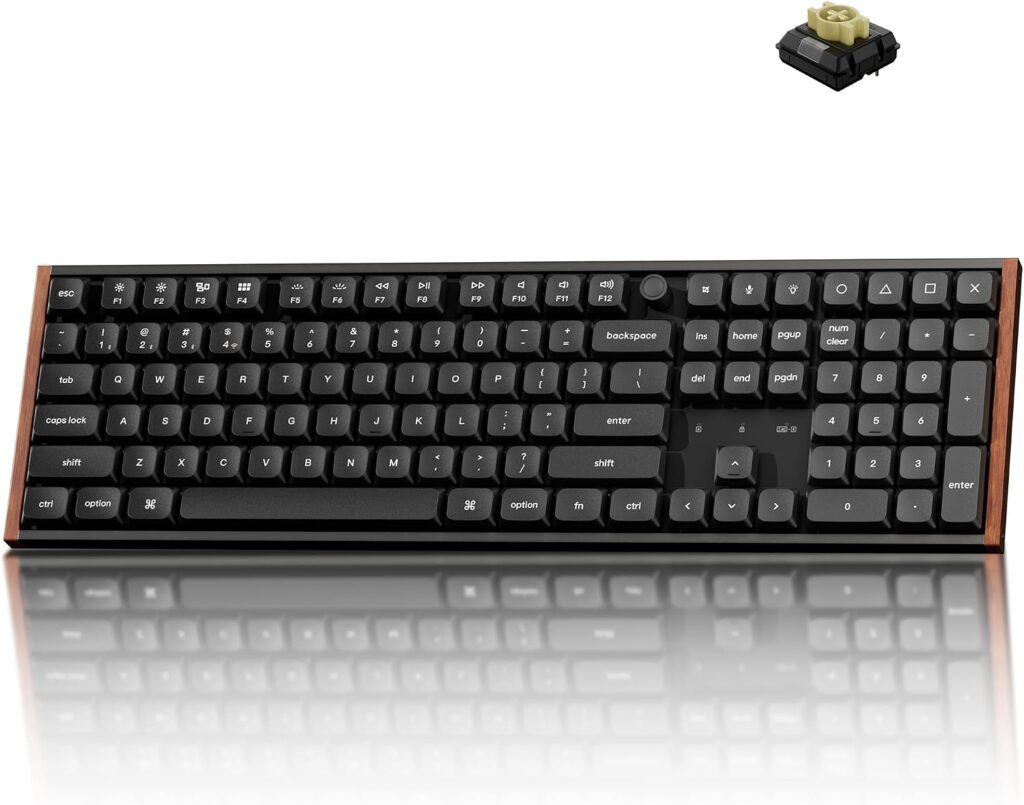
The build is where most of the money has gone. Anodised aluminum is paired with real wood on the frame, the switch plate is aluminum alloy, and several layers of internal foam sit under the board to kill the hollow, plasticky sound that cheap low-profile keyboards are known for. The stabilizers are gold-plated and mounted to the circuit board, the better of the two approaches. Keycaps are double-shot PBT, so the legends are molded into the plastic.
Two constraints shape who this suits. The switches are Keychron's own low-profile design, and while the sockets are hot-swappable, that only opens the door to Keychron's own range. The much larger pool of standard mechanical switches stays closed. And the firmware is ZMK, configured through a browser-based tool, rather than the QMK and VIA arrangement enthusiasts often assume a customizable board will use.
It makes most sense for someone who works in spreadsheets or numbers all day, wants a board that types like a mechanical keyboard without raising their wrists, and would rather not tether it to a cable. The fast wireless link is a genuine advantage over an ordinary office board, though the buyer most likely to be drawn in by that figure is a competitive gamer, and a full-size low-profile keyboard is not built for them.
Category strengths
Where the Keychron K5 Ultra 8K Wireless Mechanical beats the median
- A much higher polling rate ?8,000 Hz vs 1,000 Hz (median)
- Longer battery life ?370 h vs 325 h (median)
- A lower front height ?15.55 mm vs 20.2 mm (median)
How this VS Score was computed
Score 58: each known spec is measured against the median of all keyboards (101 products), then weighted; 50 means level with that median. In classes of six or more, a value beyond the class’s 10th–90th percentile range counts as that limit, so one extreme product cannot set the scale. 63% of the scoreable weight could be used; unknown values, features not applicable to this class and proxies (battery capacity where a rated life exists) add or remove nothing.
| Specification | This product | Cohort median | Score weight | Points moved |
|---|---|---|---|---|
| Polling rate | 8,000 | 1,000 | 0.7 | +35.0 |
| Hot-swappable | Yes | 61% of the class have it | 0.6 | +30.0 |
| Rapid trigger | No | 25% of the class have it | 0.5 | −24.0 |
| Adjustable actuation | No | 24% of the class have it | 0.4 | −19.2 |
| Sound dampening | Yes | 76% of the class have it | 0.3 | +15.0 |
| Rotary knob | Yes | 53% of the class have it | 0.2 | +10.0 |
| Battery life | 370 | 325 | 0.6 | +4.2 |
| Front height | 15.55 | 20.2 | 0.2 | +3.0 |
| Switch technology | Mechanical | Mechanical | 1 | +0.0 |
| Actuation force | 45 | 45 | 0.4 | +0.0 |
| Connection | 3 | 3 | 0.8 | +0.0 |
| Bluetooth devices | 3 | 3 | 0.3 | +0.0 |
| Keycap material | PBT | PBT | 0.4 | +0.0 |
| Backlight | RGB | RGB | 0.3 | +0.0 |
Not scored: N-key rollover (standard for the class (85% have it)); Analog input (not applicable: only 14% of this class have it); Wired latency (unknown: not scored); Wireless latency (unknown: not scored); Battery capacity (capacity is a proxy; the rated battery life is scored instead); USB passthrough (not applicable: only 4% of this class have it); Programmable keys (standard for the class (99% have it)); Media controls (standard for the class (97% have it)); Onboard profiles (unknown: not scored); Configuration software (standard for the class (95% have it)).
Editor’s note
Keychron's K5 line has always been the low-profile full-size option, and the Ultra 8K version brings it up to the same wireless specification as the rest of the Ultra range. The headline is the polling rate: 8,000 Hz over both the USB-C cable and the bundled 2.4 GHz receiver. Read the small print, though: Bluetooth runs at 125 Hz, so the fast link is the dongle, not the wireless-for-everything promise.
The battery figure is unusually large for a backlit board: Keychron quotes up to 370 hours from the 2,600 mAh cell, measured at 8K polling with the RGB backlight off. Leave the north-facing lighting on and that number falls, as it does on every keyboard that advertises this way.
Physically it is 436.6 x 128.29 mm and 720 g, with a front height of 15.55 mm before keycaps, slim enough to type on without a wrist rest, which is the whole argument for a low-profile board. The frame pairs anodised aluminum with real wood, the plate is anodised aluminum alloy, the stabilizers are gold-plated PCB-mounted units, and Keychron layers latex, IXPE and bottom-case foam inside to kill the hollow sound cheap low-profile boards make.
Switches are Keychron's own low-profile Milk POM in Red (45 gf linear), Brown (50 gf tactile) or Banana (57 gf, stronger tactile), all pre-lubed and hot-swappable, though low-profile hot-swap limits you to Keychron's own range and shuts out Cherry MX switches. Keycaps are double-shot PBT in LSA profile.
One thing to check before buying: this board runs ZMK firmware and is configured through Keychron's web Launcher. Everything remains remappable, including the knob, but the tooling is different from Keychron's older Q and V boards.
Specifications
Quality bars show where each figure sits between the lowest and highest of the 101 keyboards this VS Score is measured against.
Switches & typing
Performance
Layout & size
Connectivity
Build & sound
Features
Sources and verification
Where the specifications come from
- Official product pagekeychron.com
- Retailer listing (cross-check)amazon.com
Verification
- First published
- Specifications last checked
- Sheet completeness
- 29 of 34 specifications verified; the rest show as Unknown and are never estimated or scored
- Page type
- Product specification page — Compiled from the manufacturer’s published specifications and the cited sources; this is not a hands-on test.
- Basis
- Research-based: specifications and editorial text were compiled from the documents listed here and the manufacturer’s published data. We have not tested this unit ourselves; where independent measurements are mentioned they belong to the linked publication.
Keyboards with similar specs to the Keychron K5 Ultra 8K Wireless Mechanical
Ratings & reviews
No reviews yet. Be the first to share your experience.
The bottom line
The Keychron K5 Ultra 8K Wireless Mechanical earns a VS Score of 58, above the median of the 101 keyboards it is measured against (a score of 50 is level with that median).
- Who it’s for
- People who want a full-size board that types like a mechanical but sits low enough to use without a wrist rest, with hot-swap switches, molded PBT keycaps and a foam-damped wood-and-aluminum case.
- Who should look elsewhere
- Anyone expecting the fast wireless link to work over Bluetooth as well as the dongle, anyone short of desk space for a full-size layout, and anyone set on QMK and VIA over Keychron's own firmware and web configurator.
- The trade-off that matters
- Flagship polling and a long battery rating in a slim full-size body, paid for with a switch choice limited to Keychron's own low-profile range.
- The main alternative
- Keychron K8 Ultra 8K: the same fast wireless platform in a standard-profile TKL, if you would rather have a shorter board with full-height switches.
The VS Score is calculated from the weighted specifications above, each measured against the median of comparable keyboards — a shortlisting guide, not a substitute for your own priorities. See how we score.