Keychron B36 Wireless Keyboard: Specs, Features, Pros & Cons
This review measures the Keychron B36 Wireless Keyboard against the full 34-spec sheet we track for keyboards, comparing it like for like with the 74 other models in our database. It earns a VS Score of 32 out of 100 — the weighted result of every verified specification measured against the class average.
On the spec sheet it is strongest in layout & size and weakest in switches & typing. Its clearest single advantage over the class average: 0.99 more connection — 3 vs 2.01 (avg). None of our retail partners currently lists the Keychron B36 Wireless Keyboard, so availability may be limited; a missing price never affects the VS Score. A transparency note: this spec sheet is 53% complete. Anything unverified shows as Unknown and is left out of the score — we never estimate a missing value.
Category strengths
Where the Keychron B36 Wireless Keyboard beats the average
- 0.99 more connection ?3 vs 2.01 (avg)
- 4.07 mm less front height ?17.94 mm vs 22.01 mm (avg)
- Has configuration software ?
- Has programmable keys ?
- Has media controls ?
Where the Keychron B36 Wireless Keyboard trails the average
- 2,683.33 Hz less polling rate ?1,000 Hz vs 3,683.33 Hz (avg)
- No n-key rollover ?
- 909.11 h less battery life ?320 h vs 1,229.11 h (avg)
- 2,584.48 mAh less battery capacity ?800 mAh vs 3,384.48 mAh (avg)
- No rotary knob ?
Editor’s note
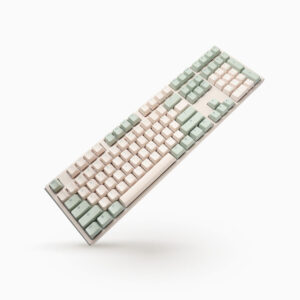
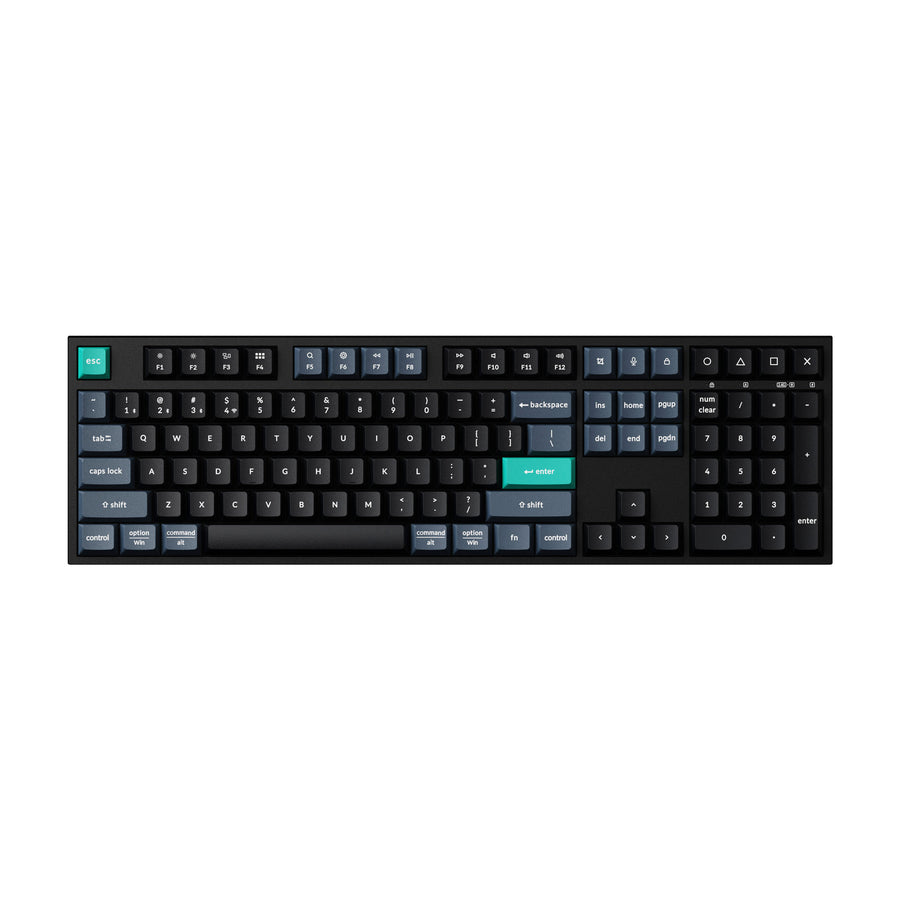
The Keychron B36 is a full-size wireless productivity keyboard built around a quiet scissor mechanism. Its 108-key layout includes a number pad, making it more appropriate than the B33 for accounting, data entry, administrative work, and anyone who regularly uses spreadsheet shortcuts. The official 436.95-millimetre width requires a reasonably generous desk and places the mouse farther from the typing position.
Keychron lists Bluetooth 5.2, 2.4 GHz, and wired USB-C connectivity, with 1,000 Hz polling over wired and 2.4 GHz modes and 125 Hz over Bluetooth. The 800 mAh battery is rated for up to 320 hours of wireless use. Keychron Launcher adds remapping and macro support, while the non-backlit design favours endurance and visual simplicity over gaming aesthetics.
The scissor switches are aimed at stable, low-noise typing, not the deeper travel or replaceable feel of a mechanical keyboard. NKRO is not supported, so buyers who press many simultaneous keys in complex games should look elsewhere. At about 650 grams it is movable, but the full-size shape is inconvenient for travel and may feel too wide beside a low-sensitivity gaming mouse.
The B36 is a strong fit for a permanent office desk, especially when quiet operation, a number pad, and switching among several devices matter. Compact-keyboard fans, mechanical-switch enthusiasts, and competitive gamers should not consider it their first choice. Check whether a listing is the standalone keyboard or the B36/BM25 mouse bundle, as those are distinct products with different prices and contents.
Mac and Windows users should verify the supplied legends and system toggle behaviour before deployment across a team. The shortcut row can change between media and standard function actions, which is useful but may confuse shared-desk users. For business purchasing, test the web configurator against browser and security restrictions before relying on custom mappings.
Specifications
Quality bars are generated automatically against 74 other keyboards.
Switches & typing
The key switch technology; later types are generally more responsive.
The specific switch used (e.g. Cherry MX Red).
The force needed to register a key; lower is lighter to type on.
Swap switches without soldering.
Registers every simultaneous keypress.
Set the actuation point per key (analog / Hall-effect boards).
Keys report their travel depth for variable gamepad-style input and multi-stage actions.
Performance
How often the keyboard reports input; higher can reduce latency.
End-to-end keypress latency over a wired connection; lower is better.
End-to-end keypress latency over the fastest wireless mode; lower is better.
Resets a key dynamically as it moves, enabling faster repeated inputs.
Layout & size
The keyboard size and layout.
The number of keys.
The overall width.
The overall depth.
The front case height without keycaps; lower boards can reduce wrist extension.
The keyboard's weight.
Connectivity
The supported connection types.
How many paired devices it can switch between.
Battery life for wireless models.
The rated capacity of the internal battery.
A built-in USB port for other devices.
Build & sound
Keycap plastic; PBT resists shine and wear better than ABS.
The case material (e.g. aluminium, ABS plastic).
The switch plate material, which influences stiffness and typing sound.
How larger keys are stabilised (e.g. screw-in PCB or plate-mounted).
The plate / PCB mounting style (e.g. gasket mount).
Internal foam or dampening for a quieter, fuller sound.
The per-key lighting.
Features
Remap keys and record macros.
Dedicated volume and playback controls.
A control knob for volume or custom actions.
Stores layouts on the board itself.
Companion configuration software (e.g. VIA / QMK).
How the VS Score works — and what it can’t tell you
Every measurable spec is scored against the average of all the keyboards we track: matching the class average scores 50, clearly beating it climbs towards 100, and each spec counts according to an editorial weight that reflects real-world impact — a battery-capacity gap moves the score far more than a colour-options list. The quality bars on the spec cards above show where this model sits inside the full range for its class, and the overall VS Score rolls every weighted result into one number.
Unknown values are never estimated. A spec this product doesn’t report simply drops out of its scoring — it isn’t penalised with a guess — but a thinner spec sheet does mean a score built on fewer data points, which is why completeness is disclosed under About this data.
Most importantly: a spec-sheet lead is not the same as a better product. Megapixels, gigahertz and benchmark points describe capacity, not experience — image processing, software optimisation, thermals, haptics and ergonomics decide how a device actually feels, and no table captures reliability or long-term support quality. Treat the VS Score as a structured summary of what can be measured, not a substitute for your own priorities.
About this data
- Specifications are compiled from each manufacturer’s official spec sheet, cross-checked against trusted specification databases, and normalised into one schema so identical things are compared identically.
- Specifications last verified August 4, 2026.
- Data completeness: 18 of the 34 specs in this category are verified (53%). Anything we could not verify is shown as Unknown — never estimated — and is excluded from the score.
- Prices and availability come from live retailer feeds via our shopping partners and refresh throughout the day; a missing price means no partner currently lists the product, not that it is discontinued.
- Want the full picture? Our editorial guidelines explain how we research products, weight the scores and stay independent.
- Spotted an error in a spec? Tell us and we will correct the sheet.
Keyboards with similar specs to the Keychron B36 Wireless Keyboard
Ratings & reviews
No reviews yet. Be the first to share your experience.
The bottom line
The Keychron B36 Wireless Keyboard earns a VS Score of 32, trailing most of the 75 keyboards we compare here, at least on the spec sheet. It stands out for 0.99 more connection, 4.07 mm less front height and has configuration software. Just be aware of 2,683.33 Hz less polling rate and no n-key rollover before you buy. Weigh those trade-offs against what matters most to you.
The VS Score is generated automatically from the weighted specifications above, measured against all other keyboards in our database. Treat it as a shortlisting guide — not a substitute for your own priorities.