Lofree Flow 2 100: Specs, Features, Pros & Cons
Light switches and a thin metal case define this keyboard as much as its number pad does. Lofree's Cloud Series switches need a lighter press than most keyboard switches, and they sit in a low-profile aluminum body with a gasket inside. Anyone moving from a laptop will recognize the height, and anyone moving from a standard mechanical board will notice how little push each key takes.
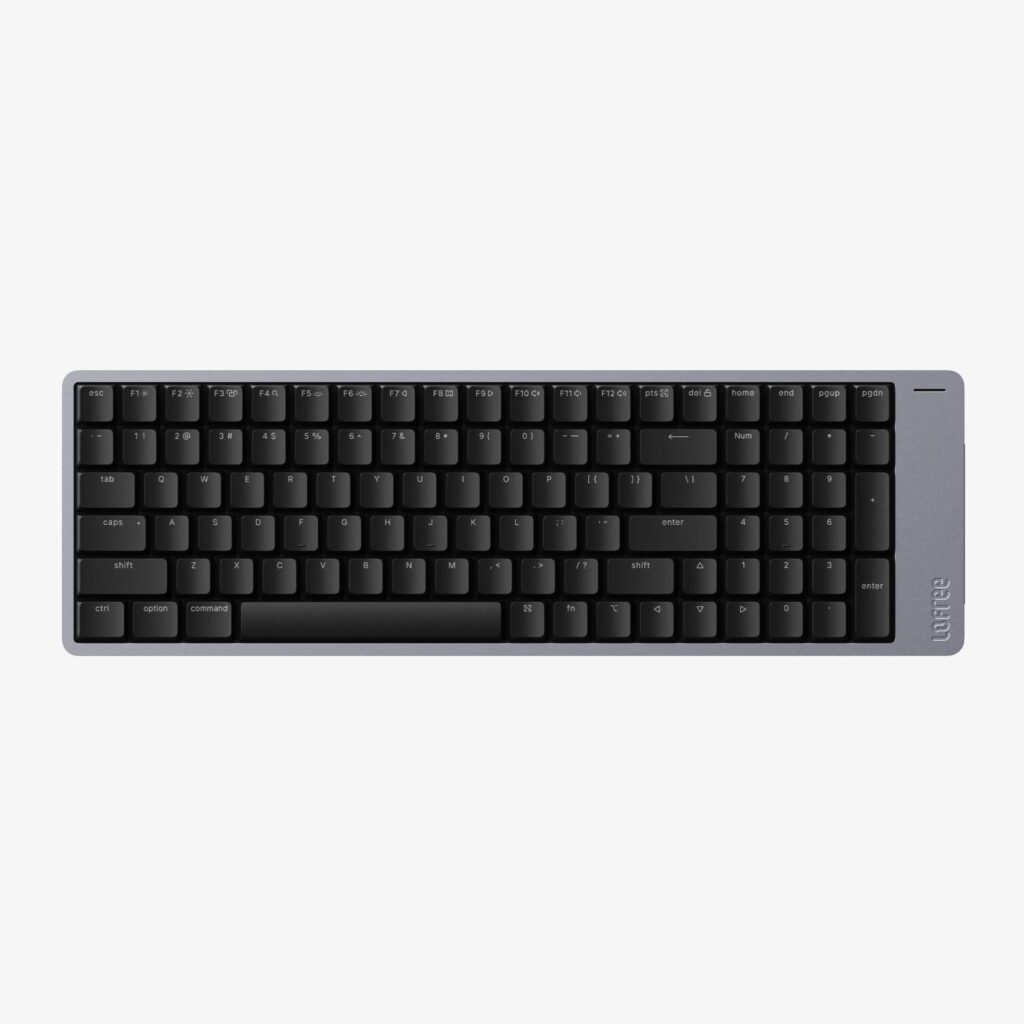
In the Flow 2 family this is the largest size. The 84- and 68-key siblings are smaller, and the 100 keeps every key in a 96% layout that closes the gaps between blocks to save width. The arrows end up pressed against the numbers with no gap between them. The Flow 2 84 is the same build with the number pad cut off.
The construction reads like a custom board in a slim shape. The frame is milled from a single aluminum block and anodised, and five layers of dampening sit inside. Switches are POM-based and hot-swappable, and the double-shot PBT caps have a translucent layer for the legends. VIA handles remapping.
Connections cover a cable, a wireless dongle and Bluetooth, and a touch bar on the side adjusts volume and brightness in place of a rotary knob.
It is built for a typist who wants numbers on the right, prefers flat keys and wants a muted, good-looking board on the desk. What it leaves out is anything for gaming, color lighting and long battery life. The backlight is white only and the battery runs out well before a typical wireless keyboard's, so this Lofree is happiest left on one desk with a cable in reach.
Category strengths
Where the Lofree Flow 2 100 beats the median
- A lighter actuation force ?40 g vs 45 g (median)
Where the Lofree Flow 2 100 trails the median
- Much shorter battery life ?120 h vs 325 h (median)
- No rotary knob ?
How this VS Score was computed
Score 45: each known spec is measured against the median of all keyboards (101 products), then weighted; 50 means level with that median. In classes of six or more, a value beyond the class’s 10th–90th percentile range counts as that limit, so one extreme product cannot set the scale. 58% of the scoreable weight could be used; unknown values, features not applicable to this class and proxies (battery capacity where a rated life exists) add or remove nothing.
| Specification | This product | Cohort median | Score weight | Points moved |
|---|---|---|---|---|
| Hot-swappable | Yes | 61% of the class have it | 0.6 | +30.0 |
| Rapid trigger | No | 25% of the class have it | 0.5 | −24.0 |
| Adjustable actuation | No | 24% of the class have it | 0.4 | −19.2 |
| Battery life | 120 | 325 | 0.6 | −19.2 |
| Sound dampening | Yes | 76% of the class have it | 0.3 | +15.0 |
| Rotary knob | No | 53% of the class have it | 0.2 | −9.6 |
| Backlight | White | RGB | 0.3 | −7.5 |
| Actuation force | 40 | 45 | 0.4 | +2.4 |
| Switch technology | Mechanical | Mechanical | 1 | +0.0 |
| Polling rate | 1,000 | 1,000 | 0.7 | +0.0 |
| Connection | 3 | 3 | 0.8 | +0.0 |
| Keycap material | PBT | PBT | 0.4 | +0.0 |
Not scored: N-key rollover (unknown: not scored); Analog input (not applicable: only 14% of this class have it); Wired latency (unknown: not scored); Wireless latency (unknown: not scored); Front height (unknown: not scored); Bluetooth devices (unknown: not scored); Battery capacity (capacity is a proxy; the rated battery life is scored instead); USB passthrough (not applicable: only 4% of this class have it); Programmable keys (standard for the class (99% have it)); Media controls (standard for the class (97% have it)); Onboard profiles (standard for the class (89% have it)); Configuration software (standard for the class (95% have it)).
Editor’s note
The Lofree Flow 2 100 is the full-size member of a family that also comes in 68- and 84-key sizes, and it is the one to pick if you want a number pad without giving up the low-profile feel. The 96% layout packs 100 keys into a 398 mm frame milled from a single block of aluminum, and at 21.5 mm thick it sits closer to a laptop keyboard than to a conventional mechanical board.
The case is the headline. A 205-grit anodised finish and a gasket mount with five layers of dampening give it a typing sound that is muted and low-pitched rather than hollow, which is unusual at low-profile heights. The Cloud Series switches are POM-based, rated at 40 g, and hot-swappable, so a heavier or silent variant can be dropped in later. Keycaps are double-shot PBT with a translucent PC legend layer, so the legends will not wear off. Connectivity covers USB-C, Bluetooth 5.3 and 2.4 GHz, polling at 1,000 Hz on the wired and dongle paths, and the 3,000 mAh battery runs about 120 hours with the backlight off. VIA support means remapping happens in a browser with nothing to install.
The limits are mostly about portability and light. At 870 g this is a desk keyboard, not a travel one, however thin it looks. Backlighting is white only at this price, and switching it on cuts battery life to roughly 14 hours. Bluetooth polling drops to 125 Hz. The side touch bar handles volume and brightness but is easy to brush by accident, and Lofree ties switch choice to case color at the factory, so a specific combination can mean buying a separate switch set on top.
Buy it if you want a desk-bound low-profile board that looks and sounds better than most, and you value build quality over gaming speed. Skip it if you need rapid trigger, an 8,000 Hz polling rate, RGB lighting, or something you can carry every day.
Specifications
Quality bars show where each figure sits between the lowest and highest of the 101 keyboards this VS Score is measured against.
Switches & typing
Performance
Layout & size
Connectivity
Build & sound
Features
Sources and verification
Where the specifications come from
- Official product pagelofree.co
- Independent testingrtings.com
Verification
- First published
- Specifications last checked
- Sheet completeness
- 27 of 34 specifications verified; the rest show as Unknown and are never estimated or scored
- Page type
- Product specification page — Compiled from the manufacturer’s published specifications and the cited sources; this is not a hands-on test.
- Basis
- Research-based: specifications and editorial text were compiled from the documents listed here and the manufacturer’s published data. We have not tested this unit ourselves; where independent measurements are mentioned they belong to the linked publication.
Keyboards with similar specs to the Lofree Flow 2 100
Ratings & reviews
No reviews yet. Be the first to share your experience.
The bottom line
The Lofree Flow 2 100 earns a VS Score of 45, below the median of the 101 keyboards it is measured against (a score of 50 is level with that median).
- Who it’s for
- A typist who wants a numpad but prefers low-profile keys, and cares how a desk keyboard looks and sounds.
- Who should look elsewhere
- Gamers after rapid trigger or fast polling, and anyone who wants RGB or a board to carry every day, should look elsewhere.
- The trade-off that matters
- The white backlight drains it fast. Leave it lit and charging comes every couple of working days, so in practice it runs dark or on a cable.
- The main alternative
- Lofree Flow 2 84: the same build without the numpad, for a desk where the mouse needs the room.
The VS Score is calculated from the weighted specifications above, each measured against the median of comparable keyboards — a shortlisting guide, not a substitute for your own priorities. See how we score.