Lofree Flow 2 84: Specs, Features, Pros & Cons
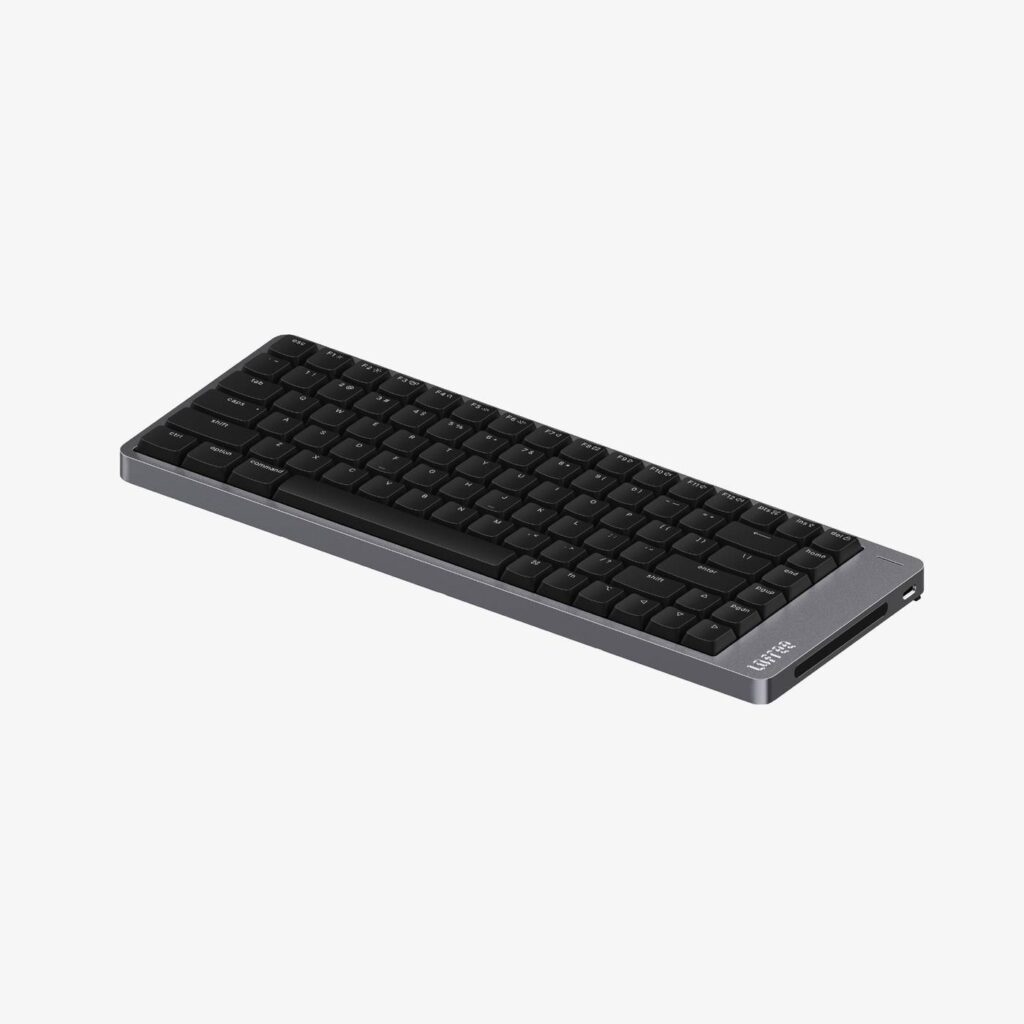
The middle Flow 2 is the size that keeps the function row and still leaves the mouse its room. Lofree builds this low-profile keyboard in three widths, and the 84 sits between the numpad model and the compact 68, with a full row of F-keys across the top and a narrow navigation column down the right.
It shares the family's construction. The case is machined from aluminum, which makes it heavier than its thin outline suggests, and a switchable typing angle gives a choice of two slopes. Inside are Lofree's Kailh Cloud switches, and here they sit in hot-swap sockets, a detail most low-profile keyboards leave out because their switches are soldered in place. That turns a slim board into one whose switches can be replaced years from now.
The keycaps are double-shot PBT and PC, lit by a white backlight. Keys can be remapped in Lofree's configuration software, and the board works with both macOS and Windows. A cable, a wireless dongle and Bluetooth give it more connection routes than most keyboards in the category.
Two gaps remain. There is no rotary knob, and the battery lasts well under half as long as a typical wireless keyboard's, a figure that shrinks sharply once the backlight is on. Anyone who types after dark should expect to plug it in often.
It suits a typist on a Mac or a PC who wants flat keys, the whole F-row and a metal case that stays put. The things it leaves off are a number pad, color lighting and the fast polling that competitive players look for. The Flow 2 68 is lighter again, for anyone happy to lose the top row.
Category strengths
Where the Lofree Flow 2 84 trails the median
- Much shorter battery life ?120 h vs 325 h (median)
- No rotary knob ?
How this VS Score was computed
Score 41: each known spec is measured against the median of all keyboards (101 products), then weighted; 50 means level with that median. In classes of six or more, a value beyond the class’s 10th–90th percentile range counts as that limit, so one extreme product cannot set the scale. 52% of the scoreable weight could be used; unknown values, features not applicable to this class and proxies (battery capacity where a rated life exists) add or remove nothing.
| Specification | This product | Cohort median | Score weight | Points moved |
|---|---|---|---|---|
| Hot-swappable | Yes | 61% of the class have it | 0.6 | +30.0 |
| Rapid trigger | No | 25% of the class have it | 0.5 | −24.0 |
| Adjustable actuation | No | 24% of the class have it | 0.4 | −19.2 |
| Battery life | 120 | 325 | 0.6 | −19.2 |
| Rotary knob | No | 53% of the class have it | 0.2 | −9.6 |
| Backlight | White | RGB | 0.3 | −7.5 |
| Switch technology | Mechanical | Mechanical | 1 | +0.0 |
| Polling rate | 1,000 | 1,000 | 0.7 | +0.0 |
| Connection | 3 | 3 | 0.8 | +0.0 |
| Keycap material | PBT | PBT | 0.4 | +0.0 |
Not scored: Actuation force (unknown: not scored); N-key rollover (unknown: not scored); Analog input (not applicable: only 14% of this class have it); Wired latency (unknown: not scored); Wireless latency (unknown: not scored); Front height (unknown: not scored); Bluetooth devices (unknown: not scored); Battery capacity (capacity is a proxy; the rated battery life is scored instead); USB passthrough (unknown: not scored); Sound dampening (unknown: not scored); Programmable keys (unknown: not scored); Media controls (unknown: not scored); Onboard profiles (unknown: not scored); Configuration software (standard for the class (95% have it)).
Editor’s note
Lofree's Flow 2 84 is the 75% member of the range, and the layout is the reason to pick it: a full F-row and a right-hand navigation column, without the numpad that makes the Flow 2 100 a desk-hog. At 341.2 x 126 mm it takes noticeably less depth than its bigger sibling while keeping everything but the numpad.
The case is CNC-machined aluminum, and that shows up on the scales at 745 g. For a low-profile keyboard that is heavy. It will not slide around mid-game, but it is not something you casually drop into a bag either. The 21.5 mm case and switchable 0 or 7 degree typing angle keep it flat enough to use comfortably without a wrist rest.
Hot-swap sockets are the unusual feature here. Low-profile boards normally solder their switches, so being able to change the Kailh Cloud switches later is real longevity rather than a spec-sheet flourish. Keycaps are double-shot PBT and PC, which should resist shine better than the ABS caps common at this price.
Two things to weigh. The backlight is white only, so if you want RGB, look elsewhere. And battery life reads well until you turn those lights on: Lofree quotes up to 120 hours with the backlight off, but only 17 with it lit, from a 3,000 mAh cell.
Polling is 1,000 Hz over cable and 2.4 GHz, which is unremarkable next to the 8,000 Hz boards now sold to competitive players, though it is entirely adequate for typing and for most gaming.
Buy it if you want a premium, repairable low-profile 75% that works across macOS and Windows and you value a fixed, solid feel. Skip it if you need a numpad, chase the lowest possible latency, want RGB, or plan to carry it daily.
Specifications
Quality bars show where each figure sits between the lowest and highest of the 101 keyboards this VS Score is measured against.
Switches & typing
Performance
Layout & size
Connectivity
Build & sound
Features
Sources and verification
Where the specifications come from
- Official product pagelofree.co
Verification
- First published
- Specifications last checked
- Sheet completeness
- 20 of 34 specifications verified; the rest show as Unknown and are never estimated or scored
- Page type
- Product specification page — Compiled from the manufacturer’s published specifications and the cited sources; this is not a hands-on test.
- Basis
- Research-based: specifications and editorial text were compiled from the documents listed here and the manufacturer’s published data. We have not tested this unit ourselves; where independent measurements are mentioned they belong to the linked publication.
Keyboards with similar specs to the Lofree Flow 2 84
Ratings & reviews
No reviews yet. Be the first to share your experience.
The bottom line
The Lofree Flow 2 84 earns a VS Score of 41, below the median of the 101 keyboards it is measured against (a score of 50 is level with that median).
- Who it’s for
- A Mac or Windows typist who wants a solid low-profile board with a function row and navigation keys but no numpad.
- Who should look elsewhere
- Look elsewhere for a numpad, RGB, top-speed polling or a keyboard to carry every day.
- The trade-off that matters
- It is heavy for a low-profile board. The aluminum keeps it planted, but the thin look promises a portability the weight takes back.
- The main alternative
- Lofree Flow 2 68: the same switches and build in a smaller, lighter case, if you can give up the function row.
The VS Score is calculated from the weighted specifications above, each measured against the median of comparable keyboards — a shortlisting guide, not a substitute for your own priorities. See how we score.