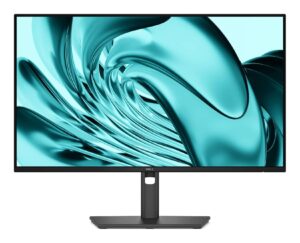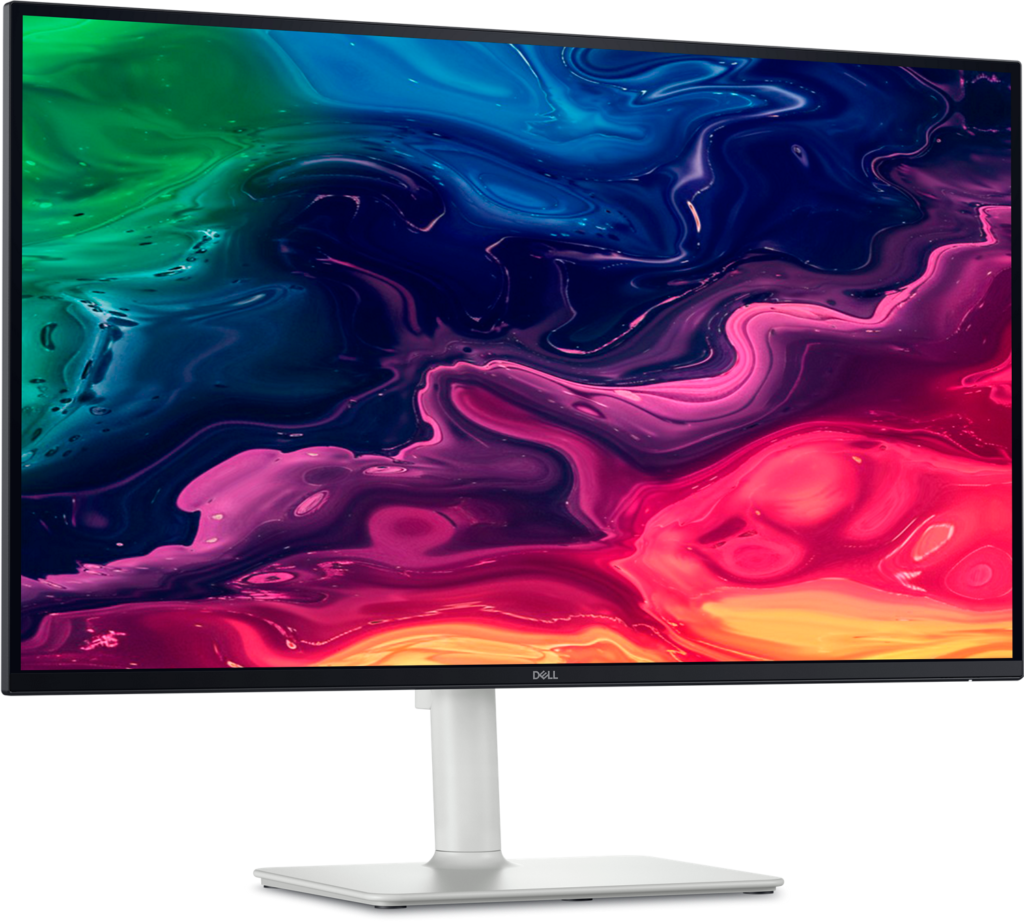
Dell S2725QC: Specs, Price, Pros & Cons
One cable from a laptop is the reason this version exists. Dell sells two near-identical models, the S2725QS and the S2725QC, with the same size, the same 4K resolution and the same 120 Hz refresh rate, and the last letter of the code marks the difference. The QS keeps a DisplayPort input, and the QC gives it up for a USB-C port that carries video, data and power to a laptop.
That makes the computer on the desk the deciding factor. A tower with a graphics card gets nothing from the USB-C port and loses an input it could have used, so the QS is the more sensible buy there. A laptop with a display-capable USB-C port is the case the QC was built for: one cable in the morning, and the laptop charges and shows its desktop on the big screen in one go.
Both versions sit in Dell's S range, the home line that sits above the plain SE models. That position explains the mix on the QC: a sharp panel, a stand with proper adjustment and a pair of built-in speakers, with the picture itself kept at a sensible everyday level. It is a monitor for the spare room or the home office, where one screen handles the working week and the occasional film.
Check the laptop before ordering. Plenty of budget and older laptops have USB-C ports that carry data and charging only, with no video, and on those machines the main advantage of the QC disappears. The laptop's own spec sheet usually lists video support as DisplayPort Alt Mode, or marks the port with a small display symbol, and a laptop without either is better paired with the QS and an ordinary cable.
Category strengths
Where the Dell S2725QC beats the median
- Has USB-C ?
- A much higher contrast ratio ?1500:1 vs 1000:1 (median)
- A much higher pixel density ?163 ppi vs 109 ppi (median)
- Has built-in speakers ?
- Has USB hub ?
Where the Dell S2725QC trails the median
- A lower refresh rate ?120 Hz vs 180 Hz (median)
- Lower peak brightness ?350 nits vs 400 nits (median)
How this VS Score was computed
Score 57: each known spec is measured against the median of IPS gaming monitors, 27 to 31 inches (29 products), then weighted; 50 means level with that median. In classes of six or more, a value beyond the class’s 10th–90th percentile range counts as that limit, so one extreme product cannot set the scale. 69% of the scoreable weight could be used; unknown values, features not applicable to this class and proxies (battery capacity where a rated life exists) add or remove nothing.
| Specification | This product | Cohort median | Score weight | Points moved |
|---|---|---|---|---|
| USB-C | Yes | 24% of the class have it | 0.5 | +25.0 |
| Height adjustment | Yes | 79% of the class have it | 0.4 | +20.0 |
| Resolution | 4K | 1440p | 1.2 | +15.6 |
| Contrast ratio | 1,500 | 1,000 | 0.6 | +15.0 |
| Adaptive sync | FreeSync | G-Sync Compatible | 0.6 | −15.0 |
| Pixel density | 163 | 109 | 0.5 | +12.5 |
| Refresh rate | 120 — capped at the class’s lower range (144) | 180 | 1.2 | −12.0 |
| Swivel | Yes | 64% of the class have it | 0.2 | +10.0 |
| Built-in speakers | Yes | 31% of the class have it | 0.2 | +10.0 |
| HDR | HDR10 | DisplayHDR 400 | 0.5 | −6.0 |
| Peak brightness | 350 | 400 | 0.8 | −4.8 |
| USB hub | Yes | 50% of the class have it | 0.05 | +2.3 |
| Pivot | Yes | 75% of the class have it | 0.02 | +1.0 |
| Screen size | 27 | 27 | 1.2 | +0.0 |
| Panel type | IPS | IPS | 0.8 | +0.0 |
| Color depth | 10 | 10 | 0.3 | +0.0 |
| Response time | 1 | 1 | 0.8 | +0.0 |
| HDMI ports | 2 | 2 | 0.4 | +0.0 |
| DisplayPort inputs | 0 — capped at the class’s lower range (1) | 1 | 0.4 | +0.0 |
| USB-C power delivery | 65 | 65 | 0.05 | +0.0 |
Not scored: DCI-P3 coverage (unknown: not scored); Local dimming (not applicable: only 17% of this class have it); Local dimming zones (unknown: not scored); Variable refresh rate (standard for the class (100% have it)); Motion blur reduction (unknown: not scored); Input lag (unknown: not scored); Tilt (standard for the class (100% have it)); Headphone output (standard for the class (86% have it)); KVM switch (not applicable: only 0% of this class have it); Webcam (not applicable: only 0% of this class have it); Microphone (not applicable: only 0% of this class have it); Ethernet (not applicable: only 0% of this class have it); Picture-by-picture (not applicable: only 14% of this class have it).
Editor’s note
The Dell S2725QC is one of the easier monitors to recommend to someone who just wants a sharp, modern desktop without overthinking it. You get a 27-inch 4K panel with a faster refresh than most budget 4K screens, so the extra smoothness on the Windows desktop and in menus is noticeable.
The headline feature is the USB-C port with 65 W power delivery. Plug in a laptop and you get video, data and charging over a single cable, which is what a laptop owner buying a 4K screen needs. Two HDMI 2.1 ports round out the inputs, and the stand is fully adjustable with height, tilt, swivel and pivot, something Dell rarely cuts from even its cheaper S-series models.
Where you have to be realistic is HDR and gaming. Dell lists HDR10 support, but with 350 nits and no local dimming it is a checkbox rather than an experience. Skip it and enjoy the accurate 99% sRGB image instead. Contrast is a typical IPS 1500:1, so blacks look gray in a dark room. FreeSync and that refresh rate make it fine for casual gaming, but competitive players will want a dedicated 144 Hz-plus panel.
This is a monitor for home-office and creative-adjacent work: spreadsheets, code, photo culling, web design and the occasional evening game. The 163 PPI density makes text razor sharp, and the built-in speakers cover video calls in a pinch.
Buy it if you want fuss-free 4K with single-cable laptop docking. Look elsewhere if HDR movies, deep contrast, or high-refresh gaming are your priority. In those cases a VA, OLED or Mini LED panel will serve you far better.
Specifications
Quality bars show where each figure sits between the lowest and highest of the 29 IPS gaming monitors, 27 to 31 inches this VS Score is measured against.
Picture
Gaming
Ergonomics & design
Connectivity
Features
Sources and verification
Where the specifications come from
- Datasheet or manualdell.com
- Independent testingrtings.com
Verification
- First published
- Specifications last checked
- Sheet completeness
- 35 of 42 specifications verified; the rest show as Unknown and are never estimated or scored
- Page type
- Product specification page — Compiled from the manufacturer’s published specifications and the cited sources; this is not a hands-on test.
- Basis
- Research-based: specifications and editorial text were compiled from the documents listed here and the manufacturer’s published data. We have not tested this unit ourselves; where independent measurements are mentioned they belong to the linked publication.
Where to buy
Prices and availability may change. Check the retailer before buying. We may earn a commission on purchases.
Price history
Monitors with similar specs to the Dell S2725QC
Ratings & reviews
No reviews yet. Be the first to share your experience.
The bottom line
The Dell S2725QC earns a VS Score of 57, above the median of the 29 IPS gaming monitors, 27 to 31 inches it is measured against (a score of 50 is level with that median).
- Who it’s for
- A home office with a laptop that wants sharp text and one-cable charging, plus the odd evening game.
- Who should look elsewhere
- HDR film fans, dark-room viewers and competitive players. The HDR is a label, the blacks are gray and the refresh rate is for casual play.
- The trade-off that matters
- Sharp text and easy docking come with an ordinary picture, so dark scenes look gray and HDR adds nothing you would notice.
- The main alternative
- Dell S2725DC: the lower-resolution sibling with a faster refresh rate and the same one-cable laptop charging, for more gaming than reading.
The VS Score is calculated from the weighted specifications above, each measured against the median of comparable IPS gaming monitors, 27 to 31 inches — a shortlisting guide, not a substitute for your own priorities. See how we score.