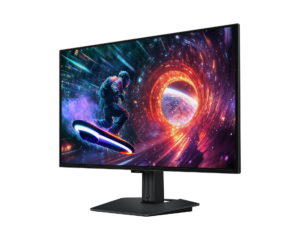
ASUS ROG Strix 5K XG27JCG: Specs, Features, Pros & Cons
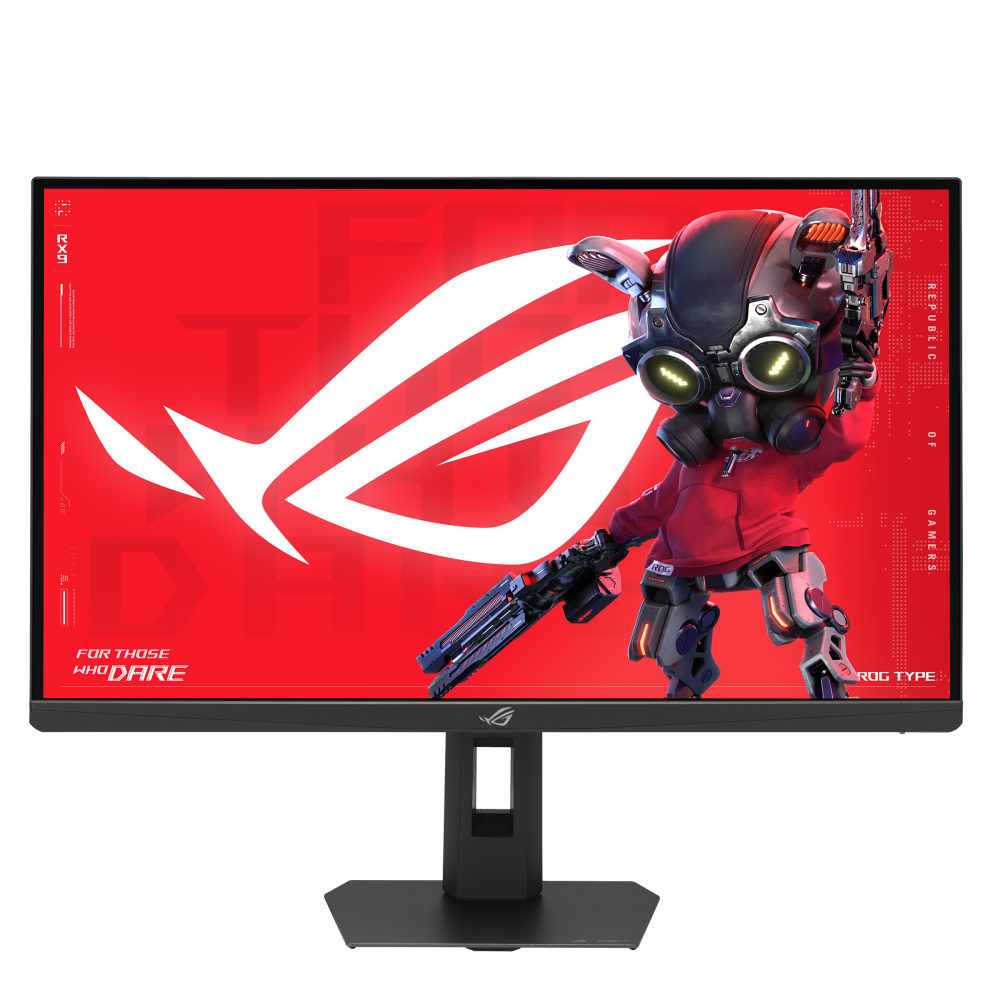
Until recently, a screen this sharp at this size belonged to office and Mac-oriented displays that topped out at a sedate refresh rate. The ROG Strix XG27JCG carries that pixel count into a gaming monitor, and that crossover is what defines it. Its resolution is exactly double QHD in each direction, which lets an operating system scale the desktop by a clean factor of two: interface elements stay the same physical size as on a QHD screen, but every letter is drawn with four times the pixels.
That makes it an unusual fit for two kinds of buyer at once. Photographers, designers and anyone who reads text all day get a display in the class of dedicated creative monitors, with wide color coverage and a properly certified HDR tier. Gamers get a fast panel with adaptive sync and a switchable lower-resolution mode for competitive titles. On a Mac, whose interface is designed around exactly this kind of two-times scaling, the fit is especially neat.
The price of that ambition is paid in two places. First, the graphics card: native resolution at high frame rates is a heavy load, and a mid-range card will spend most of its time in the fallback mode, which reduces the monitor to an expensive QHD screen. Second, the panel technology. It is still an LCD, so blacks in a dark room look gray beside an OLED, and there is no local dimming to rescue HDR highlights. Laptop owners should also note that its type-C port is not built to power a notebook.
In short, this is a work display that games very well rather than a gaming display that happens to be sharp. It is the right tool for someone whose day is split between detailed desk work and evening play on a fast PC, and a poor use of money for anyone who will never leave the lower mode.
Category strengths
Where the ASUS ROG Strix 5K XG27JCG beats the median
- A much faster response time ?0.3 ms vs 1 ms (median)
- A much higher pixel density ?219 ppi vs 109 ppi (median)
- Has USB-C ?
- Much higher peak brightness ?600 nits vs 400 nits (median)
- A much higher contrast ratio ?1500:1 vs 1000:1 (median)
- Has USB hub ?
- Slightly wider DCI-P3 colour coverage ?97 % vs 95 % (median)
Where the ASUS ROG Strix 5K XG27JCG trails the median
- Much slower USB-C charging ?15 W vs 65 W (median)
How this VS Score was computed
Score 66: each known spec is measured against the median of IPS gaming monitors, 27 to 31 inches (29 products), then weighted; 50 means level with that median. In classes of six or more, a value beyond the class’s 10th–90th percentile range counts as that limit, so one extreme product cannot set the scale. 74% of the scoreable weight could be used; unknown values, features not applicable to this class and proxies (battery capacity where a rated life exists) add or remove nothing.
| Specification | This product | Cohort median | Score weight | Points moved |
|---|---|---|---|---|
| Response time | 0.3 — capped at the class’s lower range (0.5) | 1 | 0.8 | +40.0 |
| Resolution | 5K | 1440p | 1.2 | +30.0 |
| USB-C | Yes | 24% of the class have it | 0.5 | +25.0 |
| Peak brightness | 600 | 400 | 0.8 | +20.0 |
| Height adjustment | Yes | 79% of the class have it | 0.4 | +20.0 |
| Contrast ratio | 1,500 | 1,000 | 0.6 | +15.0 |
| Motion blur reduction | Yes | 67% of the class have it | 0.3 | +15.0 |
| Pixel density | 219 — capped at the class’s upper range (163) | 109 | 0.5 | +12.5 |
| Swivel | Yes | 64% of the class have it | 0.2 | +10.0 |
| Built-in speakers | No | 31% of the class have it | 0.2 | −9.6 |
| HDR | DisplayHDR 600 | DisplayHDR 400 | 0.5 | +6.5 |
| USB hub | Yes | 50% of the class have it | 0.05 | +2.3 |
| USB-C power delivery | 15 | 65 | 0.05 | −1.7 |
| Pivot | Yes | 75% of the class have it | 0.02 | +1.0 |
| DCI-P3 coverage | 97 | 95 | 0.6 | +0.6 |
| Screen size | 27 | 27 | 1.2 | +0.0 |
| Panel type | IPS | IPS | 0.8 | +0.0 |
| Color depth | 10 | 10 | 0.3 | +0.0 |
| Refresh rate | 180 | 180 | 1.2 | +0.0 |
| Adaptive sync | G-Sync Compatible | G-Sync Compatible | 0.6 | +0.0 |
| HDMI ports | 2 | 2 | 0.4 | +0.0 |
| DisplayPort inputs | 1 | 1 | 0.4 | +0.0 |
Not scored: Local dimming (unknown: not scored); Local dimming zones (unknown: not scored); Variable refresh rate (standard for the class (100% have it)); Input lag (unknown: not scored); Tilt (standard for the class (100% have it)); Headphone output (standard for the class (86% have it)); KVM switch (not applicable: only 0% of this class have it); Webcam (not applicable: only 0% of this class have it); Microphone (not applicable: only 0% of this class have it); Ethernet (not applicable: only 0% of this class have it); Picture-by-picture (not applicable: only 14% of this class have it).
Editor’s note
Most gaming monitors ask you to choose between resolution and speed. The XG27JCG's answer is to refuse the choice: it is a 27-inch 5K panel, 5120 by 2880, running at 180 Hz.
Start with what 5K means at this size. It works out to roughly 219 pixels per inch, which is Retina-class. Text has no visible pixel structure at normal desk distance, and photo and video work benefit as much as games do. That density is the reason to buy this over a 1440p panel, and it is the reason a 27-inch screen can feel like a workstation display.
The clever part is Dual Mode. The monitor can switch to QHD and run at 330 Hz, so the same screen serves as a sharp 5K desktop for work and a fast 1440p panel for competitive play.
Two things to be honest about. Driving 5K at that refresh rate needs a serious graphics card. If yours cannot, you are paying for headroom you will not use, and the Dual Mode fallback becomes the mode you live in. And this is a Fast IPS panel, so contrast is 1,500:1. That is good for the type, but black levels are nowhere near the OLED alternatives.
The USB-C input carries only 15 W of power delivery, which is enough for a tablet or a peripheral but nowhere near enough to charge a laptop, so do not plan on single-cable docking. There are no speakers either.
Buy it if you want one screen that is both a high-resolution work display and a fast gaming one. Look elsewhere if your GPU is mid-range, or if deep blacks matter more to you than pixel density.
Specifications
Quality bars show where each figure sits between the lowest and highest of the 29 IPS gaming monitors, 27 to 31 inches this VS Score is measured against.
Picture
Gaming
Ergonomics & design
Connectivity
Features
Sources and verification
Where the specifications come from
- Official product pagerog.asus.com
- Independent testingrtings.com
Verification
- First published
- Specifications last checked
- Sheet completeness
- 37 of 42 specifications verified; the rest show as Unknown and are never estimated or scored
- Page type
- Product specification page — Compiled from the manufacturer’s published specifications and the cited sources; this is not a hands-on test.
- Basis
- Research-based: specifications and editorial text were compiled from the documents listed here and the manufacturer’s published data. We have not tested this unit ourselves; where independent measurements are mentioned they belong to the linked publication.
Monitors with similar specs to the ASUS ROG Strix 5K XG27JCG

Ratings & reviews
No reviews yet. Be the first to share your experience.
The bottom line
The ASUS ROG Strix 5K XG27JCG earns a VS Score of 66, above the median of the 29 IPS gaming monitors, 27 to 31 inches it is measured against (a score of 50 is level with that median).
- Who it’s for
- A powerful PC used for both detailed desk work and gaming. Text and photos look print-sharp, and the lower-resolution mode keeps competitive play fast.
- Who should look elsewhere
- Owners of mid-range graphics cards, dark-room film watchers, and laptop owners wanting one-cable charging. Each of those meets the monitor's weakest side.
- The trade-off that matters
- Class-leading sharpness with genuine gaming speed, in exchange for heavy graphics demands and the gray blacks of an LCD.
- The main alternative
- ASUS ROG Swift OLED PG27UCDM: the same size with somewhat lower density but true blacks and OLED motion clarity, for buyers who value contrast over sharpness.
The VS Score is calculated from the weighted specifications above, each measured against the median of comparable IPS gaming monitors, 27 to 31 inches — a shortlisting guide, not a substitute for your own priorities. See how we score.