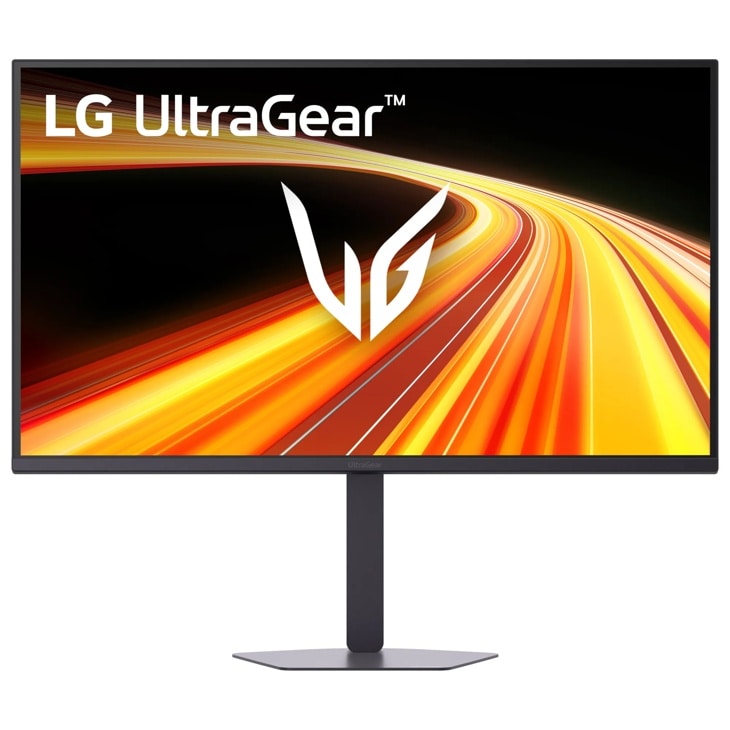
LG UltraGear G6 32G620B-B: Specs, Price, Pros & Cons
A monitor this size at 1440p is a format with a long history and a well-known compromise, and this UltraGear G6 does not try to hide it. You get a large screen that fills your view, at a resolution that mid-range graphics cards can drive at high frame rates, and you accept that text looks coarser than it would on a smaller panel with the same pixel count.
That compromise changes character depending on how you sit. At arm's length on a deep desk, or a little further back for console play, the lower density is hard to notice in games and video. Leaning in over spreadsheets and code for a full working day, you will see it. The decision is about which of those two describes your time at the screen.
LG surrounds the panel with more than this price usually buys. The stand adjusts in height and angle, adaptive sync is certified for both AMD and NVIDIA cards, and the refresh rate is comfortably beyond the needs of most players. Its connections are sensible but lean, and only one of its three inputs reaches the top refresh rate, so a PC should use that one while consoles take the other two.
There are two things it does not do. It carries no HDR certification. The HDR label means it accepts the signal, not that it can show high-contrast highlights. And there is nothing extra built in: no speakers, no USB hub and an external power brick.
For a bedroom setup shared between a console and a PC, or a first big gaming screen on a sensible budget, it is a considered choice. Anyone who mostly reads and writes at a desk will be better served by LG's smaller models with the same refresh-rate recipe.
Category strengths
Where the LG UltraGear G6 32G620B-B beats the median
- A higher refresh rate ?200 Hz vs 180 Hz (median)
- A higher contrast ratio ?1200:1 vs 1000:1 (median)
Where the LG UltraGear G6 32G620B-B trails the median
- Lower peak brightness ?300 nits vs 400 nits (median)
- A lower pixel density ?93 ppi vs 109 ppi (median)
- No USB hub ?
How this VS Score was computed
Score 45: each known spec is measured against the median of IPS gaming monitors, 27 to 31 inches (30 products), then weighted; 50 means level with that median. In classes of six or more, a value beyond the class’s 10th–90th percentile range counts as that limit, so one extreme product cannot set the scale. 68% of the scoreable weight could be used; unknown values, features not applicable to this class and proxies (battery capacity where a rated life exists) add or remove nothing.
| Specification | This product | Cohort median | Score weight | Points moved |
|---|---|---|---|---|
| USB-C | No | 24% of the class have it | 0.5 | −24.0 |
| Local dimming | No | 21% of the class have it | 0.4 | −19.2 |
| Swivel | Yes | 66% of the class have it | 0.2 | +10.0 |
| Peak brightness | 300 | 400 | 0.8 | −9.6 |
| Built-in speakers | No | 30% of the class have it | 0.2 | −9.6 |
| Refresh rate | 200 | 180 | 1.2 | +7.2 |
| Contrast ratio | 1,200 | 1,000 | 0.6 | +6.0 |
| HDR | HDR10 | DisplayHDR 400 | 0.5 | −6.0 |
| Pixel density | 93 | 109 | 0.5 | −3.5 |
| USB hub | No | 50% of the class have it | 0.05 | −2.2 |
| Pivot | Yes | 76% of the class have it | 0.02 | +1.0 |
| Screen size | 31.5 — capped at the class’s upper range (27) | 27 | 1.2 | +0.0 |
| Resolution | 1440p | 1440p | 1.2 | +0.0 |
| Panel type | IPS | IPS | 0.8 | +0.0 |
| Color depth | 10 | 10 | 0.3 | +0.0 |
| Response time | 1 | 1 | 0.8 | +0.0 |
| Adaptive sync | G-Sync Compatible | G-Sync Compatible | 0.6 | +0.0 |
| HDMI ports | 2 | 2 | 0.4 | +0.0 |
| DisplayPort inputs | 1 | 1 | 0.4 | +0.0 |
Not scored: DCI-P3 coverage (unknown: not scored); Local dimming zones (unknown: not scored); Variable refresh rate (standard for the class (100% have it)); Motion blur reduction (unknown: not scored); Input lag (unknown: not scored); Height adjustment (standard for the class (80% have it)); Tilt (standard for the class (100% have it)); USB-C power delivery (unknown: not scored); Headphone output (standard for the class (87% have it)); KVM switch (not applicable: only 0% of this class have it); Webcam (not applicable: only 0% of this class have it); Microphone (not applicable: only 0% of this class have it); Ethernet (not applicable: only 0% of this class have it); Picture-by-picture (not applicable: only 20% of this class have it).
Editor’s note
The 32G620B-B answers a specific wish: a big gaming monitor with a proper stand and a proper refresh rate, without a high price. A 31.5-inch QHD IPS panel at 200 Hz with both FreeSync Premium and G-Sync certification, on a stand that adjusts four ways including 130 mm of height, at a street price that has dipped to the low two hundreds, is a combination the spec sheet market rarely offers.
The numbers LG publishes are worth reading with care. Brightness is 300 nits typical and contrast 1200:1. These are respectable IPS figures with no HDR certification behind them, and the HDR10 badge is decode-only. LG sells the visually identical 27-inch 27G610A-B with DisplayHDR 400. This 32 does not get that, and the difference is real. Note also that LG's own spec row says 31.5 inches, not the 32 in the marketing name.
The size itself is the honest trade-off. QHD stretched across this panel lands at 93 ppi, noticeably coarser for text than the same resolution at 27 inches. For gaming at normal distances it looks fine. For all-day documents it is the compromise you are accepting in exchange for the immersion.
Connectivity is lean but sensible: two HDMI 2.0 ports and a DisplayPort 1.4, and the HDMI version means the full refresh rate requires DisplayPort. No speakers, no USB anything, external power brick.
For a console-plus-PC bedroom setup or a first big gaming screen, I would pick this over most 32-inch rivals on the strength of the stand and the dual sync certifications alone. Text workers should buy the 27-inch version of exactly this monitor instead.
Specifications
Quality bars show where each figure sits between the lowest and highest of the 30 IPS gaming monitors, 27 to 31 inches this VS Score is measured against.
Picture
Gaming
Ergonomics & design
Connectivity
Features
Sources and verification
Where the specifications come from
- Official product pagelg.com
- Retailer listing (cross-check)amazon.com
Verification
- First published
- Specifications last checked
- Sheet completeness
- 37 of 42 specifications verified; the rest show as Unknown and are never estimated or scored
- Page type
- Product specification page — Compiled from the manufacturer’s published specifications and the cited sources; this is not a hands-on test.
- Basis
- Research-based: specifications and editorial text were compiled from the documents listed here and the manufacturer’s published data. We have not tested this unit ourselves; where independent measurements are mentioned they belong to the linked publication.
Where to buy
Prices and availability may change. Check the retailer before buying. We may earn a commission on purchases.
Price history
Monitors with similar specs to the LG UltraGear G6 32G620B-B
Ratings & reviews
No reviews yet. Be the first to share your experience.
The bottom line
The LG UltraGear G6 32G620B-B earns a VS Score of 45, below the median of the 30 IPS gaming monitors, 27 to 31 inches it is measured against (a score of 50 is level with that median).
- Who it’s for
- A big-screen gaming setup on a value budget, especially one shared between a PC and a console, where the four-way stand and dual sync certification earn their keep.
- Who should look elsewhere
- All-day text work, where this size and resolution look visibly coarser than a smaller screen, and anyone wanting real HDR, which it lacks entirely.
- The trade-off that matters
- Immersion for the money against pixel density: the screen is big and fast, but softer for text and without any HDR certification.
- The main alternative
- LG UltraGear 27G61ZB-B: the same fast QHD recipe on a smaller, sharper screen, if desk-distance clarity matters more than size.
The VS Score is calculated from the weighted specifications above, each measured against the median of comparable IPS gaming monitors, 27 to 31 inches — a shortlisting guide, not a substitute for your own priorities. See how we score.