Keychron B11 Pro: Specs, Price, Pros & Cons
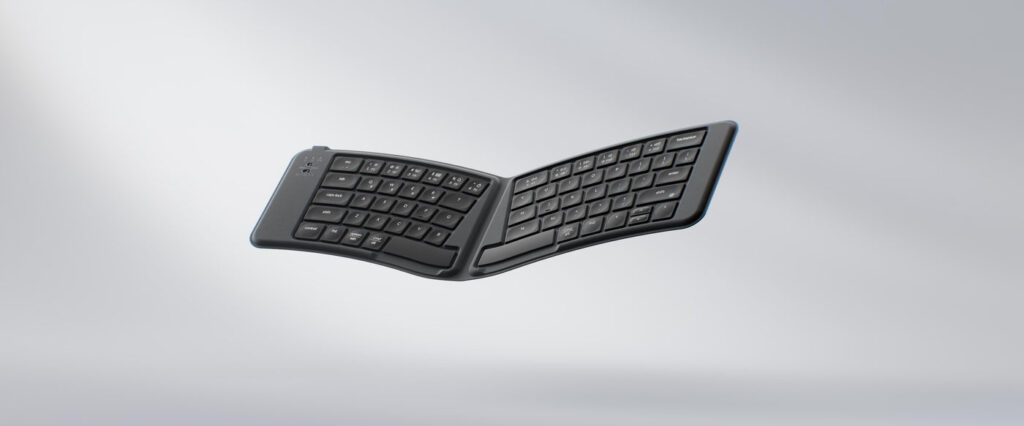
Fold the B11 Pro in half and it turns itself off, which is how Keychron made an Alice-layout ergonomic keyboard fit inside a laptop sleeve.
An Alice layout splits the letter keys into two angled halves so the wrists sit straighter, and it gives the B key a copy on each side of the split. Folding boards are usually flat slabs with cramped rows. This one keeps the angle when it opens, and the hinge sits where the halves already part.
Under the keys are scissor switches, the short and quiet mechanism of a laptop, and there is no backlight. It connects over a cable, a receiver or Bluetooth to three devices, and remapping runs in Keychron's Launcher in a browser with nothing to install. The layout is compact, with arrow keys kept and the number pad and function row gone, and the keycaps are ABS. Battery life is short for a wireless keyboard, the switches are soldered and there is no sound dampening, and all three follow from building a board this thin and light. Two things take adjustment on top of that. The split layout costs most newcomers a week or two of wrong letters, and the missing backlight shows most in the places a travel keyboard ends up, from hotel rooms to night trains.
The buyer Keychron had in mind types for hours away from a desk, has wrists that object to a flat laptop deck, and wants one small board that follows the laptop. As the only keyboard in a home, it leaves you without backlighting or a deeper stroke.
Category strengths
Where the Keychron B11 Pro trails the median
- No hot-swappable switches ?
- Much shorter battery life ?138 h vs 325 h (median)
- No sound dampening ?
- No rotary knob ?
How this VS Score was computed
Score 25: each known spec is measured against the median of all keyboards (101 products), then weighted; 50 means level with that median. In classes of six or more, a value beyond the class’s 10th–90th percentile range counts as that limit, so one extreme product cannot set the scale. 58% of the scoreable weight could be used; unknown values, features not applicable to this class and proxies (battery capacity where a rated life exists) add or remove nothing.
| Specification | This product | Cohort median | Score weight | Points moved |
|---|---|---|---|---|
| Hot-swappable | No | 61% of the class have it | 0.6 | −28.8 |
| Rapid trigger | No | 25% of the class have it | 0.5 | −24.0 |
| Adjustable actuation | No | 24% of the class have it | 0.4 | −19.2 |
| Battery life | 138 | 325 | 0.6 | −17.4 |
| Switch technology | Membrane | Mechanical | 1 | −17.0 |
| Sound dampening | No | 76% of the class have it | 0.3 | −14.4 |
| Backlight | None | RGB | 0.3 | −14.4 |
| Keycap material | ABS | PBT | 0.4 | −10.0 |
| Rotary knob | No | 53% of the class have it | 0.2 | −9.6 |
| Polling rate | 1,000 | 1,000 | 0.7 | +0.0 |
| Connection | 3 | 3 | 0.8 | +0.0 |
| Bluetooth devices | 3 | 3 | 0.3 | +0.0 |
Not scored: Actuation force (unknown: not scored); N-key rollover (unknown: not scored); Analog input (not applicable: only 14% of this class have it); Wired latency (unknown: not scored); Wireless latency (unknown: not scored); Front height (unknown: not scored); Battery capacity (capacity is a proxy; the rated battery life is scored instead); USB passthrough (not applicable: only 4% of this class have it); Programmable keys (standard for the class (99% have it)); Media controls (standard for the class (97% have it)); Onboard profiles (unknown: not scored); Configuration software (standard for the class (95% have it)).
Editor’s note
The B11 Pro is Keychron doing something unusual: a 258-gram Alice-layout keyboard that folds in half and switches itself off with a Hall sensor when you close it. Most folding travel keyboards are cramped slabs with mushy domes and no ergonomic ambition at all, so an angled, split-feel layout you can drop into a laptop sleeve is a real idea.
The switches are scissor mechanisms, like a laptop keyboard's. Typing feel will be closer to a MacBook than to an Air75. There is no backlight at all, which matters more on the road than at a desk, because hotel rooms and red-eye flights are exactly where you would want it. And Bluetooth polls at 125 Hz, so if you care about latency, use the 2.4 GHz receiver or the cable, both of which run at a proper 1000 Hz.
The Alice layout itself deserves a warning for newcomers: the split B key and angled halves can take a week or two of mistyping before it clicks. If you have never typed on an Alice board, expect an adjustment period on a keyboard you presumably bought to be productive while traveling.
What won me over on paper is the practicality of the package: three-device switching, a claimed 138 hours of battery, USB-C wired mode as a fallback, and web-based remapping through Keychron's Launcher, with no driver to install on every machine. It undercuts most serious portable boards.
I would choose this if I worked from cafes or planes weekly and my wrists complained on a flat laptop keyboard. I would skip it if I wanted one keyboard for home and travel. The scissor feel and missing backlight make it a poor only-keyboard, and a low-profile mechanical like the NuPhy Air75 V3 is the better single-board compromise.
Specifications
Quality bars show where each figure sits between the lowest and highest of the 101 keyboards this VS Score is measured against.
Switches & typing
Performance
Layout & size
Connectivity
Build & sound
Features
Sources and verification
Where the specifications come from
- Official product pagekeychron.com
- Retailer listing (cross-check)amazon.com
Verification
- First published
- Specifications last checked
- Sheet completeness
- 24 of 34 specifications verified; the rest show as Unknown and are never estimated or scored
- Page type
- Product specification page — Compiled from the manufacturer’s published specifications and the cited sources; this is not a hands-on test.
- Basis
- Research-based: specifications and editorial text were compiled from the documents listed here and the manufacturer’s published data. We have not tested this unit ourselves; where independent measurements are mentioned they belong to the linked publication.
Where to buy
Prices and availability may change. Check the retailer before buying. We may earn a commission on purchases.
Price history
Keyboards with similar specs to the Keychron B11 Pro
Ratings & reviews
No reviews yet. Be the first to share your experience.
The bottom line
The Keychron B11 Pro earns a VS Score of 25, below the median of the 101 keyboards it is measured against (a score of 50 is level with that median).
- Who it’s for
- Frequent travelers with wrist strain who type for hours away from a desk. The folding Alice layout packs ergonomics into a laptop sleeve at 258 g, and tri-mode connectivity covers a phone, tablet and laptop at once.
- Who should look elsewhere
- Anyone buying their only keyboard, or who types in dim rooms. The scissor switches feel like a laptop, there is no backlight at all, and Alice newcomers face a real adjustment period.
- The trade-off that matters
- Extreme portability against typing depth: to fold flat and weigh nothing it gives up mechanical switches, backlighting and a rigid one-piece deck, which is fine on a tray table but limiting as a daily driver.
- The main alternative
- NuPhy Air75 V3: still portable, but with real low-profile mechanical switches and backlighting, if your bag has room for a board that does not fold.
The VS Score is calculated from the weighted specifications above, each measured against the median of comparable keyboards — a shortlisting guide, not a substitute for your own priorities. See how we score.