Robot vacuums have come a long way. A few years ago, many models bumped into furniture, missed corners, got stuck on cables, and cleaned in a messy pattern. Now, in 2026, the better ones feel much more useful. They map rooms, empty themselves, avoid some objects, mop lightly, and clean on a schedule.
Still, a robot vacuum is not magic. It will not replace every type of cleaning. It will not deep clean thick carpet like a strong upright vacuum. It will not scrub dried sauce from the kitchen floor like a proper mop. Plus, it still needs maintenance.
So, are robot vacuums worth it in 2026? For many homes, yes. They make daily floor care easier and keep dust, crumbs, and pet hair under control. For other homes, the money may be better spent on a cordless stick vacuum or a full-size upright vacuum.
Why Robot Vacuums Are More Useful in 2026
The biggest change is not only stronger suction. The real upgrade is automation.
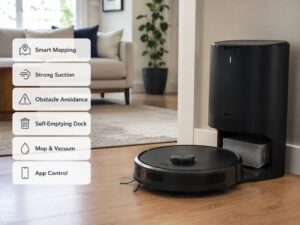
Many newer robot vacuums now include:
- Smart room mapping
- Self-emptying docks
- App-based schedules
- Room-by-room cleaning
- No-go zones
- Better pet hair pickup
- Carpet detection
- Mop lifting
- Mop washing docks
- Hot air mop drying
- Better anti-tangle brush rollers
- Improved object avoidance
As a result, a good robot vacuum now feels less like a toy and more like a daily cleaning helper. You can tell it to clean the kitchen after dinner, skip the pet bowl area, or clean only the hallway after people come home.
For example, a model with LiDAR mapping can scan your rooms and create a useful floor plan. Then, you can choose which rooms it cleans and which areas it avoids. That sounds simple, but it makes the robot much easier to live with.
What Robot Vacuums Do Best
Robot vacuums work best as daily maintenance cleaners. They are great at picking up small messes before they build up.
They are especially useful for:
- Dust on hard floors
- Pet hair
- Kitchen crumbs
- Dirt near entry doors
- Hair under beds and sofas
- Light debris on low-pile rugs
- Cleaning between deeper vacuum sessions
For this reason, a robot vacuum gives the most value when it runs often. One cleaning run per week will not feel that impressive. Daily cleaning, or cleaning every other day, makes a much bigger difference.
Over time, the floor simply stays cleaner. You see fewer dust balls. Pet hair does not gather as fast. Crumbs do not sit around all day. Plus, you spend less time doing quick cleanups with a regular vacuum.
Where Robot Vacuums Still Fall Short
Even the best robot vacuums still have limits.
They can struggle with:
- Thick carpets
- High rugs
- Loose cables
- Small toys
- Socks on the floor
- Wet spills
- Sticky stains
- Deep corners
- Stairs
- Tall thresholds
- Very dark rugs on some models
- Cluttered rooms
A robot vacuum also cannot clean your sofa, mattress, shelves, stairs, car, or ceiling corners. So, it should not be your only cleaning tool.
This matters most if you have a carpet-heavy home. A robot can help with surface dirt, but it will not pull deep dust from thick carpet as well as a strong upright vacuum. For a closer comparison, this guide on robot vacuum vs upright vacuum is useful if you are trying to decide which type fits your home better.
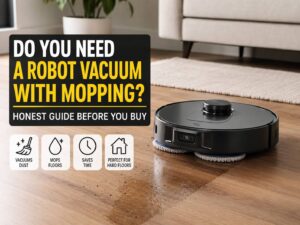
Are Robot Vacuum and Mop Combos Worth It?
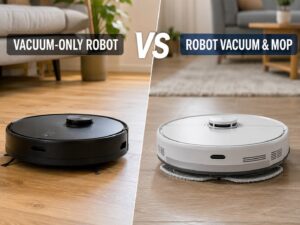
Robot vacuum and mop combos are much better now than older models. Basic robot mops used to drag a damp pad across the floor. That helped with fine dust, but it did not clean sticky dirt very well.
Newer models can use spinning mop pads, roller mops, mop lifting, mop washing, and hot air drying. Some high-end docks can even wash mop pads with warm or hot water. That makes them much more practical for hard floors.
Still, robot mops are best for light cleaning. They can freshen up tile, vinyl, laminate, and sealed hardwood. They can remove dust and light marks. Yet they still struggle with dried food, heavy grease, muddy footprints, and sticky spills.
So, a robot mop is worth it if you want your floors to feel cleaner during the week. It is not worth it if you expect it to replace manual scrubbing.
The Main Benefits You Notice Over Time
A robot vacuum does not always impress people on day one. The bigger benefit shows up after a few weeks.
You may notice:
- Less dust on hard floors
- Less pet hair under furniture
- Cleaner kitchen floors
- Fewer crumbs near the dining area
- Less dirt near entryways
- Less need for quick vacuum sessions
- Cleaner floors with less effort
That is why robot vacuums are popular with pet owners, busy families, and people who hate daily vacuuming. They reduce the small messes that make a home feel dirty.
Plus, they clean areas that are easy to skip. Under beds, under sofas, and under low tables can collect dust fast. A slim robot can reach those spots more often than you would by hand.
The Real Issues Owners Run Into
Robot vacuums sound great, but real homes are messy. That is where problems start.
Common complaints include:
- The robot gets stuck under furniture
- It tangles cables
- It drags socks around
- It misses tight corners
- It leaves streaks after mopping
- It needs frequent brush cleaning
- The dock bag fills faster than expected
- The app map sometimes needs fixing
- The dirty water tank can smell
- It struggles with thresholds
- It bumps lightweight objects
Still, many of these issues are manageable. You can lift cables, create no-go zones, clean sensors, and choose better schedules. Also, newer obstacle avoidance systems help more than older bump-and-turn robots.
Even so, you should expect some maintenance. A self-cleaning dock reduces work, but it does not remove it completely.
Hidden Costs You Should Know Before Buying
A robot vacuum is not a one-time purchase. You will need replacement parts and cleaning supplies.
Common extras include:
- Dust bags
- Filters
- Side brushes
- Main brush rollers
- Mop pads
- Cleaning solution for some models
- Replacement parts after long use
You will also need to clean the robot itself. Hair can wrap around the brush. Dust can cover sensors. Mop pads can smell if they stay damp. Dirty water tanks need rinsing.
For this reason, premium robots can still feel annoying if you expect zero work. They save time, but they still need basic care.
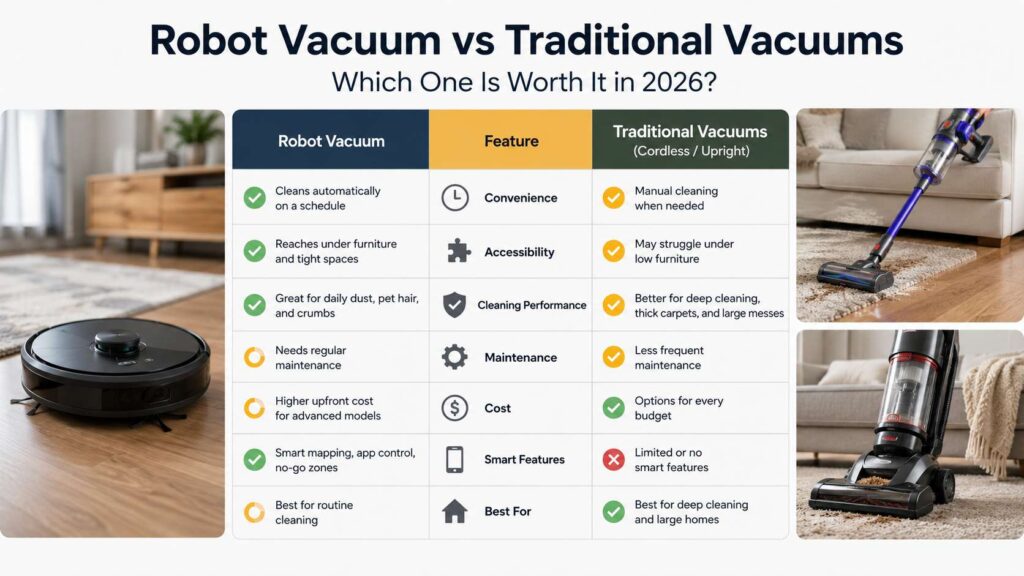
Robot Vacuum vs Cordless Vacuum
A robot vacuum and a cordless vacuum serve different jobs.
A robot vacuum is better for scheduled daily cleaning. It runs by itself and keeps light dust, crumbs, and hair under control. A cordless vacuum is better for quick spot cleaning, stairs, furniture, car interiors, and messes the robot cannot reach.
For example, if you spill cereal, a cordless vacuum is faster. If your dog sheds every day, a robot vacuum can quietly manage that hair in the background.
That is why having both can work best. The robot handles daily floor maintenance. The cordless vacuum handles deeper or faster manual cleaning. If you are comparing the two, this full guide on robot vacuum vs cordless vacuum explains the practical difference well.
Cheap vs Premium Robot Vacuums in 2026
Cheap robot vacuums can still be useful, but the gap between budget and premium models is real.
A basic model may work fine in a small apartment with hard floors. Still, it may have weaker mapping, weaker suction, smaller bins, and fewer dock features.
Mid-range models often give the best value. Many include smart mapping, self-emptying docks, better suction, decent app controls, and basic mopping.
Premium models add more comfort. They may wash mop pads, dry them, lift mops over carpet, avoid more objects, clean edges better, and handle pet hair with less tangling.
That said, the most expensive model is not always the smartest buy. A small hard-floor apartment does not need a huge dock with every feature. A large home with pets, rugs, and busy rooms will benefit more from advanced features.
Are Robot Vacuums Good for Pet Hair?
Yes, robot vacuums can be very useful for pet hair. In fact, pet owners often get the most value from them.
Pet hair builds up fast. A robot that runs daily can collect hair before it forms clumps. It can also clean under furniture, where fur often hides.
For pets, look for:
- Strong suction
- Rubber brush rollers
- Anti-tangle design
- Self-emptying dock
- Good filtration
- Smart mapping
- Object avoidance
- Easy brush cleaning
Still, pet owners need to be careful. Pet toys, food bowls, and accidents can cause problems. If your pet has indoor accidents, check the floor before running the robot. No obstacle system is perfect.
Are Robot Vacuums Good on Carpet?
Robot vacuums can handle low-pile carpet and rugs fairly well. They can pick up hair, dust, and surface dirt. Many models boost suction automatically on carpet, which helps.
Thick carpet is different. A robot vacuum has a small motor and a compact brush system. It cannot match the deep cleaning power of a strong upright vacuum.
So, if your home has mostly hard floors with some rugs, a robot vacuum makes sense. If your home has mostly thick carpet, use the robot as a helper, not your main vacuum.
Are Robot Vacuums Good for Apartments?
Apartments are often a great fit for robot vacuums.
They usually have:
- Smaller floor areas
- Fewer rooms
- Simpler layouts
- More hard flooring
- Shorter cleaning runs
A robot can clean during work hours or after dinner. Plus, a self-emptying dock means you do not need to empty the bin every day.
Noise is still worth thinking about. Self-emptying docks can be loud for a few seconds. So, in a small apartment, it is better to schedule emptying during the day rather than late at night.
Are Robot Vacuums Good for Large Homes?
Large homes need a better robot. Battery life, mapping, dock placement, and room layout matter more.
For a bigger home, look for:
- Multi-room mapping
- Multi-floor maps
- Recharge and resume cleaning
- Strong battery life
- Self-emptying dock
- Reliable app controls
- Good obstacle avoidance
- Room-specific settings
A cheaper robot may get lost or need more help in a large home. Also, remember that a robot vacuum cannot move between floors on its own. If you have two or three levels, you need to move it manually or buy more than one robot.
Privacy and Camera Concerns
Some robot vacuums use cameras for object detection. Others use LiDAR, infrared sensors, structured light, or mixed systems.
Camera-based models can spot objects better in some situations. Still, a camera moving through your home is a fair privacy concern.
Before buying, check:
- Whether the robot has a camera
- What the camera is used for
- Whether object photos appear in the app
- Whether images are stored
- Whether camera features can be turned off
- What privacy controls the brand offers
If privacy matters a lot to you, a LiDAR-based robot without a live camera feature may feel like the better choice.
Features Worth Paying For
Some robot vacuum features matter more than others.
Worth paying for:
- Smart mapping
- LiDAR navigation
- Self-emptying dock
- No-go zones
- Room-by-room cleaning
- Anti-tangle brush design
- Carpet detection
- Good app controls
- Replaceable parts
- Mop lifting for homes with rugs
- Mop washing and drying for regular mopping
- Object avoidance for homes with pets or kids
Usually less important:
- Huge suction numbers without good brush design
- Fancy lights
- Voice gimmicks
- Oversized docks for small flats
- Advanced mopping for mostly carpeted homes
- Camera features if your floors stay clear
Suction matters, of course. Still, cleaning performance comes from the full design. The brush, wheels, mapping, floor contact, and dock all matter.
Who Should Buy a Robot Vacuum in 2026?
A robot vacuum is worth buying if you:
- Have pets
- Have hard floors
- Have low-pile rugs
- Hate daily vacuuming
- Want scheduled cleaning
- Live in a busy home
- Can keep floors fairly clear
- Deal with dust and crumbs every day
- Want cleaner floors with less effort
- Do not mind basic maintenance
For these homes, a robot vacuum can feel like money well spent. It saves small chunks of time every week, and it keeps the home feeling cleaner.
Who Should Skip One?
A robot vacuum may not be worth it if you:
- Have mostly thick carpet
- Have many stairs
- Leave cables and toys on the floor
- Need deep cleaning more than daily upkeep
- Hate cleaning filters and brushes
- Do not want to use an app
- Expect perfect mopping
- Need spotless corners and baseboards
- Have many high thresholds
In those cases, a cordless vacuum or upright vacuum may give better results for the money.
How Much Should You Spend?
Most people should look at the mid-range first. A robot vacuum with smart mapping, a self-emptying dock, good suction, and basic obstacle handling will cover the basics well.
Spend more if you have pets, mixed flooring, regular mopping needs, or lots of furniture. Premium models can reduce daily effort, mainly if the dock washes and dries mop pads.
Spend less if you live in a small apartment with simple hard floors. You may not need every feature.
The key is to buy for your real home. Do not pay extra for advanced mopping if you have mostly carpet. Do not buy a basic random-navigation robot for a large home with many rooms. Match the robot to your floor plan, not just your budget.
Final Verdict: Are Robot Vacuums Actually Worth It in 2026?
Yes, robot vacuums are worth it in 2026 for many homes. They are better at mapping, better at scheduled cleaning, and much better at handling daily dust and pet hair than older models.
Still, they work best as maintenance cleaners. They keep floors cleaner between deeper vacuum sessions. They do not fully replace an upright vacuum, a cordless vacuum, or a real mop.
If you have hard floors, pets, low-pile rugs, and a busy schedule, a robot vacuum can be a smart buy. If your home has thick carpet, lots of clutter, and many stairs, the value drops fast.
The best robot vacuum is not always the most expensive one. It is the one that fits your home, your floor type, and your cleaning habits. Choose it that way, and it can make daily cleaning feel much easier.