
Midjourney built its name on AI images. People used it to create fantasy art, product mockups, portraits, ad ideas, and strange visual scenes that felt hard to imagine a few years ago. Now the company has made a sharp turn into health tech, and the move has surprised almost everyone watching the AI space.
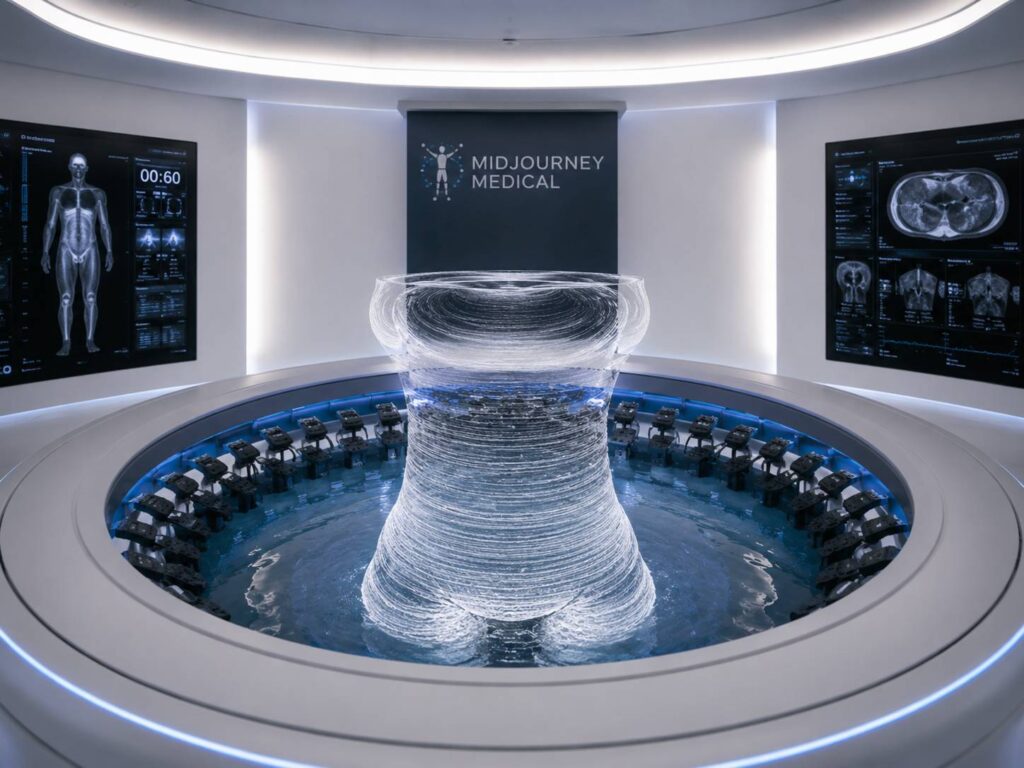
The new project is called Midjourney Medical. Its first major product is a full-body ultrasound scanner called Ultrasonic CT. The machine uses sound, water, sensors, and AI to build a 3D view of the body. It does not use radiation. It does not need strong magnets. It does not place a person inside a long MRI tube.
That alone makes the project stand out. Still, the bigger story is the company behind it. Most people expected Midjourney to focus on image models, video tools, 3D design, or creative software. Instead, it is working on a scanner that aims to turn the human body into a detailed visual map.
This is not a tiny side idea. Midjourney says it wants about 50,000 scanners around the world over the next six years. It has also talked about a target of up to one billion full-body scans each month. That number sounds huge, but it shows how serious the company wants this project to become.
What Midjourney Medical Is Building
The Midjourney Scanner is a full-body ultrasound machine built around a water-based scan. A person steps onto a platform, then moves down through water. Around the body, a ring of underwater sensors sends ultrasound waves from many angles. Those sensors then read how the sound moves through tissue.
Next, software turns those wave patterns into images. Midjourney says the system can build a 3D body map with fine detail. Early scan examples show reconstructed slices and AI segmentation. That means the system tries to identify tissue types and body parts inside the scan.
This works very differently from the ultrasound most people know from clinics. A standard ultrasound often uses a handheld probe. A trained operator moves that probe over one area, such as the abdomen, heart, thyroid, or shoulder. Midjourney wants a more automatic scan that covers the full body in one session.
The company says the scan can take about 60 seconds. That speed matters. MRI scans often take much longer. They can cost more, need more staff, and require large machines that many clinics cannot buy. So a fast water-based ultrasound scanner has clear appeal, mainly for people who want repeat body tracking.
Why Water Matters in This Scanner
Water has a practical role in the system. Ultrasound travels well through water, and the body can pass through the sensor ring without direct pressure from a probe. That detail matters since pressure from a handheld probe can change the shape of soft tissue during a scan.
The water setup also gives the product a spa-like feel. Midjourney does not plan to launch the first scanners in a standard clinic. Instead, it plans to open a Midjourney Spa in San Francisco near the end of 2027. The location is expected to include hot tubs, saunas, cold plunges, and 10 scanners.
At first, that sounds odd. Then the idea starts to make more sense. Midjourney wants body scanning to feel normal, simple, and less clinical. A person visits a spa, gets scanned, and builds a record of body changes over time.
That idea will split opinions. Some people will love the thought of routine body data. Others will worry about privacy. Both reactions are fair. Health data has real value, and it needs serious protection.
The Butterfly Network Connection
Midjourney is not building this scanner from nothing. Butterfly Network has confirmed a co-development partnership with Midjourney. Butterfly is known for chip-based ultrasound, and its Ultrasound-on-Chip technology uses semiconductor sensors instead of traditional piezoelectric crystals.
That detail matters for size, cost, and software control. A chip-based ultrasound system can place many tiny transducer elements into a compact design. Butterfly has already used this idea in handheld whole-body ultrasound probes. Midjourney’s scanner takes that idea into a much larger, more automatic format.
The partnership gives Midjourney a real hardware base. It also helps explain why an AI image company has entered medical imaging. Midjourney understands image generation and reconstruction. Butterfly understands ultrasound hardware. Together, the two companies are working in the space between sensors, images, and AI.
What the Scanner Can Do First
Midjourney says the early version starts with body composition maps. That means the scanner can track muscle, fat, bone, organs, and other body structures. The company frames this as a way to watch the body change over time.
For example, a person can track fitness progress, muscle gain, fat loss, or body shape changes after a new training plan. In my view, that use case feels more realistic for the first version than broad disease detection. Body composition tracking fits a wellness setting better than medical diagnosis.
Midjourney has said diagnostic use needs FDA approval. That point matters. A scanner can create impressive images and still lack clearance for diagnosis. People should not treat early wellness scans as a replacement for a doctor, an MRI, a CT scan, blood tests, or normal medical imaging.
So the useful first step is tracking and education. The harder step is diagnosis, screening, and clinical decision-making. That second step needs testing, approval, and trust.
Why People Compare It to MRI
People keep talking about MRI since Midjourney’s goal touches the same broad area: detailed internal imaging. MRI machines can show soft tissue in great detail, and doctors use them for many serious checks.
Still, ultrasound and MRI work in different ways. Ultrasound reads sound waves. MRI reads signals from the body under strong magnetic fields. Each method has strengths, limits, and proper use cases.
For that reason, nobody should say Midjourney has replaced MRI. It has not. The better point is this: Midjourney wants to make full-body internal imaging faster, cheaper, and easier to repeat. That goal is big enough.
If the system keeps improving, it can sit between basic wellness trackers and high-end medical scans. That middle space is where this project becomes worth watching.
Privacy Will Make or Break the Product
The scanner’s greatest asset is data. A person who scans often can build a long-term record of internal body changes. That record can help doctors, trainers, dietitians, or AI health tools spot patterns.
Still, the same data creates risk. Full-body scans reveal private details. Users need clear answers on storage, access, deletion, sharing, consent, and security. Midjourney says more data policy details will come closer to launch. A short privacy note will not be enough for a product like this.
Health data works only with trust. A polished scanner and a spa-like room will not carry the product alone. People need to know who sees their scans, how long the data stays stored, and what happens after they leave the service.
The same issue appears across consumer tech. A product can look simple on the outside, but the real value often sits inside the data it collects. Readers who compare tech features in daily products, such as an all-in-one printer vs printer-only model, already know that the most useful choice often comes down to what the device actually does over time, not only what it promises on the box.
Why This Move Fits Midjourney
At first, the scanner feels like a strange turn. After a closer look, it fits Midjourney better than it seems.
Midjourney built a business around turning complex data into images people can understand. Medical imaging has a similar core task. Machines collect complex signals. Software turns those signals into pictures. People then use those pictures to make choices.
The stakes are much higher here. A bad AI image is annoying. A bad health scan can cause fear, missed care, or false confidence. That is why regulation, testing, and clinical proof matter so much.
My opinion is simple: Midjourney’s scanner is exciting, but the launch story should stay grounded. The wellness version sounds realistic for the near term. The medical version needs time, proof, and approval.
What Happens Next
The next phase will likely center on research trials, image quality, hardware changes, and the first spa buildout. Midjourney says the first San Francisco location should open near the end of 2027. The company has also talked about a third-generation scanner in 2028 with custom silicon and stronger image quality.
The key question is not whether the scanner looks impressive in a demo. The real test is repeat performance. Can it scan different body types well? Can it create useful data every time? Can it handle motion, water movement, and normal daily use? Can it protect user data? Can it pass medical review for future diagnostic claims?
If Midjourney answers those questions well, this project can become one of the most unusual health tech launches of 2026 and beyond.
The Bottom Line
Midjourney’s full-body ultrasound scanner is not what people expected from an AI image company. Yet the move is not random. It connects imaging, sensors, AI, and personal health data in one product.
For now, the first version should be seen as a wellness and body tracking system, not a hospital-grade diagnostic tool. The bigger promise sits further ahead. Fast full-body scans can help people see changes in their bodies sooner and more often.
That promise will matter only if the scanner proves accurate, safe, private, and useful in real life. Midjourney Medical has a bold idea. Now it needs proof.