Why smoke needs a stronger air purifier
Smoke is harder to clean than normal household dust. It carries fine particles, gases, and odor that can sit in a room long after the smoke looks gone. Wildfire smoke, cigarette smoke, cigar smoke, fireplace smoke, and cooking smoke all create a heavier air problem than pollen or pet hair.
First, the biggest concern is PM2.5. These fine particles are small enough to stay in the air for hours. They can pass through weak filters, and they can spread from one room to another. So, a small purifier made for light dust will not do enough during smoky days.
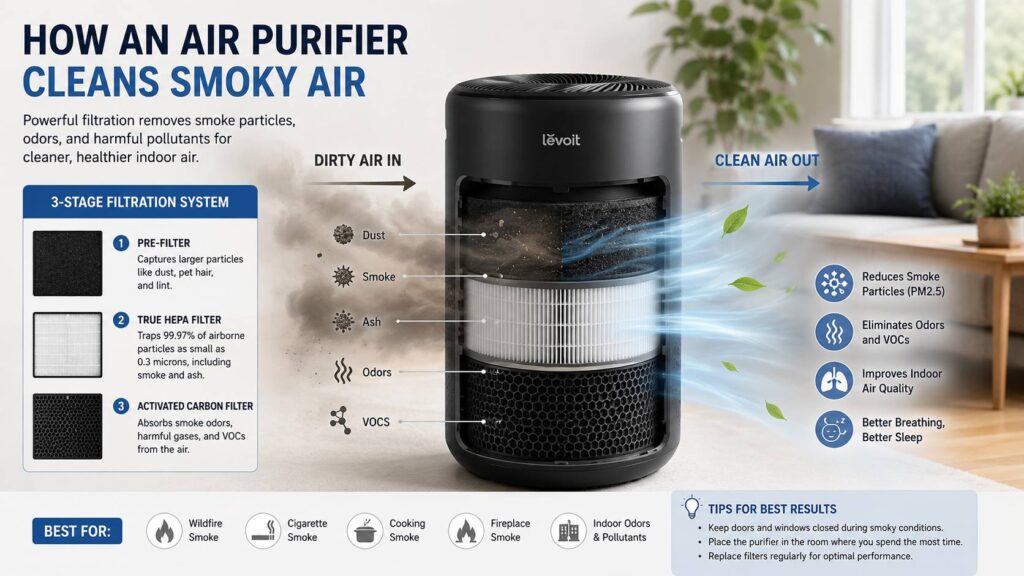
Next, smoke smell needs a different filter. A HEPA filter handles tiny particles, but activated carbon handles odor. For that reason, the best air purifiers for smoke need both strong particle filtration and a proper carbon filter.
This matters most in bedrooms, living rooms, home offices, nurseries, apartments near smokers, and homes in wildfire areas. A purifier will not make bad indoor air perfect. Still, the right unit can lower smoke particles, reduce smell, and make the room feel easier to breathe in.
Here is the honest part. It is easy to buy too small. The purifier looks modern, the box says “large room,” and the price feels fair. Then smoke enters the room, the fan gets loud, and the smell stays. Smoke needs more power than the box suggests.
What makes an air purifier good for smoke
A good smoke purifier needs four things:
- Strong smoke CADR
- True HEPA or a high-grade particle filter
- A real activated carbon filter
- No ozone-producing mode
CADR means Clean Air Delivery Rate. It shows how much clean air the purifier can deliver per minute. For smoke, check the smoke CADR first. Do not rely only on the room size printed on the box.
For example, two purifiers can both say they work in a “large room.” One may clean smoke much faster than the other. The smoke CADR tells the real story.
Then, check the filter type. A strong particle filter captures fine smoke particles, ash, dust, pollen, and other tiny airborne matter. The carbon filter works on smell and some gases. These filters do separate jobs, so a purifier needs both for smoke.
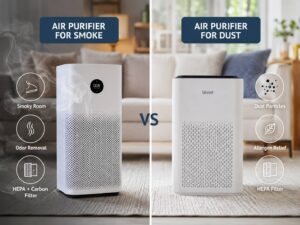
If you want a deeper comparison, this guide on an air purifier for smoke vs dust explains why smoke needs a stronger setup than everyday dust control.
Match smoke CADR to your real room size
Room size claims can confuse buyers. Some brands list coverage at one air change per hour. That number sounds big, but it means the purifier cleans the room air only once per hour. Smoke needs faster cleaning.
For better smoke control, aim for a purifier that can clean the room several times per hour. That gives the unit a better chance during wildfire days, cigarette smell, or smoke from cooking.
Use this simple guide:
- 150 sq ft room: smoke CADR near 150 CFM
- 250 sq ft room: smoke CADR near 250 CFM
- 400 sq ft room: smoke CADR near 400 CFM
- 600 sq ft room: smoke CADR near 600 CFM, or use two units
Ceiling height matters too. Most room-size math uses an 8-foot ceiling. A room with a 10-foot ceiling has more air to clean. So, open rooms and tall rooms need more power.
Next, think about layout. Smoke spreads through doorways, vents, staircases, and open living spaces. A purifier in one corner may not clean an entire open floor plan. For that reason, two medium units can work better than one weak unit in an odd-shaped room.
HEPA removes smoke particles, carbon reduces smoke smell
Smoke has two problems: particles and odor.
HEPA-style filtration handles the particle side. This includes fine smoke, ash, dust, pollen, pet dander, and other small airborne particles. For wildfire smoke, this filter does the main work.
Activated carbon handles the smell side. It can reduce cigarette odor, wildfire smell, cooking smoke, and stale indoor air. Still, carbon works best when the filter contains enough carbon material. A thin black sheet will not handle heavy smoke for long.
This is where many cheap purifiers fall short. They say “smoke removal,” but the carbon layer feels thin and light. After a few weeks near smoke, the filter can smell used. Then the purifier keeps running, but the room still feels stale.
For heavy smoke, look for a thicker carbon filter. A separate carbon filter is often better than a tiny carbon layer attached to the main filter. Plus, check the replacement filter cost before buying. Smoke can fill a filter faster than normal household dust.
Avoid ozone, ionizers, and weak odor claims
For smoke, avoid ozone generators. Ozone can irritate the lungs, and it should not be used as a quick fix for indoor smoke. A good purifier should clean air through filters, not add another irritant to the room.
Next, be careful with ionizers, plasma modes, and electronic cleaning features. Some purifiers let you turn these modes off. For smoke control, filter-only mode is the safer choice.
Do not buy a purifier based only on phrases like “fresh air,” “odor control,” or “air sanitizer.” Those words sound good, but they do not prove smoke performance.
Look for clear details instead:
- Smoke CADR
- Filter type
- Carbon filter size
- Noise level
- Replacement filter price
- Energy use
- Ozone safety details
- Room size at higher air changes per hour
A good purifier makes these numbers easy to find. Vague product pages usually mean weak smoke performance.
Best purifier type for each smoke problem
Different smoke problems need different buying choices.
For wildfire smoke, choose high smoke CADR first. Run the unit in the room where people sleep or spend the most time. Then, keep spare filters at home during smoke season. Heavy wildfire smoke can load a filter fast.
For cigarette smoke, choose strong carbon and strong airflow. One purifier in a hallway will not fix smoke from a nearby room. Put the purifier near the smoke source, or place it where the smell collects.
For neighbor smoke in apartments, use a purifier in the room closest to the shared wall, vent, window, or door gap. Then, seal obvious air leaks with weather stripping or draft blockers. The purifier works better once less smoke gets inside.
For cooking smoke, use the range hood first. After that, run the purifier on high for 20 to 40 minutes. Place it near the kitchen, but keep it away from grease, steam, and splatter.
For fireplace smoke, fix the draft or chimney problem first. A purifier can reduce leftover smoke particles and odor. Still, it cannot solve smoke that keeps entering the room.
Best rooms for a smoke air purifier
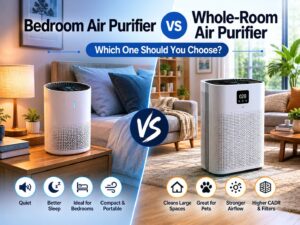
A bedroom is one of the best places to use a smoke purifier. People spend many hours sleeping, and clean air matters most during that time. For a 200 sq ft bedroom, a smoke CADR near 200 CFM gives the purifier more room to work without staying on max speed all night.
A living room needs stronger airflow. Smoke spreads fast in open spaces, and furniture can block air movement. For a 350 to 450 sq ft living room, look near 350 to 450 CFM smoke CADR.
A home office needs quiet performance. A PM2.5 display helps during smoke events, but do not trust auto mode alone. Smoke smell can linger after the sensor drops. So, use a higher fan speed during strong smell or visible haze.
A nursery or child’s room needs quiet filtration and ozone-free operation. Keep cords safe, leave the air intake open, and do not place the purifier where bedding or curtains can block airflow.
An open-plan room needs honest math. If a purifier claims very large coverage, check the details. Some large-room claims use weak air-change rates. For smoke, buy more power or use two purifiers.
Our suggestion
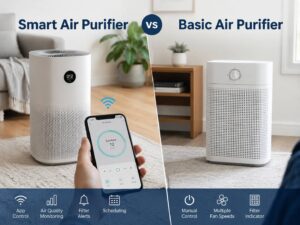
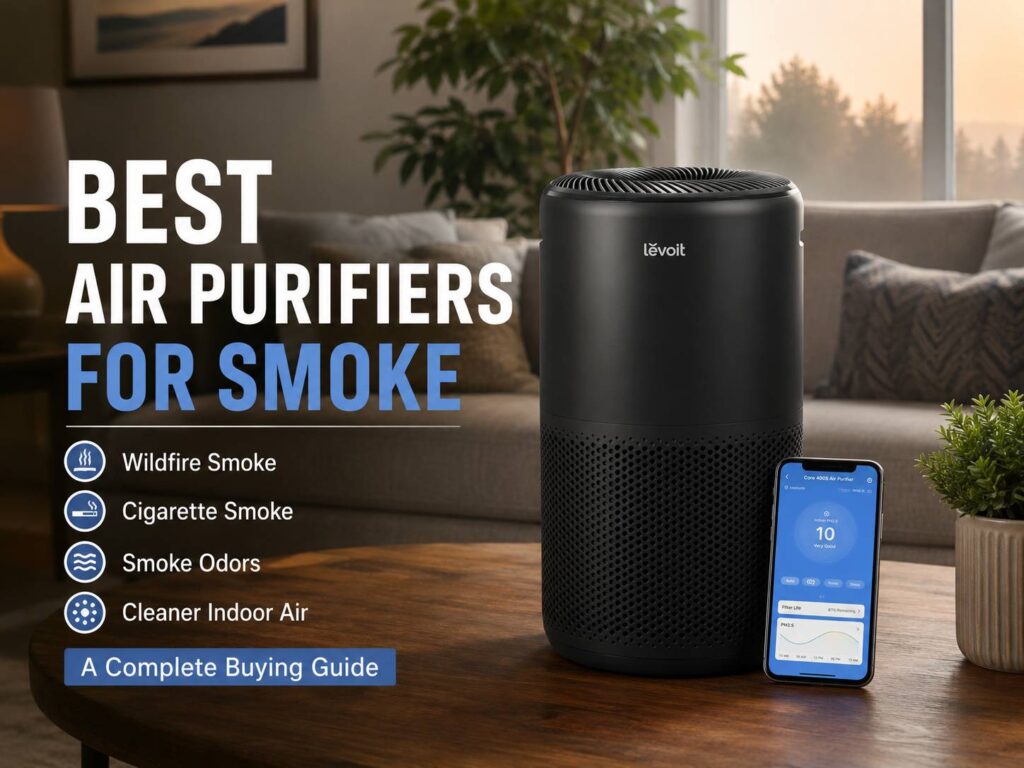
A practical starting point is the Levoit Core 400S-P. It has a 231 CFM CADR, smart controls, a PM2.5 display, and a listed 358 sq ft room size at 4.8 air changes per hour. That makes it a good fit for many bedrooms, offices, and medium rooms.

Buy it for:
- Bedrooms and offices
- Medium rooms
- Light to moderate smoke smell
- Buyers who want app control
- Users who want a visible PM2.5 reading
Skip it for:
- Large open-plan rooms
- Heavy daily cigarette smoke
- Strong wildfire smoke in bigger spaces
- Homes that need a large carbon filter
For bigger rooms, look at stronger smoke CADR models. The Blueair Blue Pure 211i Max is a stronger class of purifier, with much higher listed smoke CADR. The Coway Airmega AP-1512HH is another popular choice for medium spaces.
Still, do not buy only by brand name. Check the smoke CADR, filter cost, and carbon design first.
Setup tips that help the purifier work better
Placement matters. Put the purifier in the room where people spend the most time. A bedroom purifier has more value at night than a hallway purifier far from the bed.
Next, leave open space around the unit. Keep the intake and outlet clear. Do not push the purifier tight against furniture, curtains, or a wall. Blocked airflow makes a strong unit act weak.
Run the purifier on high at first. Use high speed for 30 to 60 minutes after smoke enters the room. Then lower the fan to a steady speed.
Auto mode can help, but it should not be your only setting during smoke events. Sensors can react late, and odor can remain after the particle reading drops. So, trust your nose too.
Close windows during outdoor smoke events. Outdoor air can keep filling the room with new particles. Use the purifier in a closed room, then ventilate later after outdoor air improves.
Keep bedroom doors closed during wildfire smoke. A smaller sealed room cleans faster than a large open area.
Do not spray fragrance, odor removers, or strong cleaners near the purifier. These products add more chemicals to the room and can fill the carbon filter faster.
Common issues buyers notice
The first issue is noise. A purifier that works well for smoke often needs a strong fan. So, buy a unit powerful enough to run at medium speed most of the time. Medium speed is much easier to live with than max speed.
The next issue is filter cost. Smoke shortens filter life. Wildfire smoke, cigarette smoke, and fireplace smoke can fill carbon faster than normal dust. Check the price of replacement filters before you buy.
Another issue is odor return. A loaded carbon filter can push stale smell back into the room. Replace the filter once the purifier smells smoky during use.
Room coverage is another common problem. Some brands list huge room sizes. The purifier can move air in that space, but it may not clean smoke fast enough. Smoke CADR gives a better buying signal.
Sensor trust can be a problem too. Air quality sensors help, but they do not catch every smoke odor. Strong smoke smell means higher fan speed, better sealing, and fresh filters.
If you are still unsure whether the purchase makes sense, read this guide on whether air purifiers are worth buying in 2026. It helps explain when a purifier gives real value and when it becomes an expensive fan.
Maintenance tips for smoke-heavy homes
A smoke purifier needs regular care.
Clean the pre-filter every 2 to 4 weeks. Pet hair, lint, and dust block airflow before the main filter can do its job. A washable or vacuumable pre-filter can save money over time.
Next, replace the main filter on schedule. Change it sooner after heavy smoke. Wildfire smoke season can age a filter fast, so keep one spare filter at home.
Check the carbon filter often in smoking homes. Cigarette odor can fill carbon quickly. A purifier with cheap filters can cost more over one year if it needs frequent changes.
Use proper replacement filters. Poor-fit filters can leak air around the edges. Then smoke particles pass through the unit instead of through the filter.
Clean dust from sensors and vents. A dirty sensor can give bad readings and keep the fan too low.
Final buying checklist
Use this checklist before buying an air purifier for smoke:
- Smoke CADR matches your room size
- True HEPA or high-grade particle filter
- Real activated carbon filter
- No ozone generator
- Ionizer can stay off
- Replacement filters are easy to buy
- Noise level works for your room
- Room size is listed with higher air changes per hour
- Pre-filter can be cleaned
- Unit fits the room without blocked airflow
The best air purifiers for smoke are not always the most expensive models. The right choice comes down to smoke CADR, particle filtration, carbon capacity, and real room size.
For bedrooms and offices, a strong medium purifier can work well. For open rooms and wildfire smoke, go larger than the label suggests. For cigarette smell, choose more carbon. For cooking smoke, use fast fan speed after the range hood does its part.
A good purifier will not remove every pollutant from a home. Still, it can make one room cleaner, calmer, and easier to use during smoky days.