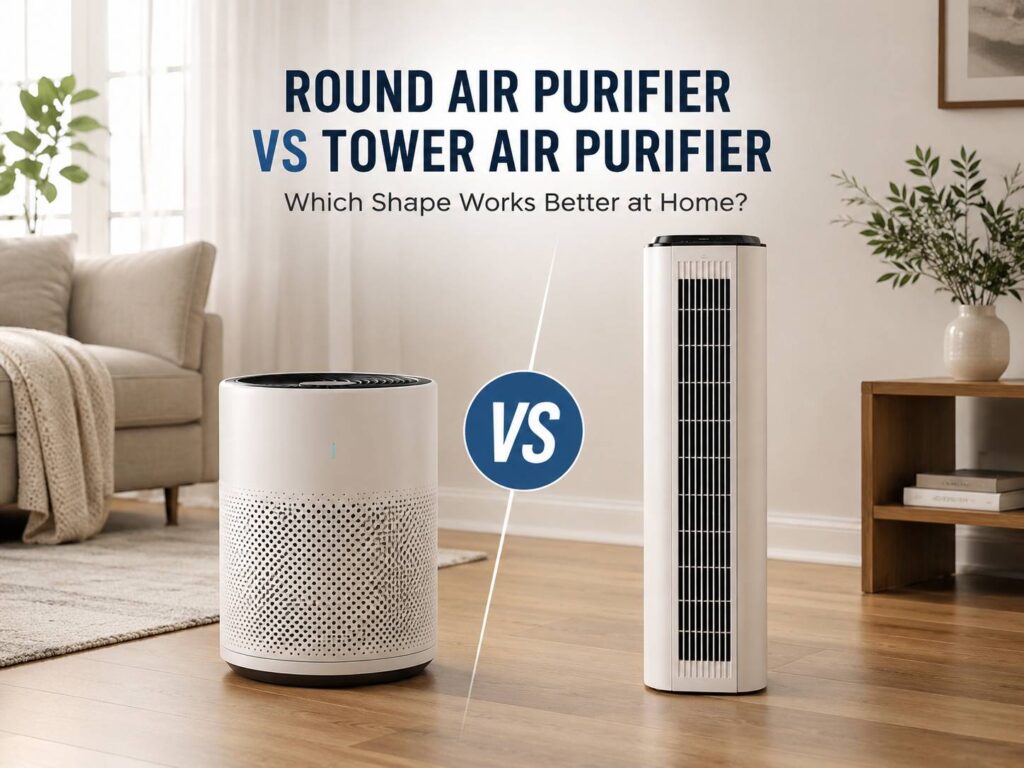
A round air purifier and a tower air purifier can both clean indoor air well. Still, the shape changes how each unit fits, pulls air, and feels in daily use.
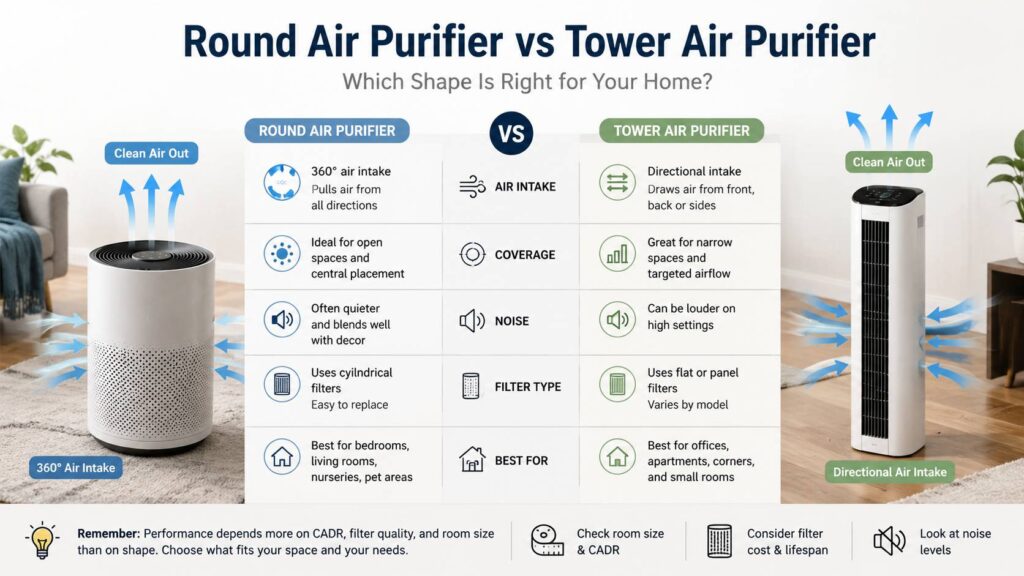
Round models usually have a cylinder shape. Many pull air from all sides, then push clean air upward. Tower models are taller and slimmer. They often pull air through front, side, back, or lower vents, then send clean air out through the top or front.
So, which one should you buy? The honest answer is simple: look at your room first. Then check CADR, filter type, noise, yearly filter cost, and placement needs. A round purifier can work better in open spaces. A tower purifier can work better where floor space is tight. Yet the stronger model on paper is not always the better one for your home.
This guide explains the real differences between round air purifiers and tower air purifiers. It covers airflow, room size, allergies, pet hair, smoke, noise, filter cost, safety, and the problems people often notice after a few weeks of use.
Round Air Purifier vs Tower Air Purifier: What Changes in Real Use?
A round air purifier usually uses a wide body with a circular filter inside. Many models use a 360-degree air intake. That means air can enter through several sides at once. From there, the purifier pushes clean air out through the top.
A tower air purifier has a slimmer, taller body. It often fits beside a desk, sofa, dresser, or wall. Some tower units pull air from the front. Others pull from the back or sides. For this reason, placement matters a lot.
The round design feels more flexible in open rooms. It can sit near the center of a bedroom, nursery, or pet area and pull air from different directions. The tower design feels easier to place in smaller rooms. It can slide into narrow gaps where a wide purifier looks bulky.
Still, shape does not clean the air by itself. A weak round purifier will not beat a strong tower purifier. A small tower unit will not clean a large living room well. The purifier needs enough power for the room.
CADR Matters More Than Shape
CADR stands for Clean Air Delivery Rate. It measures how much filtered air the purifier can deliver. Most reliable models list separate CADR numbers for smoke, dust, and pollen.
This number matters more than the shape. A high-CADR tower air purifier can clean a room faster than a low-CADR round purifier. The reverse is true too.
For example, a small bedroom does not need a huge machine. A compact purifier with a suitable CADR can work well. A larger living room needs more airflow. So, a pretty design will not help much if the fan and filter cannot move enough air.
Some brands advertise very large room coverage. Yet that number can feel misleading. A purifier may cover a large room only at a low air-change rate, or only on its loudest fan setting. For daily use, check whether the purifier can handle your room on medium speed. That matters for comfort.
If you are still deciding whether this category makes sense for your home, our guide on are air purifiers worth buying in 2026 explains the practical benefits, limits, and buying mistakes in more detail.
Airflow: 360-Degree Intake vs Directional Intake
Round air purifiers often have one clear advantage: they can pull air from several directions. That helps in rooms with beds, rugs, curtains, toys, or pet beds. Air rarely moves in one neat line. So, a 360-degree intake can make the purifier easier to place.
A tower air purifier often uses more directional airflow. This can work very well, mainly if you place the unit correctly. A front-intake tower can sit closer to a wall than a rear-intake model. A rear-intake tower needs more clearance behind it. Side-intake models need space on both sides.
For example, a tower purifier pushed into a tight corner may still run, but it may not pull enough air. The fan keeps spinning, yet airflow drops. Next, dust builds near the vents. Then the filter gets dirty faster.
A round purifier can forgive poor placement a little more. Still, it needs open space around the body. If half the intake sits against a wall or curtain, you lose part of the design advantage.
Which Shape Works Better for Small Rooms?
Small rooms are usually easy to handle. A bedroom, nursery, compact office, or guest room can work with either shape.
A round air purifier often makes sense if you can place it near open floor space. It works well beside a bed, near a dresser, or close to a pet bed. The airflow feels balanced, and many round models run quietly at night.
A tower air purifier makes sense if the room has little free floor space. It can fit near a desk, beside a shelf, or along a wall. For students, apartment owners, and people with compact home offices, that slim body can be a real advantage.
Still, do not pick only by size. A small purifier can look right but clean too slowly. Check the CADR and the room size. Then check noise on medium speed. A unit that needs max speed all day can become irritating fast.
Which Shape Works Better for Large Rooms?
Large rooms need more airflow. For this reason, CADR should lead the choice. Shape comes second.
A tower purifier can work very well in a living room if it has strong airflow and a good outlet design. It can push clean air across the room, which helps in open seating areas. At the same time, a round purifier can work well if it sits in a central or semi-open spot.
For long rooms, L-shaped rooms, or open-plan spaces, one purifier may not clean evenly. In that case, two smaller units can beat one large unit. You can place one near the seating area and another near the source of dust, pets, or outdoor air.
This setup costs more at first, but it often feels better in real life. Each unit can run at a lower speed. So, noise drops, and air moves more evenly.
Noise: Which One Is Quieter?
Shape does not guarantee quiet performance. Fan quality, filter density, motor design, and speed setting decide noise.
Round purifiers can feel softer in bedrooms. Many push air upward, so the sound does not hit you directly. Tower purifiers can sound more focused, mainly when the outlet faces a bed, sofa, or desk.
Still, a quiet purifier can clean poorly if it runs at a very low speed. Sleep mode is useful, but it often cuts airflow. For cleaner air at night, run the purifier on medium before bedtime. Then switch to a lower setting for sleep.
For allergy season, smoke days, or heavy dust, medium speed works better than sleep mode. High speed works well for short bursts, but it is loud to run for hours.
My real opinion: judge noise at the speed you will use daily. A purifier that sounds fine for 5 minutes in a store can feel loud after 3 hours beside your bed.
Filter Design and Yearly Cost
Filter cost can change the value of an air purifier fast. A cheap unit with expensive filters can cost more over time than a pricier purifier with longer-lasting filters.
Round purifiers often use cylindrical filters. These are usually simple to remove. Many combine a pre-filter, HEPA-style layer, and carbon layer into one cartridge.
Tower purifiers use more varied filter designs. Some use flat panels. Some use long filters. Others use separate pre-filters, HEPA filters, and carbon filters.
Before buying, check these points:
- Filter price
- Filter life
- Yearly replacement cost
- Filter stock availability
- Pre-filter cleaning steps
- Carbon filter thickness
- Filter replacement alert
Pet owners should pay close attention to the pre-filter. Pet hair and larger dust can clog the main filter faster. A washable or easy-clean pre-filter saves money and keeps airflow stronger.
Round Air Purifier Pros
A round air purifier works well in many rooms. It suits people who want balanced airflow and simple placement.
Main benefits:
- Often pulls air from all sides
- Works well in bedrooms and nurseries
- Good for pet areas
- Easy to place in open spaces
- Simple cylindrical filters on many models
- Top air outlet can spread air smoothly
Round models feel natural in rooms where air moves from many directions. For example, a bedroom with curtains, bedding, rugs, and a pet bed can benefit from that full-body intake.
The shape can also look softer in a home. Many round purifiers blend better with modern furniture than tall technical-looking units.
Round Air Purifier Cons
A round purifier can take more floor space than expected. The wide body may not fit well beside a narrow desk or between furniture.
Common downsides:
- Needs space around the full body
- Can feel bulky in small rooms
- Not ideal for tight corners
- Some cylindrical filters cost more
- Small models can have weak CADR
- Top airflow may bother plants, shelves, or nearby objects
The biggest mistake is buying a compact round model for a room that needs more power. The design looks capable, but airflow may be too low.
Tower Air Purifier Pros
A tower air purifier works well where space is limited. The slim shape can fit near a desk, wall, sofa, or cabinet.
Main benefits:
- Takes less floor space
- Fits narrow rooms better
- Can direct clean air across the room
- Often has a taller outlet
- Works well in offices and apartments
- Some models offer strong CADR for their size
Tower purifiers are practical. For a home office, they can sit beside a desk without taking much room. For an apartment, they can clean the air without blocking walkways.
A tower model can also look cleaner in a corner, as long as the intake remains open.
Tower Air Purifier Cons
Tower purifiers need more careful placement. The slim body can tempt people to push the unit against a wall. That can block the intake or reduce airflow.
Common downsides:
- Rear intakes need wall clearance
- Directional airflow can be easier to block
- Tall bodies can tip more easily
- Narrow filters may clog faster in dusty homes
- Some models blow air too directly
- Corner placement can reduce performance
This is the main issue I see with tower models. People buy them for tight spaces, then place them too tightly. The purifier runs, but it does not clean as well as expected.
Which One Is Better for Allergies?
For allergies, filter performance matters more than shape. Look for strong dust and pollen CADR. Then check the filter type and room match.
A round purifier can work well in bedrooms, mainly near bedding and carpets. A tower purifier can work well in offices and living rooms, mainly where people spend the most time.
For pollen season, run the purifier for longer periods. Do not rely only on auto mode. Some sensors respond better to smoke and fine particles than pollen. A steady fan speed can give better results.
For dust mites, pet dander, and pollen, cleaning habits still matter. Wash bedding, vacuum rugs, and keep windows closed during high-pollen periods. The purifier helps the air, but it does not clean surfaces.
Which One Is Better for Pets?
Pet homes need airflow and easy filter care. Hair, dander, litter dust, and odors can load filters quickly.
A round purifier works well near pet beds or open spaces where hair moves around the room. A tower purifier works well near litter boxes, crates, or feeding areas, if the intake stays open.
For odor control, activated carbon matters. A thin carbon layer helps a little. A thicker carbon filter works better for litter smell, dog odor, and cooking smells. Still, no purifier replaces cleaning the litter box, washing pet bedding, or vacuuming floors.
For pet owners, my pick is simple: choose the model with the easiest pre-filter to clean. That one is more likely to stay useful after the first month.
Smart Features: Nice Extra or Real Benefit?
Smart features can be helpful, but they should not carry the buying decision. App control, air quality sensors, schedules, and voice assistant support can make daily use easier. Still, the purifier must first have enough CADR and a good filter.
A basic purifier with strong airflow can beat a smart purifier with weak performance. At the same time, smart controls can help if you forget to change fan speed or run the unit during certain hours.
For a deeper comparison, read our guide on smart air purifier vs basic air purifier. It explains which smart features matter and which ones mainly add cost.
My view: smart features are useful when they support better habits. They are less useful when they hide weak core specs.
Safety Features to Check
A good air purifier should clean air without adding another problem. Be careful with ozone claims, ionizer features, and vague “fresh air” modes.
Look for these features:
- Mechanical filtration
- Clear HEPA or HEPA-type filter details
- CARB certification for ozone safety
- ENERGY STAR rating
- AHAM Verifide listing where available
- Child lock
- Tip-over protection on tall models
- Filter replacement alert
- Display-off mode for bedrooms
For bedrooms, nurseries, and pet spaces, avoid ozone-generating features. A purifier should remove particles, not produce irritating gases.
Placement Tips That Improve Performance
Placement can change how well a purifier works. Even a strong model performs poorly with blocked vents.
Use these practical tips:
- Keep the purifier away from curtains.
- Leave open space around intakes.
- Keep the outlet clear.
- Place the unit near the problem area.
- Close the door for faster room cleaning.
- Avoid placing it behind furniture.
- Clean the pre-filter often.
- Keep it on a stable surface.
For round purifiers, leave space around the full body. For tower purifiers, check where the intake sits. A rear-intake tower needs space behind it. A side-intake tower needs open sides.
After setup, watch dust buildup around the vents. If dust gathers fast on one side, airflow may be blocked or the purifier may sit too close to a wall.
Common Problems Buyers Notice
When an air purifier disappoints, the cause is usually wrong sizing, poor placement, or filter neglect.
Common issues include:
- The purifier feels too loud on the needed speed.
- The room coverage claim feels overstated.
- Replacement filters cost more than expected.
- Pet hair clogs the pre-filter quickly.
- Auto mode stays too low during allergy season.
- The unit blows cold air toward a bed or desk.
- A tower model loses airflow near a wall.
- A round model takes too much floor space.
These issues are avoidable. Measure the room, check CADR, plan the placement, and calculate filter cost before buying.
Buying Checklist
Use this checklist before choosing a round or tower air purifier:
- Measure your room.
- Check CADR for smoke, dust, and pollen.
- Compare CADR with real room size.
- Check noise at medium speed.
- Review yearly filter cost.
- Confirm filter availability.
- Check where the intake sits.
- Plan where the purifier will stand.
- Avoid ozone-generating features.
- Pick a design you can clean easily.
A purifier that looks good but stays off will not help. A strong purifier with costly filters can also become frustrating. The right model should fit your room, clean enough air, and remain easy to live with.
Final Verdict: Should You Choose Round or Tower?
Choose a round air purifier if you want balanced airflow, easier open-room placement, and a strong bedroom or pet-area unit. It works best when you can leave space around the full body.
Choose a tower air purifier if you need a slim design for a tight room, office, apartment, or narrow corner. It works best when the intake and outlet remain clear.
For most homes, the better choice is not about shape alone. Start with room size and CADR. Then compare filter cost, noise, safety ratings, and placement. After that, choose the shape that fits your daily space.
A round purifier often feels easier in bedrooms and pet rooms. A tower purifier often fits better in offices and small apartments. Both can clean well. The better one is the purifier you can place correctly, run often, and maintain without hassle.