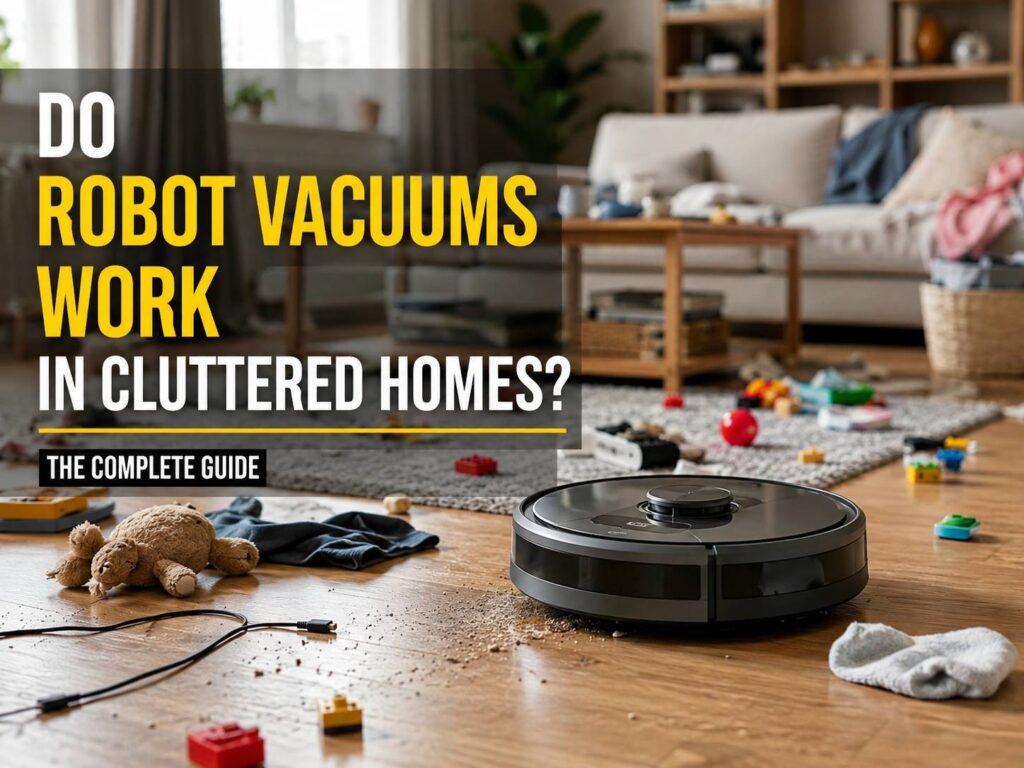
Robot vacuums sound like the perfect helper for a busy home. You press a button, leave the room, and the little cleaner handles dust, crumbs, pet hair, and everyday dirt. In a tidy home, that idea works well. In a cluttered home, the answer needs more detail.
So, do robot vacuums work well in cluttered homes? Yes, they can, but they work best with the right setup. A good robot vacuum can move around furniture, map rooms, avoid many objects, and return to its dock. Still, it cannot clean under a pile of clothes, untangle every cable, or move toys out of the way.
That does not mean cluttered homes should avoid robot vacuums. Families, pet owners, and people with packed apartments can still get real value from them. The key is knowing what the robot can handle, what causes trouble, and which features matter before you spend money.
The Short Answer: Yes, But Clutter Changes the Result
A robot vacuum works best on open floor space. The more clear floor it has, the better the cleaning pattern. It can move in straight lines, cover more of the room, and return to the dock with fewer problems.
Clutter changes that. Shoes near the door can block dust in corners. Toys under a table can stop the robot from reaching crumbs. A cable beside a desk can wrap around the brush and end the cleaning run early.
So, a robot vacuum can help in a cluttered home, but it should not be treated like a full cleaning replacement. It is better as a daily floor maintenance tool. It keeps reachable areas cleaner, but it still needs a floor it can reach.
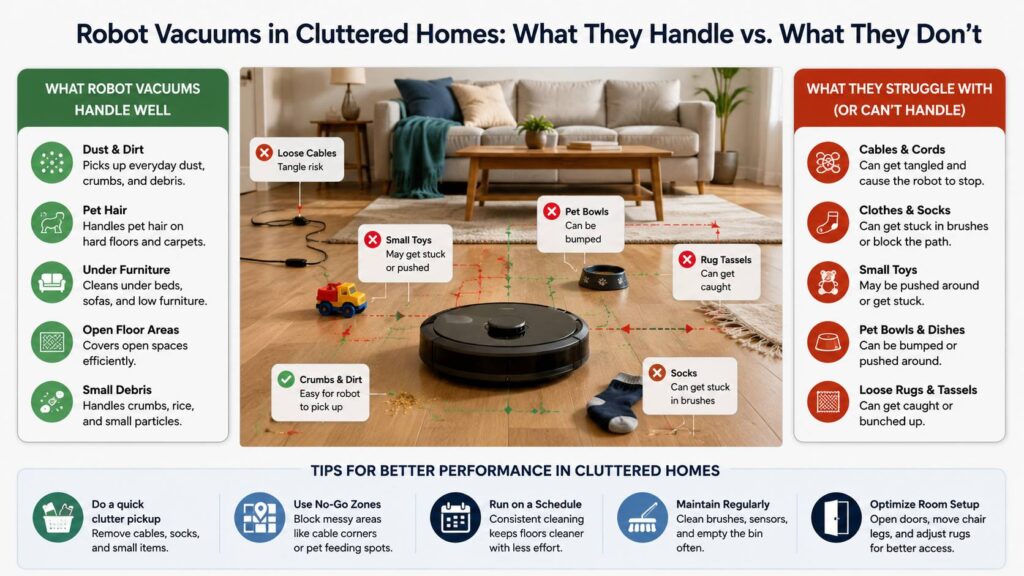
My honest view: a robot vacuum is worth it in a cluttered home only when you are willing to do a quick floor reset. That does not mean cleaning the whole house first. It means picking up the worst items, such as socks, cables, and small toys.
What Counts as a Cluttered Home?
A cluttered home does not always mean a dirty home. Normal homes have clutter. Kids leave toys on the floor. Pets move bowls and chew toys around. Bedrooms collect socks near the bed. Home offices often have cables, chargers, boxes, and chair legs in tight spaces.
For robot vacuums, clutter means anything that blocks, traps, tangles, or confuses the machine. Common examples include:
- Phone charging cables
- USB cables under desks
- Socks and small clothing
- Pet toys
- Kids’ toys
- Lightweight rugs
- Loose rug tassels
- Shoelaces
- Plastic bags
- Thin mats
- Dining chairs
- Floor lamps
- Low furniture
- Laundry piles
- Pet bowls
- Random boxes near walls
Some items cause only small detours. Others can stop the robot completely. Cables are one of the worst problems, since they can wrap around the brush roller or side brush. Socks and thin fabric can do the same. Lightweight rugs can fold under the robot, then the vacuum gets stuck or drags the rug across the room.
Why Robot Vacuums Struggle With Clutter
Modern robot vacuums are much smarter than old random-bounce models. Many use LiDAR, cameras, structured light, bumpers, cliff sensors, and mapping software. Better models can remember rooms, clean in rows, avoid some objects, and follow app-based zones.
Even so, they still see the home from floor level. That creates real limits.
Small flat objects are hard to detect. A black cable on a dark floor can blend in. A sock can look like a soft bump. A thin toy can sit lower than the robot’s sensor range.
Daily clutter changes the map. The robot can learn the sofa, table, hallway, and bedroom layout. It cannot predict a hoodie dropped in front of the bathroom door right before cleaning starts.
Loose objects can move after contact. The robot can push a toy under a chair, nudge a pet bowl, or drag a cable just enough to create a new blockage.
This is why even expensive robot vacuums still need some help in messy homes.
Navigation Matters More Than Suction in Cluttered Homes
Suction power is the headline spec. Strong suction helps with dust, crumbs, pet hair, and carpet debris. In a cluttered home, though, navigation matters more.
A powerful robot vacuum does not help much if it gets stuck every day. It also fails to clean well if it misses half the room. For cluttered spaces, smart movement should come before the largest suction number.
The most useful features include:
- LiDAR or advanced room mapping
- Camera-based object detection
- 3D obstacle avoidance
- No-go zones in the app
- Room-by-room cleaning
- Custom cleaning zones
- Multi-floor mapping
- Good edge cleaning
- Anti-tangle brush design
- Reliable return-to-dock behavior
LiDAR helps the robot build a map and clean in planned lines. Camera-based systems can spot certain floor objects. 3D obstacle systems can help the robot judge object height and shape. No-go zones let you block cable corners, pet feeding areas, toy zones, and rug edges that cause trouble.
For a deeper feature comparison, this guide on LiDAR robot vacuum vs camera-based robot vacuum is a useful next read before choosing a model.
Suction still matters, but navigation decides whether the robot finishes the job.
Object Avoidance Is Helpful, Not Magic
Object avoidance is one of the best features for cluttered homes. It helps the robot spot things like shoes, socks, cords, pet bowls, and toys. Better models can steer around these items instead of chewing them up.
That said, object avoidance does not make the robot perfect. It works better with clear shapes and decent lighting. It can struggle with dark cables, tiny items, flat fabric, shiny surfaces, or clutter packed tightly together.
In real use, object avoidance reduces problems. It does not remove them. You should still pick up cables, socks, jewelry, small toy parts, and anything fragile before a cleaning run.
Pet owners should be extra careful. Some premium models can detect and avoid solid pet waste, but no one should rely on that feature as a daily safety net. A quick floor check matters more than any sensor.
For shoppers comparing basic and premium models, the real question is whether the extra sensors pay off in daily use. This guide on robot vacuum obstacle avoidance worth paying more for covers that buying decision in more detail.
Cables Are the Biggest Clutter Problem
Cables are one of the most common reasons robot vacuums get stuck. They are thin, flexible, and easy to catch in a spinning brush. One loose phone charger can stop a cleaning run. Worse, the robot can pull the cable and knock something off a desk or side table.
Home offices and TV areas are the highest-risk spots. Look around desks, routers, gaming setups, speakers, floor lamps, bedside tables, and power strips.
A few simple changes can prevent most cable problems:
- Lift loose cables off the floor
- Use cable clips behind furniture
- Place power strips inside cable boxes
- Create a no-go zone around messy desk areas
- Run the robot after a quick floor check
- Avoid automatic cleaning in rooms with changing cable clutter
My practical opinion: cable management matters more than buying the most expensive robot. A premium model can avoid some cords, but a tidy cable corner beats sensor guessing every time.
Do Robot Vacuums Work Around Toys and Kids’ Mess?
Robot vacuums can work well in homes with kids, but toy clutter needs a routine. Large toys are easy for most robots to avoid. Small toys create more trouble.
Building blocks, puzzle pieces, doll accessories, toy food, crayons, and small plastic parts can block the brush or end up in the dustbin. Soft toys can get pushed or dragged. Paper, stickers, and hair ties can wrap around moving parts.
The best fix is a two-minute toy sweep before the robot starts. A basket in each room helps. You do not need a spotless floor. You only need to remove the small items that can jam the vacuum.
A robot vacuum can even help build a better habit. Kids often learn to pick up toys before the robot starts. That small routine can make the whole floor easier to manage.
Pet Homes Need a Smarter Setup
Robot vacuums are very useful in homes with pets. They can pick up daily pet hair, litter tracking, dust, and dirt from paws. In a cluttered pet home, though, the setup matters.
Pet bowls should not sit in the robot’s main path. Water bowls are a bigger risk than food bowls. A robot can bump the bowl, spill water, and drag moisture across the floor. Robot vacuums are not made for random wet messes.
Pet toys can cause the same problems as kids’ toys. Rubber toys can block the route. Rope toys can tangle in brushes. Small balls can roll under furniture and confuse the robot.
Set a no-go zone around feeding areas. Check the floor before a scheduled clean if your pet is sick, nervous, or still house training. This one habit can prevent the worst robot vacuum disaster.
Furniture Clutter Can Slow the Robot Down
A room can look tidy and still be hard for a robot vacuum. Dining chairs, bar stools, floor lamps, plant stands, side tables, and narrow gaps can create a maze.
Robot vacuums can clean around furniture legs, but they often take longer. Some bump more often. Others repeat small areas or skip tight spaces. Round models can struggle with deep corners. Square-front models can help near edges, but they still need room to turn.
Dining rooms are often the hardest areas. Chair legs create narrow lanes, and crumbs collect under the table. For better results, lift chairs onto the table or pull them away before the robot runs. Doing this once or twice a week can improve cleaning a lot.
Low furniture creates another issue. A robot can get trapped if it fits halfway under a sofa but not fully. Measure the robot height before buying. Check it against your sofa, bed, TV unit, and low cabinets.
Rugs, Mats, and Loose Edges Can Cause Trouble
Rugs make robot vacuum cleaning harder. Thick rugs, loose corners, fringes, and lightweight mats can stop the robot or reduce contact with the floor.
Many robot vacuums handle low-pile rugs well. Rug edges and tassels still cause problems. The robot can climb at a bad angle, fold the corner, and get stuck. A side brush can catch fringe and pull it into the roller.
Use these fixes for better results:
- Tape down rug corners with washable rug tape
- Remove thin bath mats before cleaning
- Set no-go zones around rugs with tassels
- Use heavier rugs that stay flat
- Choose a robot with carpet detection
- Keep mop runs away from rugs
Mixed floors need better app controls. You want to tell the robot where to vacuum, where to mop, and which areas to avoid.
The Best Robot Vacuum Type for a Cluttered Home
A basic robot vacuum can help in a simple apartment. Cluttered homes need better sensors, better mapping, and better app controls.
Look for these traits:
- Smart mapping instead of random movement
- Real object avoidance
- Clear app controls
- No-go zones and room zones
- Anti-tangle brush design
- Strong battery life for your floor size
- Auto-recharge and resume
- Easy brush and dustbin maintenance
- Reliable replacement parts
- A dock that fits your space
A self-emptying dock can help in pet homes and busy homes. It does not solve clutter, but it reduces daily bin emptying. A robot vacuum and mop combo can help on hard floors, but only after you create safe zones around rugs, bowls, and cables.
For very cluttered homes, smart navigation is often worth more than extra suction power.
How to Make a Robot Vacuum Work Better in a Cluttered Home
You do not need to clean the whole house before the robot cleans. That defeats the purpose. A short reset is enough.
Try this routine:
- Pick up cables, socks, and small toys
- Move pet bowls away from the cleaning path
- Lift light mats that bunch up
- Open doors to rooms you want cleaned
- Close doors to rooms that are too messy
- Use no-go zones for cable corners
- Run the robot on a regular schedule
- Clean brushes and sensors weekly
- Check the bin often in pet homes
Daytime cleaning works better than overnight cleaning for many cluttered homes. Camera-based robots get better visibility, and you can rescue the vacuum faster if it gets stuck.
Room-by-room cleaning works well too. Start with cleaner rooms first. Run problem rooms only after a quick check.
Common Issues Owners Notice
Cluttered homes create repeat problems. These are normal limits of small floor-cleaning robots, not always signs of a bad product.
The robot can miss dirt behind clutter. A shoe blocks a dusty corner, so the vacuum cleans around the shoe and leaves dirt behind.
It can get stuck under furniture. A sofa or cabinet with the wrong clearance can trap the robot.
Light items can move during cleaning. Thin mats, small toys, plastic bags, and loose paper can travel with the vacuum.
Hair and cords can tangle. Long hair, pet hair, shoelaces, and charging cables can wrap around brushes.
Tight spaces slow cleaning down. Chair legs, small gaps, and crowded corners make the robot spend more time turning than cleaning.
Strong object avoidance can leave missed strips. The robot protects your items, but it can become too cautious near clutter.
These issues do not mean the robot vacuum was a bad buy. They mean the home needs better zones, a better schedule, or a clearer cleaning path.
Who Should Buy One Anyway?
A robot vacuum makes sense in a cluttered home for people who want cleaner floors with less daily effort. It works best for owners who can do a quick floor check before cleaning. It is a strong fit for pet owners, parents, and anyone dealing with daily dust or crumbs.
It is not the right tool for floors that stay covered most of the time. If every room has clothes, toys, cables, boxes, and loose items across the floor, the robot will spend more time avoiding clutter than cleaning.
Start with one room in that case. Set up the kitchen, hallway, or living room first. Once the robot handles that area well, expand the map.
A robot vacuum does not need a perfect home. It needs a path.
Final Verdict: Robot Vacuums Can Work in Cluttered Homes, But Setup Matters
Robot vacuums can work well in cluttered homes, but expectations matter. They are great for daily dust, crumbs, pet hair, and light debris. They struggle with loose cables, small toys, clothes, wet messes, and packed floor clutter.
For the best result, choose a model with smart mapping, object avoidance, no-go zones, and anti-tangle brushes. Then give it a simple routine. Pick up the worst items, block risky areas, and let the robot handle the reachable floor.
The honest answer is simple: a robot vacuum will not turn a cluttered home into a tidy one. Still, it can keep the open parts of your floor much cleaner. For many busy homes, that alone makes it worth buying.