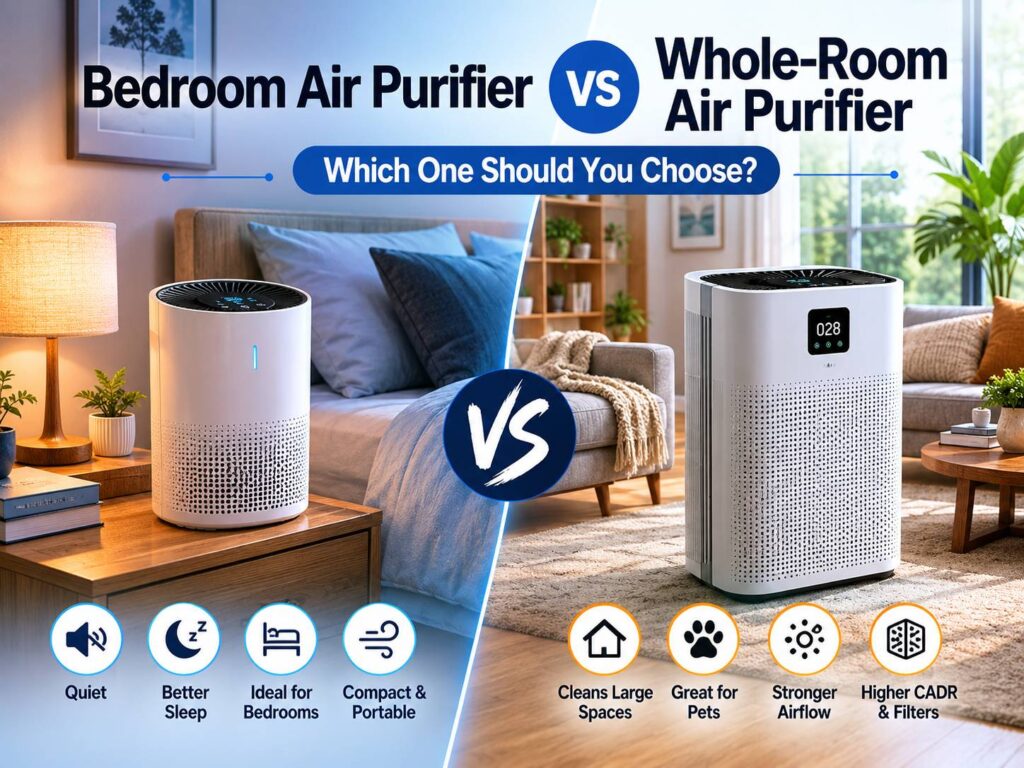
Bedroom Air Purifier vs Whole-Room Air Purifier: What Is the Real Difference?
A bedroom air purifier is made for a smaller, more personal space. It usually runs near the bed, dresser, or wall and works through the night. Its main job is to clean the air where you sleep, so it can help with dust, pollen, pet dander, and that stale feeling some rooms get by morning.
A whole-room air purifier is built for a larger space. It fits better in a living room, large bedroom, family room, home office, or open-plan area. It usually has a stronger fan, a bigger filter, and a higher CADR, which means it can clean more air in less time.
The choice sounds simple at first. Still, it is easy to buy the wrong size. A small bedroom purifier can look neat on a nightstand but may not clean a full room well. A large whole-room purifier can clean fast, but it may feel too loud or too bulky beside the bed.
So the right choice is not just about the name on the box. You need to look at room size, airflow, filter type, noise level, placement, and filter cost. Those details make the difference between a purifier that quietly helps every day and one that sits unused in a corner.
What Is a Bedroom Air Purifier?
A bedroom air purifier is a portable air cleaner designed for smaller rooms and sleep areas. It usually focuses on quiet use, lower light, and simple controls. Many models include sleep mode, dimmable displays, timers, and lower fan speeds.
Bedroom air purifiers work best in:
- Small bedrooms
- Kids’ rooms
- Guest rooms
- Dorm rooms
- Nursery spaces
- Small home offices
- Rooms with closed doors
The best bedroom models balance quiet sound with real airflow. That balance matters. A purifier can be almost silent on sleep mode, but it may clean very little air at that setting. For that reason, a slightly stronger purifier often works better than a tiny one.
My honest opinion is simple: buy a bedroom purifier with more power than the room barely needs. Then you can run it on a lower fan speed at night and still get useful air cleaning. A weak purifier on its lowest setting may sound calm, but it may not do enough for allergies, dust, or pet dander.
For a deeper buying guide, see this related article on how to choose the right air purifier.
What Is a Whole-Room Air Purifier?
A whole-room air purifier is made to clean one full room, not an entire house. That point is easy to miss. “Whole-room” does not mean “whole-home.” It means the purifier has enough airflow to clean a larger single space.
A whole-room purifier works well in:
- Living rooms
- Large bedrooms
- Open-plan rooms
- Finished basements
- Family rooms
- Shared offices
- Rooms with pets
- Rooms close to kitchens
- Spaces that collect dust quickly
These models usually have bigger filters and stronger fans. They can pull in more air, clean it, and push it back into the room faster. For pet owners, families, and homes near busy roads, that extra power can matter.
There is a trade-off, though. Whole-room purifiers take up more space. They can cost more, and they can be louder on high fan speeds. In a living room, that may not bother you. In a bedroom, it can become annoying at night.
CADR: The Number That Matters Most
CADR stands for Clean Air Delivery Rate. It tells you how much clean air the purifier can deliver. Good models often show separate CADR ratings for smoke, dust, and pollen.
Do not rely only on room coverage claims. Some brands use very generous numbers that sound impressive but do not reflect strong daily cleaning. A purifier listed for a large room may only clean that space once per hour. For allergies, smoke, and dust, you need more air movement than that.
A useful rule is to choose a purifier with a smoke CADR of at least two-thirds of the room’s square footage. For a 150 square foot bedroom, a smoke CADR around 100 or higher is a good starting point. For a 300 square foot living room, look closer to 200 or higher.
Smoke CADR is helpful because smoke particles are very small. If a purifier handles smoke well, it usually has strong performance for many fine airborne particles too. Dust and pollen CADR still matter, mainly for larger particles, but smoke CADR gives a practical view of overall particle cleaning.
Room Size: Why Bigger Claims Can Mislead You
Room size is one of the biggest reasons people feel disappointed after buying an air purifier. The box may say “covers up to 500 square feet,” but that does not always mean it cleans that space well in real life.
For a bedroom, the room is usually smaller and more closed off. That helps the purifier work better. Closed doors keep new dust, pollen, and pet dander from entering as fast. So a good bedroom air purifier can create a more comfortable sleep space.
For a whole-room purifier, the job is tougher. Living rooms often connect to hallways, kitchens, stairs, or open spaces. Air keeps moving in from other areas, so the purifier has more work to do. For that reason, whole-room models need higher airflow and stronger filters.
Measure the real room before buying. Length times width gives the square footage. Then check the CADR, not only the advertised coverage. If the room has high ceilings, open doors, or many connected spaces, choose a stronger unit.
HEPA Filtration: Best for Dust, Pollen, and Pet Dander
A good bedroom air purifier or whole-room purifier should use true HEPA filtration or a high-grade mechanical filter. HEPA filters are made to capture very small airborne particles, including pollen, dust, mold spores, pet dander, and many smoke particles.
For bedrooms, HEPA filtration can help people who wake up with a blocked nose, itchy eyes, or a dry throat. It can also help during pollen season, mainly if you keep windows closed and run the purifier before sleep.
For whole-room use, HEPA filtration helps control particles in shared spaces. This is useful in homes with pets, kids, fabric sofas, rugs, or heavy foot traffic. Bigger rooms collect more dust, so a larger filter can make a real difference.
Be careful with vague terms like “HEPA-like” or “HEPA-style.” These labels do not always mean true HEPA performance. If the product does not clearly state its filter grade or test standard, treat the claim with caution.
Activated Carbon: Better for Odors and Smoke Smells
HEPA filters catch particles. Activated carbon helps with some gases and odors. That includes light pet smells, cooking odors, smoke smells, and some household chemical odors.
A bedroom purifier with a thin carbon sheet can help with mild smells, but do not expect too much. Small carbon filters get used up faster. For stronger odor control, choose a model with a thicker carbon filter or a separate carbon stage.
Whole-room purifiers often do better with odors because they have space for larger carbon filters. That matters in living rooms, pet areas, and rooms near kitchens. Still, no portable purifier fixes every smell.
If the room smells from damp carpet, dirty litter, mold, smoke residue, or old fabric, the purifier can only help so much. You still need to remove the source. The purifier cleans the air, but it does not clean the carpet, sofa, or walls.
For more detail on particle and smoke performance, you can read this guide on air purifiers for smoke vs dust.
Noise: The Main Bedroom Problem
Noise is often the biggest deal breaker in a bedroom. A purifier can clean well on high speed, but that speed may be too loud for sleep. Then you switch to sleep mode, and the airflow drops too much.
A better routine is to run the purifier on a higher fan speed for 30 to 60 minutes before bed. Then lower it at night. This gives the purifier time to clean the room before you sleep, and it keeps noise down later.
Whole-room purifiers can be louder, but that is less of a problem during the day. TV sound, cooking noise, and conversation can cover fan noise. At night, the same fan can feel much louder.
My real opinion: do not buy only by the lowest decibel number. Check how much air the purifier moves at that quiet setting. A quiet fan with weak airflow will not help much. A slightly larger unit on low speed can be a smarter bedroom choice.
Placement: A Good Purifier Can Work Poorly in the Wrong Spot
Placement matters more than it seems. An air purifier needs open space around the intake and outlet. If you hide it behind furniture or push it into a tight corner, it cannot pull in enough air.
For a bedroom, place the purifier a few feet from the bed if possible. Keep it away from curtains, pillows, walls, and laundry piles. Do not place it so close that the airflow blows straight into your face all night. That can feel dry and uncomfortable.
For a whole-room purifier, place it where air can move freely. A central spot usually works better than a hidden corner. In a living room, place it near the main seating area or near the area that collects pet hair and dust.
Closed doors can help bedroom performance. Open spaces need more power. If you leave doors open, the purifier has more air to clean, so choose a stronger model.
Bedroom Air Purifier Pros and Cons
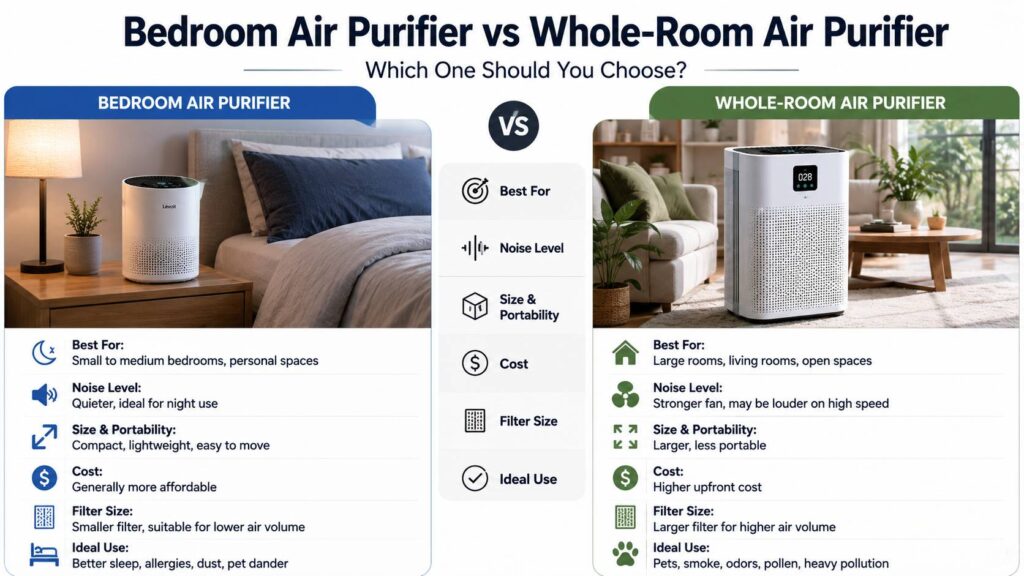
A bedroom air purifier is best for people who want cleaner air while they sleep. It is usually smaller, quieter, and easier to place. It can also cost less to run.
Pros:
- Good fit for small and medium bedrooms
- Quieter for night use
- Easier to place near the bed
- Usually cheaper to buy
- Lower power use
- Helpful for sleep comfort
- Good for dust, pollen, and pet dander in one room
Cons:
- Small models may clean too slowly
- Sleep mode often reduces airflow too much
- Small filters may need frequent replacement
- Not ideal for large rooms
- Weak odor control on cheaper units
- Less useful in open-plan spaces
The biggest mistake is buying a purifier that is too small. Compact models look nice, but some do not move enough air for a real bedroom. A good bedroom purifier should match the room size and still work well at a comfortable noise level.
Whole-Room Air Purifier Pros and Cons
A whole-room air purifier is better for larger rooms and shared spaces. It gives stronger airflow and usually has a larger filter. That makes it a better choice for pets, smoke particles, pollen, and rooms used by several people.
Pros:
- Better for large rooms
- Higher CADR
- Larger filters
- Stronger airflow
- Better for pet areas
- More useful for smoke and pollen
- Good value per square foot in larger spaces
Cons:
- Takes up more space
- Costs more upfront
- Can sound louder on high speed
- Replacement filters can cost more
- May feel too bulky in a small bedroom
- Coverage claims can be confusing
The main issue is comfort. A large purifier can clean very well, but it may not be pleasant near the bed. If you want one for a bedroom, check both CADR and sound level before buying.
Which One Is Better for Allergies?
For allergies, the better purifier is the one that fits the room and has enough airflow. A bedroom air purifier can be the better choice for nighttime symptoms. You spend many hours in bed, so cleaner air in that room can help you feel better in the morning.
For pollen, keep windows closed on high pollen days. Run the purifier before bed and wash bedding often. Store outdoor clothes away from the sleeping area. These small habits help the purifier work better.
For pet dander, the right choice depends on where the pet spends time. If your pet sleeps in your room, choose a strong bedroom purifier. If your pet spends most of the day in the living room, a whole-room purifier makes more sense.
For dust, both types can help. Still, dust already sitting on shelves, floors, and bedding needs cleaning. Air purifiers catch dust floating in the air, not dust stuck to surfaces.
Which One Is Better for Smoke?
For smoke, stronger airflow matters. Smoke particles are small and spread fast. A whole-room purifier with a high smoke CADR is usually the better pick for a living room or open space.
For a bedroom, choose a strong purifier with true HEPA filtration and a good carbon filter. Run it on a higher speed before sleep, then lower the fan once the room feels cleaner. This works better than leaving a weak unit on sleep mode all night.
Avoid ozone generators. Ozone is not a good indoor air cleaning choice for occupied rooms. It can irritate the lungs and create extra risk for children, pets, older adults, and people with asthma or breathing problems.
Which One Is Better for Odors?
A whole-room purifier often performs better for odors, mainly if it has a larger activated carbon filter. Bigger carbon filters can hold more odor-trapping material, so they usually last longer and work better.
A bedroom purifier can still help with light odors. It can reduce stale air, mild pet smells, and some smoke smell that drifts indoors. Yet strong odors need cleaning, ventilation, or source removal too.
Do not expect a small bedroom purifier to remove cooking smells from the next room. It is not built for that. For a kitchen-adjacent living area, choose a larger whole-room model with strong airflow and a proper carbon stage.
Filter Costs and Maintenance
Filter cost can change the real price of an air purifier. A cheap unit may become expensive if replacement filters cost a lot or need changing often. A larger purifier may have pricier filters, but those filters may last longer.
Check these details before buying:
- Replacement filter price
- Filter life in months
- Official filter availability
- Pre-filter cleaning steps
- CADR ratings
- Noise ratings
- Power use
- Warranty terms
- Room size rating
- Carbon filter size
A washable pre-filter is useful for pet hair and large dust. It helps protect the main filter and can reduce filter clogging. Still, most HEPA filters are not washable. Washing the wrong filter can damage it and reduce performance.
Common Problems People Notice After Buying
An air purifier does not always make the room feel fresh right away. Air purifiers work best with time, steady airflow, and the right room size.
Common issues include:
- The purifier feels too loud at night
- Sleep mode is too weak
- Filter replacements cost more than expected
- Odors remain after the purifier runs
- Dust still appears on furniture
- The room coverage claim feels exaggerated
- The purifier is too bulky for the space
- The display light is too bright for sleep
Most of these problems come from sizing, placement, or expectations. A purifier is not a deep cleaner, a dehumidifier, or a ventilation system. It is an air cleaner. It works best as part of a cleaner room routine.
Bedroom vs Whole-Room Air Purifier: Which Should You Buy?
Choose a bedroom air purifier if your main goal is better sleep, less dust near the bed, or allergy relief in a smaller room. Pick a quiet model with true HEPA filtration, enough CADR, and a display that can dim or turn off.
Choose a whole-room air purifier if you need to clean a living room, large bedroom, pet area, or open-plan room. It is the better pick for stronger airflow, faster cleaning, and heavier particle loads.
For many homes, the best setup is two purifiers: one stronger unit in the main living space and one quieter unit in the bedroom. That gives you cleaner air during the day and better comfort at night.
My practical view is this: buy for the room you use most. A well-sized purifier in the right place beats a huge purifier used on the wrong setting.
Final Verdict
A bedroom air purifier is best for quiet, personal air cleaning during sleep. A whole-room air purifier is better for larger spaces, pets, smoke, pollen, and shared rooms.
The right choice depends on room size, CADR, filter quality, noise, and daily use. For most bedrooms, choose a quiet true HEPA purifier with enough power to clean the room several times per hour. For living rooms and open spaces, choose a larger model with a higher smoke CADR and a real activated carbon filter.
Cleaner air does not come from the biggest purifier alone. It comes from the right purifier in the right room, used at the right fan speed, with clean filters and open airflow.