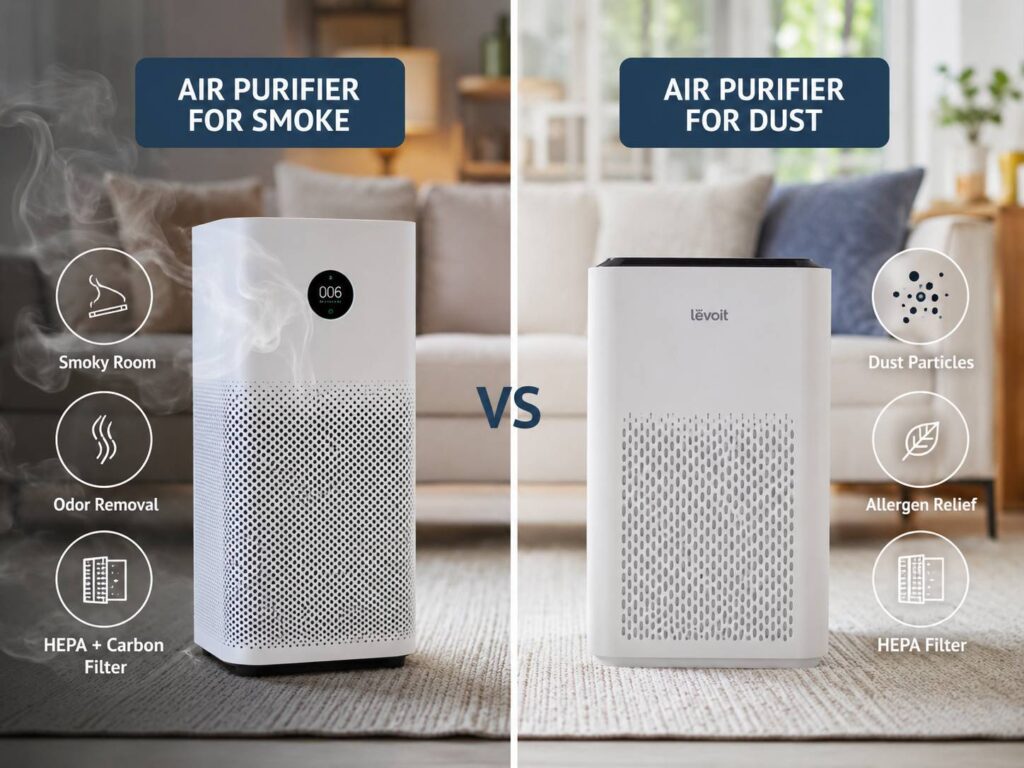
Smoke and dust both make indoor air feel dirty, but they do not behave the same way. That is why an air purifier for smoke and an air purifier for dust should not be judged by the same features.
Dust is usually made of larger particles. It can include fabric fibers, pet dander, pollen, skin flakes, soil, hair, and tiny bits from carpets or furniture. You see it on shelves, screens, vents, and dark tables. Smoke is finer and more stubborn. It can come from cigarettes, cooking, candles, fireplaces, wood stoves, wildfires, or outdoor pollution that slips indoors.
A good air purifier can help with both problems. Still, smoke needs more filtration power, better odor control, and often a higher budget. Dust is easier to trap, but it still needs steady airflow and regular cleaning around the home.
So, which one should you buy? Let’s break it down in a simple, practical way.
Air Purifier for Smoke vs Dust: The Real Difference
The main difference comes down to particle size, odor, and how long the pollution stays in the air.
Dust often settles on surfaces. It floats for a time, then lands on furniture, floors, blinds, and bedding. A purifier can catch airborne dust before it settles, but it will not remove dust that already sits on surfaces.
Smoke acts differently. It contains very fine particles that can stay in the air for longer. It can also carry odors and gases, which makes it harder to control. That is why a basic dust purifier often feels weak against cigarette smoke, wildfire smoke, or heavy cooking smells.
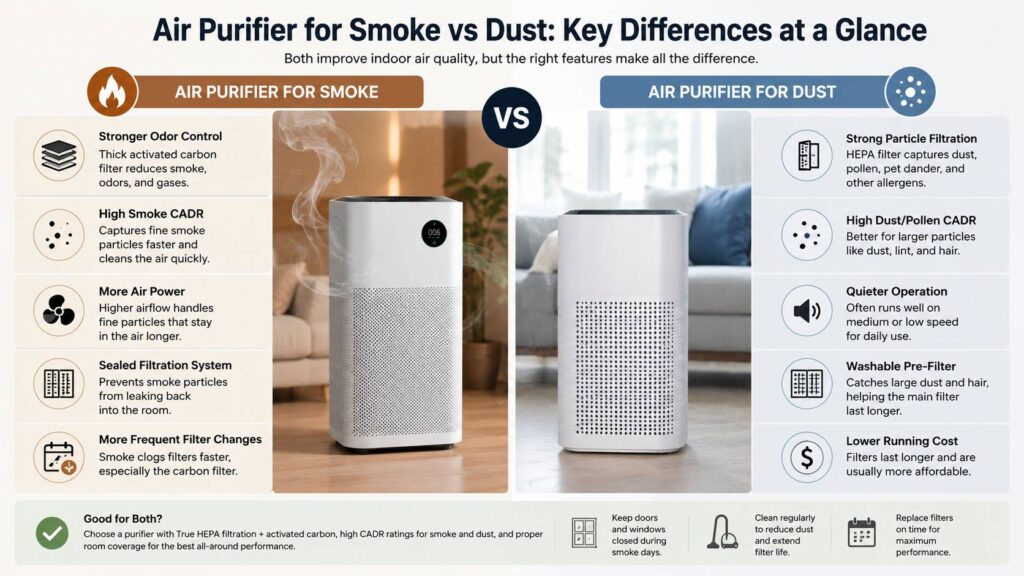
For dust, the most useful feature is strong particle filtration. For smoke, you need strong particle filtration plus activated carbon. The carbon part matters since it helps reduce odors and some gases.
A small purifier with a thin deodorizing layer might help with light smells. Still, it will not handle a smoky room well. Smoke needs more filter material, more airflow, and better room coverage.
What an Air Purifier for Dust Should Have
A dust-focused purifier should be simple, strong, and easy to maintain. The goal is to catch floating particles before they spread around the room.
Look for these features:
- True HEPA or a strong HEPA-style filter
- Good dust and pollen CADR ratings
- A pre-filter for hair, lint, and larger particles
- Low noise on medium speed
- Easy filter replacement
- Affordable filter costs
- Room coverage that fits your space
The pre-filter is more useful than it looks. It catches large debris before it reaches the main filter. As a result, the main filter can last longer and keep better airflow.
A dust purifier works best in bedrooms, offices, carpeted rooms, pet areas, and spaces near open windows. It can also help during pollen season, especially if you keep windows closed during high pollen hours.
Still, do not expect it to replace cleaning. A purifier reduces airborne dust, not settled dust. You still need to vacuum, wash bedding, clean vents, and wipe surfaces. For better results, use a sealed vacuum with a good filter and avoid shaking dusty fabrics indoors.
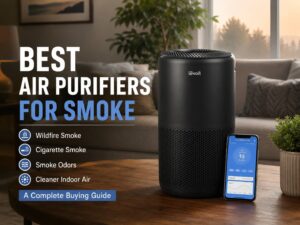
What an Air Purifier for Smoke Should Have
Smoke needs a tougher purifier. Fine particles are only part of the issue. Odor control matters too.
For smoke, look for:
- High smoke CADR rating
- True HEPA filtration
- A real activated carbon filter
- Strong fan power
- Sealed filter design
- Good room coverage
- Manual speed controls
- Replacement filters that are easy to find
A high smoke CADR helps the purifier clean fine particles faster. This is useful for wildfire smoke, cigarette smoke, fireplace smoke, and cooking smoke. If the purifier is too small, it will run loudly and still fall behind.
Activated carbon is the part that many cheap purifiers get wrong. A thin carbon sheet can reduce mild odors for a short time. Heavy smoke needs more carbon. The more smoke exposure a room gets, the faster the carbon filter wears out.
For cigarette smoke, the source matters most. A purifier can reduce airborne particles and some smell, but it cannot make indoor smoking safe. Smoke residue sticks to walls, carpets, sofas, curtains, and clothes. For this reason, even a strong purifier will struggle in a room where smoking happens every day.
HEPA Filters: Great for Dust and Smoke Particles
HEPA filtration is useful for both dust and smoke. It traps tiny airborne particles, so it helps with dust, pollen, pet dander, and fine smoke particles.
For dust, a HEPA filter catches floating particles before they settle around the room. For smoke, it catches fine particles that are too small to see.
Still, HEPA alone does not solve smoke odor. That is where activated carbon comes in. If you want a deeper filter comparison, this guide on HEPA vs activated carbon filter explains the difference in a clear way.
Some brands use vague labels such as “HEPA-type” or “HEPA-like.” That wording can be confusing. For a dust-only room, a good HEPA-style filter may still help. For smoke, vague claims are not enough. Choose a purifier with clear filter details, a proper CADR rating, and replacement filters from a reliable source.
Activated Carbon: The Filter Smoke Really Needs
Activated carbon helps reduce odors and certain gases. It is not the main filter for dust, but it matters a lot for smoke.
Cigarette smoke, wildfire smoke, fireplace odor, and cooking smells all need carbon support. Without it, the purifier may remove particles but leave the room smelling stale.
The size of the carbon filter matters. A thin carbon layer can lose strength fast. A thicker carbon filter has more material to trap odors, so it works better in smoky rooms.
That said, carbon does not last forever. Once it fills up, odors return. Smoke-heavy rooms need filter changes sooner than clean rooms. This is a hidden cost that is easy to miss.
For dust, carbon is nice to have but not required. For smoke, it should be treated as a core feature.
CADR: The Number You Should Check Before Buying
CADR means Clean Air Delivery Rate. It tells you how fast a purifier can deliver cleaner air for certain particles. Many purifiers list CADR scores for smoke, dust, and pollen.
For this topic, smoke CADR and dust CADR matter most.
A higher dust CADR means the purifier can clear dust particles faster. A higher smoke CADR means it can clear fine smoke particles faster. Still, the rating only helps if the purifier matches the room size.
Do not trust big room-size claims without checking the details. Some brands use loose room coverage numbers based on slow air cleaning. In real homes, especially with smoke or allergies, you need stronger performance.
A simple rule works well: buy a purifier rated above your actual room size. Then you can run it at a lower speed most of the time. The room stays cleaner, and the fan noise feels less annoying.
Which One Is Better for Allergies?
For allergies, a dust-focused HEPA purifier is usually the better first choice. Dust often carries pollen, pet dander, dust mite waste, and other particles that can trigger symptoms.
A good allergy purifier should have:
- Strong HEPA filtration
- High dust and pollen CADR
- A washable or easy-clean pre-filter
- Quiet night mode
- No ozone output
- Easy filter changes
Pet owners should pay close attention to the pre-filter. Pet hair and larger debris can clog the main filter faster. A removable pre-filter helps reduce that problem.
Smoke purifiers can help allergy sufferers too, especially during wildfire smoke events. Still, if your main issue is bedroom dust or pet dander, spend your budget on CADR, quiet operation, and filter cost before paying extra for a large carbon filter.
Which One Is Better for Cigarette Smoke?
For cigarette smoke, choose a smoke-focused air purifier. A basic dust purifier will not be enough.
Cigarette smoke contains fine particles and odor. It also leaves sticky residue on surfaces. A purifier should have a high smoke CADR and a real activated carbon filter. Small desktop units usually disappoint in this situation.
Here is the honest view: no portable air purifier fully fixes indoor smoking. It can reduce airborne particles and some odor, but it cannot clean smoke residue from curtains, walls, carpets, and furniture.
For better results:
- Keep smoking outside whenever possible
- Place the purifier in the room where smoke enters
- Use a purifier with high smoke CADR
- Choose a model with a large carbon filter
- Clean fabrics and hard surfaces often
- Replace filters sooner than the normal schedule
If children, pets, older adults, or people with asthma live in the home, the safest choice is to keep smoke out of the house.
Which One Is Better for Wildfire Smoke?
Wildfire smoke needs a smoke-focused purifier with strong fine-particle filtration. A high smoke CADR is very useful here.
During wildfire smoke days, use the purifier in one closed room. A bedroom or main living room often works best. Keep windows and doors closed as much as practical. Block obvious gaps if smoke smell enters around doors or windows.
Run the purifier before the room smells smoky. Once smoke has built up indoors, the purifier has a harder job. During severe smoke events, manual high speed often works better than auto mode.
Filter life can drop fast during wildfire smoke. If the air starts to smell smoky again or airflow feels weaker, the filter may need replacement earlier than expected.
Which One Is Better for Everyday Dust?
For normal home dust, a HEPA air purifier with a good pre-filter is enough for most people. You do not need the largest carbon filter if odor is not a major issue.
Dust purifiers work well in:
- Bedrooms
- Home offices
- Living rooms with pets
- Carpeted rooms
- Nurseries
- Rooms near open windows
- Spaces with lots of fabric furniture
Run the purifier daily. Short use after cleaning can help, but steady use works better. Air moves all day, so the purifier should run for more than a few minutes.
Placement matters too. Do not hide the purifier behind furniture. Keep space around the intake and outlet. If the purifier cannot pull air in freely, it cannot clean the room well.
For a full buying checklist, this guide on how to choose the right air purifier is a useful next step before you pick a model.
Filter Costs Can Change the Whole Decision
The purchase price is only the start. Filters decide the long-term cost.
Dusty homes clog filters faster. Smoky homes use up carbon faster. Homes with pets can do both.
Check these details before buying:
- Replacement filter price
- Filter life estimate
- Carbon filter size
- Pre-filter cleaning method
- Filter availability
- Whether the purifier uses separate or combined filters
Separate filters can save money in smoke-heavy rooms. You can replace the carbon filter more often without replacing the HEPA filter every time. Combined filters are simpler, but they can cost more if one section wears out faster.
If replacement filters seem expensive before purchase, they will feel worse later. A purifier with cheap, available filters is easier to live with.
Noise Level Matters More Than the Box Suggests
A purifier only helps if you run it often. Noise plays a big role here.
For bedrooms, check the noise level on low and medium speeds. Do not judge only by sleep mode. Sleep mode can be quiet but too weak for fast cleaning.
For smoke, high speed matters more. Smoke needs fast air cleaning, and fast airflow creates noise. A larger purifier can be a smarter choice, since it can move more air at a lower fan speed.
For dust, medium speed often does enough after the room air improves. A quiet purifier that runs all day is better than a loud one that gets turned off.
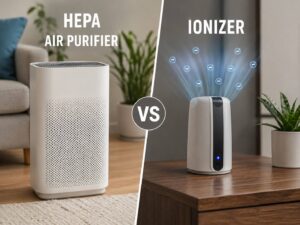
Ozone and Ionizers: Be Careful
Avoid air purifiers that produce ozone. Ozone can irritate the lungs, so it is a poor choice for home air cleaning.
Some purifiers include ionizers or plasma settings. For most homes, HEPA filtration and activated carbon are the safer, more practical filters.
This matters for both dust and smoke. You want particles trapped inside a filter, not charged onto walls, furniture, or floors.
Best Choice by Situation
Choose a dust-focused air purifier if:
- Your main issue is dust on furniture
- You deal with pollen or pet dander
- You need a bedroom purifier
- Odor is not a major concern
- You want lower filter costs
- You prefer quiet daily use
Choose a smoke-focused air purifier if:
- You deal with cigarette smoke
- Wildfire smoke enters your home
- Fireplace smell lingers
- Cooking smoke spreads into other rooms
- Odor control matters
- You need a stronger carbon filter
Choose a purifier that handles both if:
- You have pets and smoke exposure
- You live near traffic or wildfire-prone areas
- You cook often
- You want one purifier for mixed air problems
- You need extra protection during bad outdoor air days
The best balanced model should have strong HEPA filtration, high smoke CADR, high dust CADR, and a real activated carbon filter.
Common Problems People Notice After Buying
Many air purifier complaints come from sizing, placement, or filter cost.
Common issues include:
- The purifier is too small for the room
- The unit looks nice but has weak airflow
- Smoke smell returns after a few hours
- Filters cost more than expected
- The purifier is too loud on useful speeds
- Replacement filters are hard to find
- Dust still settles on furniture
- The unit sits too close to walls or curtains
The biggest mistake is expecting one small purifier to fix a constant source problem. If smoke keeps entering the room, the purifier must fight nonstop. If dust comes from carpets, bedding, pets, or dirty vents, cleaning habits still matter.
Real-World Opinion: Smoke Needs More Power Than Dust
For dust, many mid-range HEPA purifiers work well in normal bedrooms and offices. After a few days, the room can feel fresher. You may notice less floating dust in sunlight, fewer stuffy mornings, and less dust near electronics.
Smoke is less forgiving. Weak purifiers rarely satisfy people who deal with cigarette smoke or wildfire smoke. The smell comes back, the filter wears out fast, and the fan often needs to run loudly.
My honest opinion: buy more purifier than you think you need for smoke. For dust, you can stay closer to the room size rating. For smoke, extra CADR and more carbon are worth it.
Final Verdict: Air Purifier for Smoke vs Dust
If your main problem is dust, choose a HEPA air purifier with strong dust CADR, a good pre-filter, quiet operation, and affordable replacement filters. It will help with dust, pollen, pet dander, and other common airborne particles.
If your main problem is smoke, choose a stronger purifier with high smoke CADR, true HEPA filtration, and a large activated carbon filter. Smoke is harder to remove, so filter quality and room coverage matter more.
For mixed homes, choose a model built for both smoke and dust. Look for strong CADR ratings, proper HEPA filtration, real carbon, easy maintenance, and filter prices you can live with.
An air purifier works best as part of a cleaner routine. Reduce smoke sources, clean dust traps, place the purifier correctly, and replace filters on time. Do that, and the air in your home should feel cleaner, fresher, and easier to breathe.