Buying a robot vacuum sounds simple until you start reading about navigation. Then you see terms like LiDAR, vSLAM, AI camera, obstacle recognition, laser mapping, 3D sensors, room maps, and smart cleaning paths. That is where the LiDAR robot vacuum vs camera-based robot vacuum debate starts to matter.
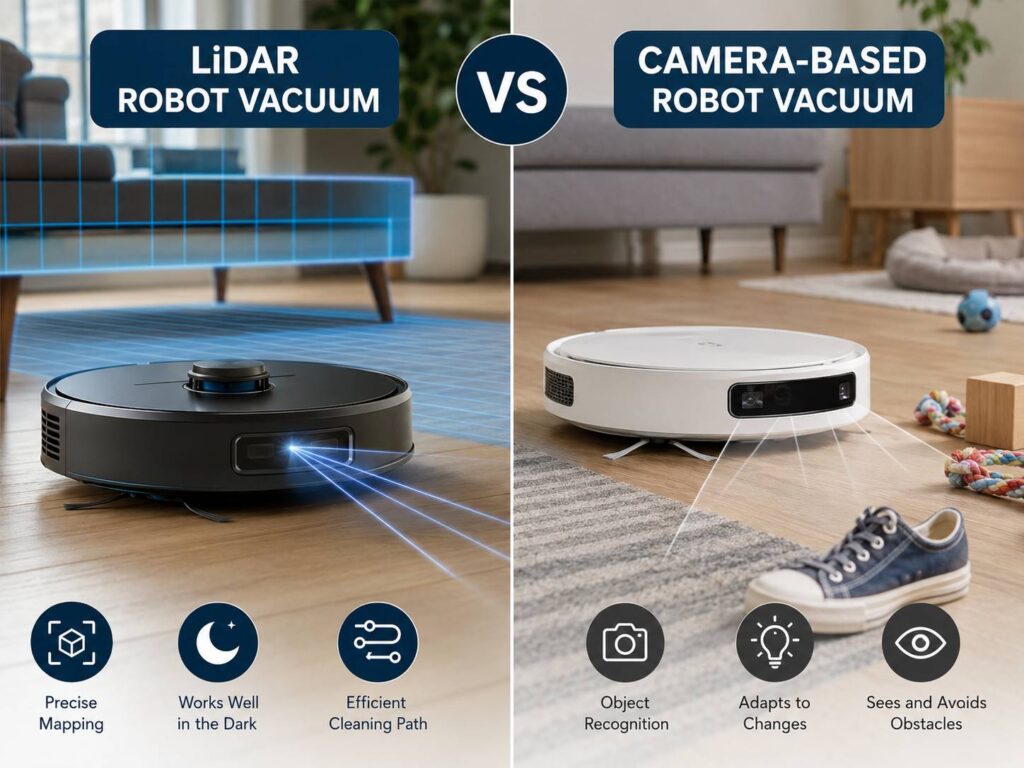
Both types can clean your floors without much effort from you. Still, they do not “see” your home in the same way. A LiDAR robot vacuum uses laser-based scanning to measure the room and build a map. A camera-based robot vacuum uses visual information to understand the space, spot objects, and follow landmarks.
So, which one is better? For most homes, LiDAR gives more reliable mapping, cleaner routes, and better performance in dark rooms. A camera-based robot vacuum can be smarter around clutter, especially if it has strong object recognition. The best choice depends on your home, your habits, your pets, and how much floor clutter you deal with every day.
What Is a LiDAR Robot Vacuum?
A LiDAR robot vacuum uses laser navigation to scan your rooms. LiDAR means Light Detection and Ranging. The robot sends out laser signals, reads the reflections, and builds a map based on distance.
That sounds technical, but the real benefit is simple. The robot understands the shape of your home quickly. It can tell where walls, doors, furniture, and open floor areas are. After that, it can clean in neat lines instead of bumping around randomly.
Most LiDAR robot vacuums create a map during the first cleaning run. Some models can map a floor even before they start a full clean. Once the map is ready, you can often name rooms, set no-go zones, choose cleaning areas, and send the robot to one room from the app.
In daily use, LiDAR feels predictable. The robot usually knows where it is, where it has cleaned, and how to get back to the charging dock. That makes it a strong choice for larger homes, open-plan spaces, and users who want a robot vacuum that behaves in a calm, organized way.
Still, LiDAR has one common downside. Many models have a small raised tower on top. That tower helps with scanning, but it can stop the robot from fitting under low beds, sofas, and cabinets.
What Is a Camera-Based Robot Vacuum?
A camera-based robot vacuum uses one or more cameras to understand your home. Some models use a top-facing camera for mapping. Others use a front-facing camera to detect objects on the floor. Premium models may combine cameras with lights, AI software, and extra sensors.
Instead of measuring the room with lasers, the robot uses visual clues. It looks at walls, furniture, corners, doorways, and objects. Then it builds a map and tracks its position.
This can work very well in bright rooms. A camera can recognize more detail than a basic laser scanner. For example, a good camera-based robot may identify shoes, cables, socks, toys, pet bowls, or other small objects. That helps the robot avoid things that can jam the brush or stop a cleaning run.
Still, camera navigation has a clear weakness. It needs decent light. If the room is dark, the camera has less information to work with. Some models use front lights, but they still may not feel as steady as LiDAR in low-light spaces.
LiDAR vs Camera-Based Robot Vacuum: The Simple Difference
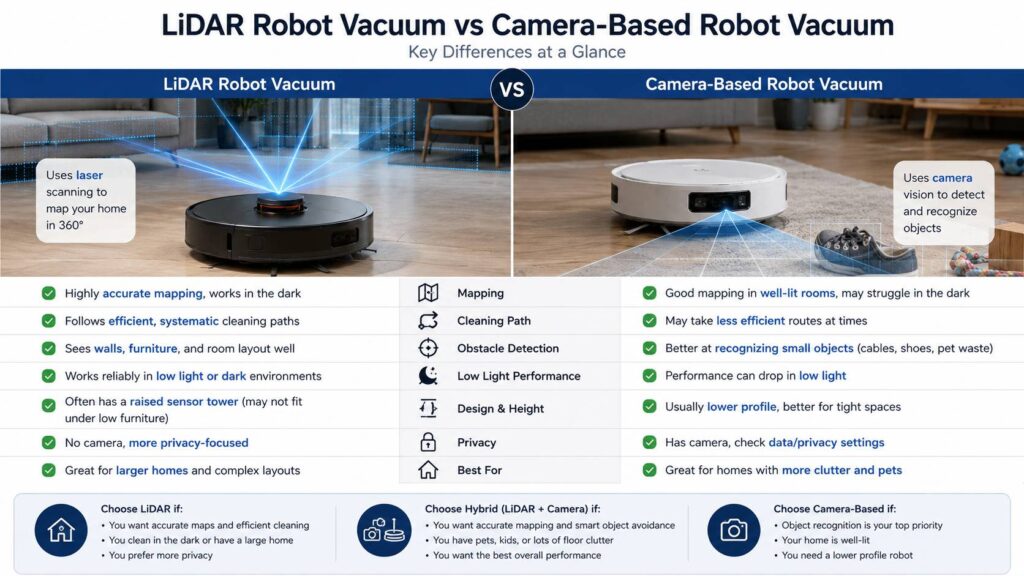
The easiest way to compare them is this: LiDAR is better at mapping space, and cameras are better at recognizing objects.
LiDAR helps the robot understand room shape. It works well for walls, furniture, doors, and open floor areas. It also works in the dark, which is a big deal if you run the robot at night.
Camera-based navigation helps the robot understand what it sees. A camera can identify clutter better, especially on higher-end models with AI object detection. So, it can be more useful in messy rooms where cables, toys, and pet items often sit on the floor.
That is why many premium robot vacuums now combine both systems. LiDAR handles the map. The camera handles the clutter. In my opinion, this hybrid setup is the best option for busy homes, especially if you have pets, kids, or lots of small objects on the floor.
Mapping Accuracy: LiDAR Usually Wins
Mapping is where LiDAR has a clear advantage. It scans the room with distance data, so it does not rely on daylight or visual landmarks. As a result, the robot usually creates a more stable map.
This matters more than it seems. A good map helps the robot divide rooms correctly, clean in straight rows, avoid repeated areas, and return to the dock without confusion. It also makes app controls more useful.
For example, if you want the robot to clean only the kitchen after dinner, a LiDAR model usually handles that command well. If you want to block a rug during mopping, virtual no-mop zones tend to feel more reliable with a strong map.
Camera-based models can create good maps too. Yet they can struggle more with poor light, mirrors, strong sunlight, and plain rooms with fewer visual details. A room with white walls, glossy floors, and low light can make visual navigation less reliable.
So, if map quality matters most, choose LiDAR.
Object Avoidance: Cameras Can Be Smarter
Obstacle avoidance is different from mapping. A robot can map your room well and still run over a sock.
LiDAR sees walls, furniture, and larger objects. It helps the robot avoid big crashes and plan a clean path. Yet small objects are harder. Thin cables, hair ties, Lego pieces, socks, and pet waste can still cause problems.
Camera-based robot vacuums can do better here, but only if the model has real object recognition. A basic camera does not guarantee smart avoidance. The software matters a lot.
A strong camera-based robot can spot common floor items and drive around them. That means fewer stuck sessions and fewer “robot trapped under chair” moments. For pet owners, object avoidance matters even more. Nobody wants a robot vacuum to run over a pet accident.
That said, object recognition is not perfect. A camera can miss a flat cable, a dark object on a dark floor, or a small item near a table leg. The best camera systems reduce risk, but they do not remove it.
Cleaning in the Dark
LiDAR is the better choice for dark rooms. It does not need normal room light to understand the space. You can run it at night, early in the morning, or in a hallway with no windows.
Camera-based robots need light to see clearly. Some use built-in LEDs, and that helps. Still, a dark room can reduce accuracy. Shadows can create extra confusion too.
If you like scheduled cleaning while everyone sleeps, LiDAR is the safer pick. It keeps navigation stable without needing lamps on in every room.
Privacy: Cameras Need More Thought
Privacy is a real concern with camera-based robot vacuums. A camera can collect visual information from inside your home. Some models process images on the device. Others may use cloud features for object recognition, remote viewing, or image review.
Not every camera robot is risky by default. Many brands offer privacy controls. Still, you should check the settings before buying. Look for options to disable live view, delete maps, manage image storage, and control object photo uploads.
LiDAR-only models can feel more private because they do not use normal camera images. Even so, they still create floor maps. A map of your home is personal data too.
My honest opinion: if privacy worries you, buy a LiDAR-only robot vacuum from a trusted brand and skip camera features. If you want AI object detection, choose a model with clear privacy controls and avoid turning on features you do not need.
Furniture Clearance and Robot Height
Robot height can matter more than suction power in some homes. If the robot cannot fit under your sofa, it will never clean that area.
Many LiDAR robot vacuums have a raised sensor tower. That makes them taller. In homes with low furniture, this can be annoying. The robot may stop at the front edge of a cabinet or get stuck under a bed frame.
Camera-based robots often have a flatter body. That can help them slide under more furniture. Still, not all camera models are slim, so check the exact height before buying.
A simple tape measure can save you a bad purchase. Measure the gap under your bed, sofa, TV stand, and cabinets. Then compare it with the robot’s height.
Carpet, Hard Floors, and Mopping
Navigation type does not decide cleaning power by itself. Suction, brush design, wheel grip, mop system, and carpet detection matter more for actual dirt pickup.
Still, navigation affects coverage. A LiDAR robot vacuum usually cleans in tidy rows and avoids missing large patches. That helps on hard floors, where you can often see dust trails and missed zones.
On carpets, strong navigation helps the robot cover the area evenly. Yet deep carpet cleaning still depends on suction and brush quality. A good map will not fix a weak motor or a poor brush roll.
For mopping, LiDAR can help with room control and no-mop zones. If you have rugs near hard floors, map accuracy becomes very useful. A robot that understands zones well is less likely to drag a wet mop over a rug.
For more buying help, this guide on robot vacuum features that actually matter is a good place to compare suction, docks, mops, sensors, and app controls before you choose a model.
Pet Owners: Which Type Makes More Sense?
Pet homes need more than basic navigation. Pet hair, food bowls, toys, litter, and accidents all create extra challenges.
LiDAR is great for planned cleaning. It can cover rooms well and return to the dock without much drama. That helps with daily pet hair control.
Camera-based object detection can be better for pet-related clutter. It can help the robot avoid bowls, toys, and some pet accidents on supported models. This is where premium camera systems can feel worth the extra money.
Still, no robot replaces basic prep. You should pick up loose cords, remove fragile pet toys, and keep food mats tidy. A robot vacuum is helpful, but it does not understand your home like a person.
My opinion: pet owners should choose either a strong LiDAR robot with good suction or a hybrid LiDAR plus camera model. If pet accidents are a real risk, do not buy a basic robot with no object recognition.
Common LiDAR Robot Vacuum Problems
LiDAR robot vacuums are reliable, but they are not perfect.
Common problems include:
- The raised tower may not fit under low furniture
- Mirrors can confuse the map
- Glass doors can create odd room shapes
- Thin cables can still get caught
- Very cluttered chair areas can slow the robot down
- The map may shift if someone moves the dock
- Black or reflective surfaces can cause strange behavior on some models
Most of these issues are manageable. Keep the dock in the same place. Give it open space on both sides. Use no-go zones for messy corners, cable areas, and narrow spots. After a few runs, the robot usually becomes easier to manage.
Common Camera-Based Robot Vacuum Problems
Camera-based models can feel smart, but they can be more sensitive to the room.
Common problems include:
- Weak performance in dark rooms
- Confusion from shadows or direct sunlight
- Missed small objects
- Privacy concerns
- Higher prices for good AI recognition
- More dependence on software updates
- Less stable mapping in plain rooms with few visual clues
A camera-based robot works best in homes with decent light and moderate clutter. It is less ideal for people who run the robot only at night or keep rooms very dark.
Which One Is Better for Most Buyers?
Start with LiDAR. It gives better mapping, better room control, and better cleaning routes. It also works well in the dark, which makes scheduled cleaning easier.
A camera-based robot vacuum makes sense if your main problem is floor clutter. If you often leave cords, socks, toys, or pet bowls around, object recognition can save you from stuck cleanings.
A hybrid robot is the best choice if your budget allows it. You get LiDAR for accurate mapping and a camera for smarter obstacle avoidance. That combination feels more complete in real homes.
If you are still unsure whether a robot vacuum fits your routine, read this guide on are robot vacuums worth it in 2026. It explains the real benefits and limits before you spend money.
LiDAR Robot Vacuum vs Camera-Based Robot Vacuum: Final Verdict
A LiDAR robot vacuum is the better choice for most people. It maps faster, cleans in more organized lines, works in dark rooms, and gives better control through the app. If you want reliable daily cleaning with fewer surprises, LiDAR is the safer pick.
A camera-based robot vacuum is better for object recognition. It can avoid more floor clutter, especially on premium models with AI detection. That makes it useful for homes with pets, kids, cables, toys, or busy rooms.
The best robot vacuum navigation system is usually a mix of both. LiDAR handles the map. The camera helps with real-life mess. That is why many top robot vacuums now use hybrid navigation.
For value, choose a good LiDAR model. For smarter obstacle avoidance, choose a camera-based or hybrid model. For privacy, choose LiDAR-only and review the app settings carefully.