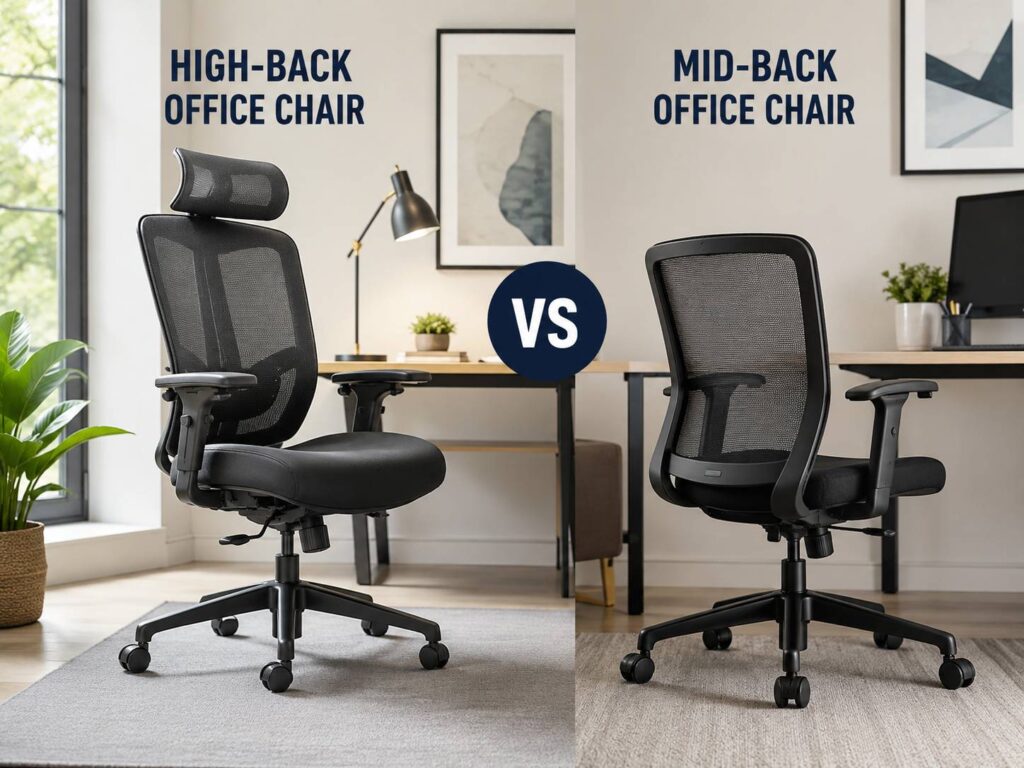
Choosing between a high-back and mid-back office chair seems easy until you sit in the wrong one for a full workday. The taller chair looks more supportive. The smaller one looks cleaner and easier to fit under a desk. Both can be comfortable, but they serve slightly different needs.
The real question is not just which chair has a taller backrest. It is how you sit, how long you work, how much you move, and what kind of support your body needs. A chair that feels perfect for one person can feel stiff, bulky, or awkward for someone else.
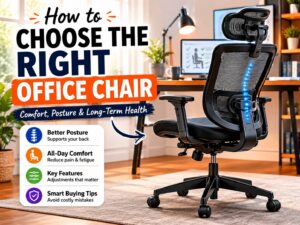
A good office chair should support your lower back, keep your shoulders relaxed, and let your feet rest flat on the floor. It should also help you sit close enough to your desk without forcing your arms forward. Backrest height matters, but lumbar support, seat depth, armrest position, recline tension, and build quality matter just as much.
This guide breaks down the real difference between a high-back and mid-back office chair, what each one does well, and which type makes more sense for long hours, posture, small rooms, and everyday home office use.
What Is a High-Back Office Chair?
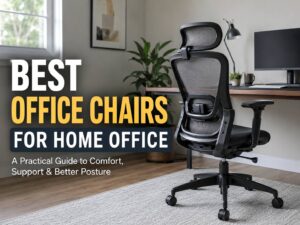
A high-back office chair has a taller backrest that supports more of your back. Most models cover the lower back, middle back, upper back, and shoulders. Many of them also include a headrest or neck support.
This type of chair usually feels more complete. You get more surface area to lean against, which can help during long desk sessions, video meetings, reading breaks, or relaxed work. People who lean back often usually prefer a high-back design since the chair supports more of the upper body.
High-back chairs are common in executive chairs, ergonomic office chairs, and gaming-style chairs. They often look more premium too, which makes them popular for home offices and dedicated workspaces.
Still, bigger does not always mean better. Some high-back chairs feel too bulky. Some headrests push the head forward. Others have a backrest shape that does not match the spine well. A tall chair only helps when it fits your body properly.
What Is a Mid-Back Office Chair?
A mid-back office chair has a shorter backrest. It usually supports the lower and middle part of your back, but it does not reach the head or neck. Some models come close to the shoulder blades, though they still leave the upper body freer than a high-back chair.
Mid-back chairs are common in task chairs, shared offices, meeting rooms, and smaller home workspaces. They are lighter, easier to move, and less visually heavy. They allow more shoulder movement and make it easier to shift positions during the day.
This design can work very well for focused desk tasks. Typing, writing, studying, editing, browsing, and short work blocks all fit the mid-back chair style. The chair gives support without making you feel locked into one position.
The trade-off is clear. A mid-back chair will not support your neck or head during reclined breaks. It may also feel less comfortable during very long days. That does not make it a bad choice. It simply makes it more task-focused than lounge-friendly.
High-Back vs Mid-Back Office Chair: The Main Difference
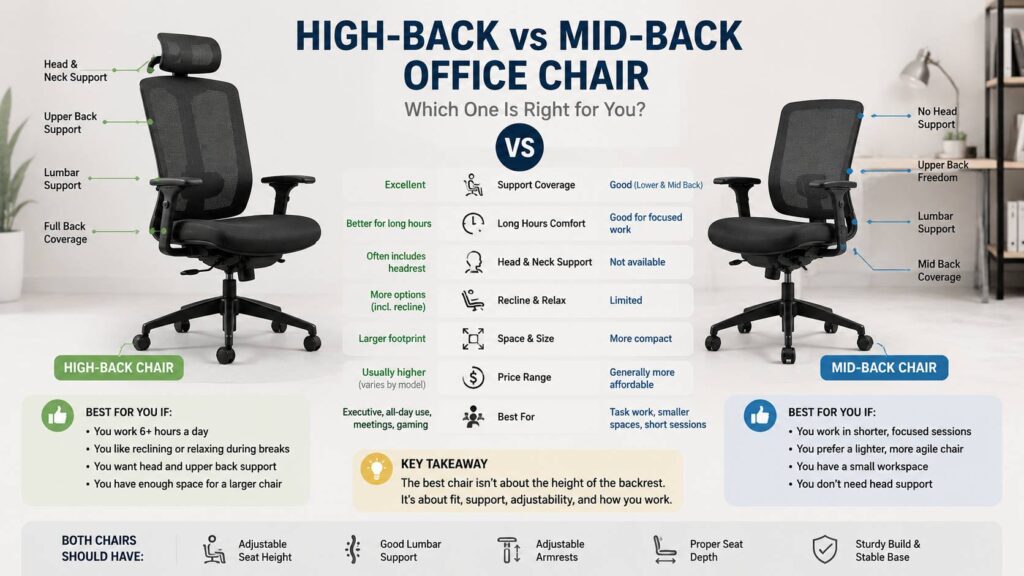
The main difference is support coverage. A high-back chair supports more of the spine and upper body. A mid-back chair focuses on the lower and middle back.
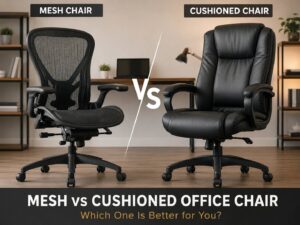
A high-back office chair usually feels better for long hours, relaxed sitting, and frequent reclining. It gives your upper back and shoulders a place to rest. A headrest also helps during calls or breaks.
A mid-back chair works better for people who sit upright, move often, or work in a smaller room. It feels less bulky and gives the upper body more freedom. This can feel more natural, especially during active desk work.
There is also a style difference. A high-back chair can make an office look more serious and complete. A mid-back chair often looks cleaner, simpler, and easier to blend into a bedroom or small apartment.
The right choice comes down to your daily routine. A chair for eight-hour workdays should not be judged the same way as a chair used for two-hour study sessions.
Which Chair Is Better for Long Hours?
For long hours, a high-back office chair is usually the better choice for most people. It supports more of the back and feels more comfortable when you switch between upright work, calls, reading, and reclining.
A high-back chair also gives you more room to rest. That matters during full workdays. After several hours, you probably stop sitting perfectly upright. You lean back, shift your shoulders, or change angles. A taller backrest helps during those posture changes.
Yet the chair still has to fit. A cheap high-back chair with weak lumbar support can feel worse than a good mid-back ergonomic chair. Thick padding can flatten. Faux leather can trap heat. A fixed headrest can press against the neck in the wrong place.
A mid-back chair can still work for long hours if you sit actively and take breaks. Some people prefer the freedom of movement. They do not want a large backrest behind them all day. Still, for most full-time desk workers, high-back models offer more comfort over longer sessions.
My honest view: if your chair is your main seat for work, calls, browsing, and gaming, a high-back ergonomic chair makes more sense. If you work in shorter blocks and move around often, a mid-back chair can be perfectly fine.
Which Chair Is Better for Posture?
Neither chair type fixes posture on its own. A tall backrest does not magically make you sit well. A shorter backrest does not automatically make you sit badly.
Posture depends on the full setup. Your lower back needs support. Your feet should rest flat. Your monitor should sit at a comfortable height. Your arms should stay close to your body. The chair should let you sit near the desk without reaching forward.
A high-back chair can help by supporting more of your back. This can reduce the urge to hunch during long meetings or reading sessions. It can also help people who feel upper-back fatigue after several hours.
A mid-back chair can encourage a more active sitting style. You may shift more, sit taller, and move your shoulders more freely. That can feel better for people who dislike large chairs.
The best posture choice is the chair that keeps your lower back supported without forcing your shoulders, neck, or hips into an awkward position. The label matters less than the fit.
Why Lumbar Support Matters More Than Chair Height
Lumbar support is one of the biggest comfort factors in any office chair. It supports the natural curve of the lower back. Without it, it is easy to slide forward, round your shoulders, or sit on the front edge of the seat.
A high-back chair with poor lumbar support is not a good ergonomic chair. A mid-back chair with strong, adjustable lumbar support can feel much better.
Good lumbar support should meet your lower back, not your upper back. If it presses too high, it can feel annoying. If it sits too low, it may do almost nothing. Height-adjustable lumbar support helps a lot, especially when different people use the same chair.
Depth adjustment is useful too. Some users need stronger pressure. Others prefer lighter support. A flexible backrest can also help since it moves slightly with your body.
This is one reason budget chairs can feel hit or miss. Many look ergonomic in photos, but the lumbar support is fixed in one place. That works only if your body matches the chair shape.
Seat Depth Can Make or Break Comfort
Seat depth is easy to overlook. A chair can have a great backrest and still feel wrong if the seat pan is too deep or too shallow.
A deep seat can stop your lower back from touching the backrest. This happens often with large executive chairs. Shorter users may sit forward without any real lumbar support.
A shallow seat creates a different problem. It may not support enough of the thighs. Taller users can feel like they are perched on the chair instead of sitting in it.
A good seat leaves a small gap between the front edge of the chair and the back of your knees. Your thighs should feel supported, but the seat should not press into the knees.
Adjustable seat depth is a strong feature for both high-back and mid-back chairs. It helps the chair fit more body types and makes long sessions easier.
Headrest or No Headrest?
A headrest sounds useful, and sometimes it is. It helps most during reclined sitting, long calls, reading, or short breaks. It gives your neck a place to rest when you lean back.
During active typing, the headrest matters less. Your head should stay balanced over your shoulders. Your eyes should face the screen without craning your neck.
The problem is that many headrests are poorly placed. Some push the head forward. Some sit too low for tall users. Others sit too high for shorter users. A bad headrest can create neck tension instead of comfort.
Choose a high-back chair with an adjustable headrest if neck support matters to you. Look for height and angle adjustment. A fixed headrest is risky unless you can test the chair first.
A mid-back chair usually has no headrest. That is fine for task work. It just feels less relaxing during reclined breaks.
Space and Room Setup
A high-back office chair takes up more visual space. In a small bedroom or apartment, it can make the room feel crowded. Some tall chairs also block more light and stand out in video calls.
A mid-back chair looks lighter. It usually slides under desks more easily and fits better in shared spaces. If your desk sits in a bedroom, living room, or tight corner, this can matter a lot.
Desk size also matters. Large high-back chairs often have wider armrests and bigger seats. If the arms do not fit under the desk, you may sit too far away. That can lead to reaching, wrist strain, and shoulder tension.
Before buying, measure your desk height, chair width, and available space. This small step prevents a lot of frustration.
Office Chair vs Gaming Chair: Does Back Height Change the Choice?
Many gaming chairs use a high-back design. They look supportive, and some feel comfortable for reclining. Still, a gaming chair is not always the best choice for office work.
Some gaming chairs have firm side bolsters, deep seats, and fixed shapes that do not suit every body type. They can feel snug at first, then restrictive after a few hours. A good ergonomic office chair often gives better adjustability for daily desk use.
That does not mean every gaming chair is bad. Some models work well. The point is that the category name does not matter as much as the fit, support, and adjustment range.
If you are comparing a tall gaming-style chair with a proper ergonomic office chair, read this full guide on office chair vs gaming chair. It will help you avoid buying based on looks alone.
Materials: Mesh, Fabric, Faux Leather, or Padding?
Material changes comfort more than people think. Mesh backs breathe well and suit warm rooms. They can also feel firm, which some users like and others dislike.
Fabric chairs feel softer and warmer. They often make sense for home offices. The downside is cleaning. Fabric can stain and hold dust more easily than mesh.
Faux leather looks premium in photos, but it can trap heat. It may also crack or peel over time, especially on cheaper chairs. Thick padding feels nice at first, but it can flatten with daily use.
For most people, breathable mesh or quality fabric is the safer daily choice. Soft padding alone should not sell the chair. Support and fit matter more.
High-Back Office Chair Pros and Cons
A high-back office chair works best for long days, reclined sitting, and users who want more upper-body support.
Pros:
- Supports more of the back
- Often includes a headrest
- Feels better for reclining
- Helps during long calls or reading
- Looks more premium in a dedicated office
- Works well as an all-day chair
Cons:
- Takes more room
- Can look bulky
- Poor headrests can cause neck discomfort
- Some models restrict shoulder movement
- Large seats may not suit shorter users
- Good models often cost more
A high-back chair makes the most sense when comfort over long hours matters more than saving space.
Mid-Back Office Chair Pros and Cons
A mid-back office chair works best for focused work, compact spaces, and people who like to move while sitting.
Pros:
- Feels lighter and less bulky
- Fits smaller rooms more easily
- Allows freer shoulder movement
- Often slides under desks better
- Usually costs less than premium high-back chairs
- Works well for upright task work
Cons:
- Does not support the head or neck
- Feels less relaxing when reclining
- May feel tiring during very long sessions
- Depends heavily on lumbar support
- Can feel too basic for all-day use
A mid-back chair is a smart choice when you want support without a large chair taking over the room.
Common Problems People Notice After Buying
The most common complaint with high-back chairs is poor headrest placement. People buy them for neck support, then find that the headrest pushes their head forward. This can make the chair uncomfortable fast.
Another issue is heat. Padded executive chairs and faux leather models can feel warm after one or two hours. The chair may look premium, but the sitting experience can become sticky and uncomfortable.
Mid-back chairs have different drawbacks. Upper-back support is missing during long calls, there is no headrest for reclining, and the shorter backrest can make you sit more upright than you would like.
Seat depth creates problems in both categories. A deep seat can ruin a good chair for shorter users. A shallow seat can annoy taller users. Armrests can also cause trouble if they sit too high, too low, or too wide.
The safest choice is a chair with more adjustment. Look for adjustable seat height, armrests, lumbar support, recline tension, and seat depth.
What to Look for Before Buying
Start with fit. Your feet should rest flat on the floor or on a footrest. Your knees should sit at a comfortable angle. Your lower back should touch the lumbar support without forcing you forward.
Check the armrests next. They should support your arms without lifting your shoulders. Adjustable armrests are much better than fixed ones.
The backrest should support your natural posture. A high-back chair should not push your head forward. A mid-back chair should support the lower back firmly enough for your work sessions.
Recline control matters too. A chair that reclines smoothly feels more natural. Recline tension lets you match the chair to your body weight.
Budget matters, but avoid the cheapest chair that only looks ergonomic. A low-cost chair with weak support can cost more in discomfort. For more help with price ranges and value picks, this best affordable office chair guide for 2026 is a useful next step.
Quick Decision Guide
Pick a high-back office chair if:
- You sit six or more hours per day
- You lean back often
- You want head or neck support
- You take long video calls
- You use one chair for work and gaming
- You have enough room for a larger chair
Pick a mid-back office chair if:
- You work in shorter sessions
- You prefer sitting upright
- You move around often
- You have a small workspace
- You dislike bulky chairs
- You do not need head support
Most full-time desk workers will feel better in a good high-back ergonomic chair. People with smaller workspaces or active sitting habits may prefer a mid-back chair.
Final Verdict: High-Back or Mid-Back Office Chair?
A high-back office chair is usually better for long hours, reclining, and full-back support. It gives your upper body more contact with the chair and feels more complete for all-day use.
A mid-back office chair is better for compact rooms, active sitting, and focused desk work. It feels lighter, takes less space, and gives your shoulders more freedom.
The real winner is the chair that fits your body and your desk. Do not buy only by backrest height. Look at lumbar support, seat depth, armrest adjustment, material, recline control, and overall fit.
For most home office users who work long days, a high-back ergonomic office chair is the safer pick. For smaller spaces or shorter work sessions, a well-made mid-back chair can be the cleaner and more practical choice.