
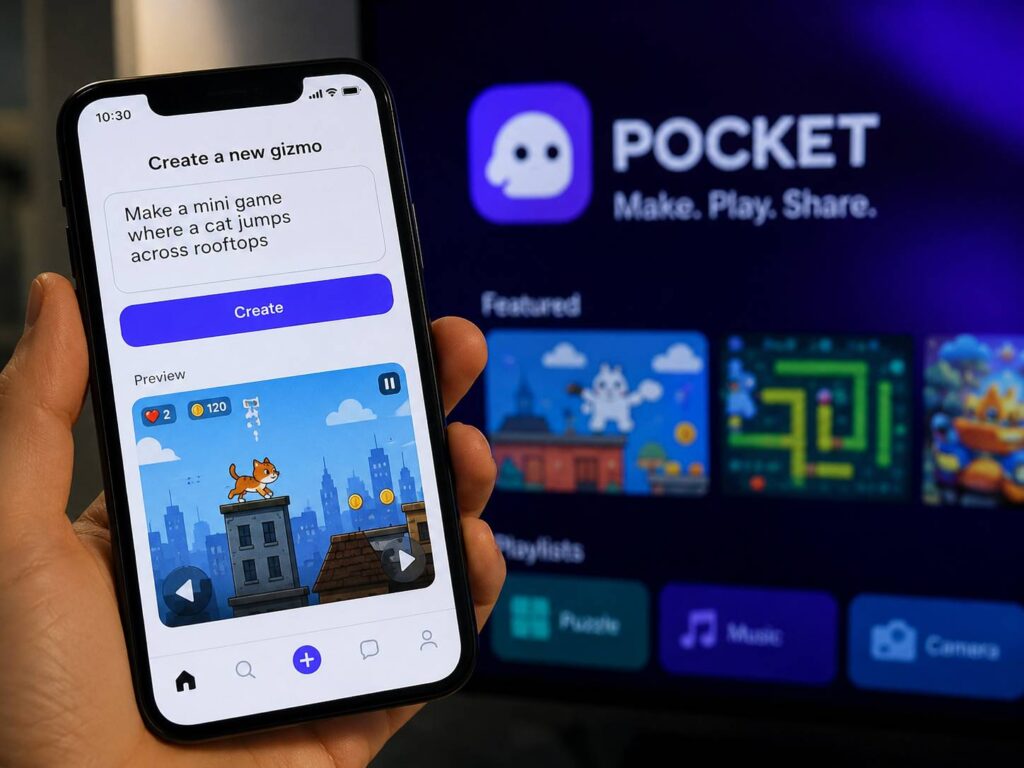
Meta Pocket is one of the more interesting AI experiments from Meta right now. Instead of asking people to write code or learn a game engine, the app lets users describe small interactive ideas in plain text and turn them into playable mini games, toys, camera tools, and other bite-sized experiences.
Meta calls these creations “gizmos.” A gizmo can be a quick puzzle, a funny soundboard, a camera effect, a small arcade-style game, or a playful tool that reacts to touch, motion, sound, or images. The idea is simple: write what you want, adjust the result, then share it with other users.
That makes Pocket feel less like a normal mobile game and more like a creative social app. You do not just play what someone else built. You can make your own version, save favorites, remix ideas, and browse a feed full of tiny interactive experiments.
What Is Meta Pocket?
Meta Pocket is a prompt-based creative app from Meta. It focuses on small AI-generated experiences instead of long games or complex apps. Users describe an idea, and the app turns that idea into an interactive “gizmo.”
This kind of tool lowers the barrier for people who have game ideas but no coding background. A user can start with a simple prompt such as “make a maze game with a robot dog,” “create a bouncing ball puzzle,” or “build a camera filter that reacts to my face.” Pocket then generates a playable version that can be edited and shared.
The app seems built for fast creation. It does not aim to replace professional game studios. It gives regular users a way to test small ideas and share them quickly. That is where Pocket gets interesting. It turns game creation into something closer to posting a photo or making a short video.
How Meta Pocket Turns Prompts Into Mini Games
Pocket works around plain-language prompts. You describe the type of experience you want, and the app builds a first version. From there, you can adjust the creation inside the editor.
A basic prompt can include the character, goal, style, controls, sound, or rules. For example, someone can ask for a falling-block game with fruit, a reaction timer with animals, or a tiny adventure where a spaceship collects stars.
The app’s real value comes from speed. A normal mini game needs planning, code, visuals, testing, and bug fixes. Pocket compresses that first step into a text box. The result will not always feel polished, but it gives users something playable right away.
That fast feedback loop matters. People can test an idea, change the prompt, adjust details, then publish a better version. It feels more like playful experimenting than formal game development.
Why AI Mini Games Matter
AI mini games are interesting because they move generative AI beyond static text, images, and video. A picture can look good, but it does not respond to the user. A mini game reacts. It gives players something to tap, tilt, test, and replay.
This turns AI content into an active experience. Instead of scrolling past a post, users interact with it. That extra layer of action can make Pocket more engaging than a regular social feed.
Meta already has a strong interest in social platforms, AI assistants, avatars, and smart devices. Pocket fits that direction. The company is trying to make AI feel more useful, personal, and entertaining. You can see the same broader push in products like Meta smart glasses, which bring AI features into everyday hardware.
Pocket takes a different route. It keeps the experience inside an app, but the goal feels similar: make AI feel more practical, more creative, and easier for normal users to try.
Pocket Feels More Like A Social Playground Than A Game Store
Most app stores work around finished products. Developers publish games, users install them, and updates arrive later. Pocket changes that pattern.
Inside Pocket, the feed becomes part of the experience. Users can browse other people’s gizmos, save the ones they like, and create their own versions. That makes the app feel closer to a social playground than a traditional game catalog.
This matters for discovery. A small game usually struggles to find an audience. In Pocket, each mini game can appear inside a feed, gain attention fast, and inspire new versions. Good ideas can spread through remixing rather than downloads alone.
My opinion: this is the part that gives Pocket its best chance. The app does not need every user to become a serious creator. It only needs enough people making fun, strange, and shareable gizmos that others want to try.
What Users Can Create With Pocket
Pocket’s format works best for small interactive ideas. The app seems better suited for short sessions than long-form gaming.
Users can create things like:
- Tap-based arcade games
- Camera filters with interactive effects
- Soundboards and music toys
- Puzzle games with simple rules
- Tilt-controlled challenges
- Photo-based mini experiences
- Quizzes and reaction games
- Funny tools made for sharing with friends
The strongest creations will likely be simple. A clever 20-second game can work better than a rough attempt at a large adventure. Pocket’s charm comes from quick ideas, not heavy production.
For teachers, Pocket can become a simple way to create learning games. For creators, it can become a tool for interactive posts. For casual users, it can become a place to make jokes, challenges, and tiny games for friends.
What Makes Pocket Different From AI Chatbots?
Most AI chatbots answer questions, write text, summarize information, or generate images. Pocket does something more hands-on. It creates interactive objects.
That difference matters. A chatbot gives you an answer. Pocket gives you something to play with. The output has rules, movement, buttons, reactions, and feedback.
This makes Pocket easier to understand for people who do not care about AI as a technical topic. They do not need to think about models or prompts in a serious way. They type a fun idea and see what happens.
The experience feels closer to making a toy than using a productivity tool. That gives Pocket a more casual, human feel.
The Limits Of Prompt-Made Games
Pocket sounds exciting, but prompt-made games have real limits.
AI can create a first version quickly, but that does not mean every result will feel good. Controls can feel awkward. Game rules can break. Visuals can look mismatched. Some prompts may produce dull or confusing results.
The editor will matter more than the prompt box. Users need simple ways to fix what the AI gets wrong. They need to change movement speed, button placement, sounds, colors, rules, and difficulty without fighting the app.
Privacy also deserves attention. Pocket creations can use photos, camera input, audio, or other phone features. Users should check app permissions before giving access to personal media or sensors.
My view: Pocket will succeed only if Meta keeps the creation process fun after the first prompt. A cool first result helps, but simple editing keeps people coming back.
Why Meta Pocket Could Become Popular
Pocket has a few things working in its favor.
First, people already understand short mobile content. They scroll, tap, like, save, and share every day. Pocket adds interaction to that behavior.
Second, AI creation still feels new to many users. A tool that turns a sentence into a playable mini game has a strong “try this” factor. That can help it spread through curiosity.
Third, the remix format can keep the feed fresh. One user can create a simple game, another can change the theme, and someone else can improve the rules. That creates a loop of playful copying and editing.
Pocket also gives Meta a way to test a new content format. Short video became the default social format for many people. Playable AI posts could become another format, at least for casual entertainment.
What Pocket Means For Casual Creators
Pocket gives casual creators a new way to make content without filming, editing, or coding. That is useful for people who want to create but do not want a complex workflow.
A creator can make a tiny game based on a trend. A parent can create a silly puzzle for a child. A student can build a quick quiz. A fan account can create a mini challenge around a character or topic.
The best use cases will likely be personal and playful. Pocket does not need to produce console-quality games. It only needs to help people make things that feel fun enough to share.
That is a realistic goal. Many popular social posts are not polished. They work because they are quick, funny, timely, or relatable. Pocket can bring that same energy to mini games.
Final Thoughts On Meta Pocket
Meta Pocket feels like an early look at where social AI content may go next. Text, images, and videos are already common. Interactive AI posts feel like the next step.
The app’s success will depend on three things: how good the generated mini games feel, how easy the editor is, and how active the community becomes. A strong feed can turn Pocket from a simple AI toy into a place people visit often.
My honest opinion: Pocket is not about replacing real game development. It is about making tiny playable ideas easy to create. That makes it more interesting than many AI apps that only generate text or images.
If Meta expands Pocket carefully and keeps the experience simple, AI mini games could become a new casual content format. Not every gizmo will be great, but the fun comes from trying, remixing, and finding the few that surprise you.