
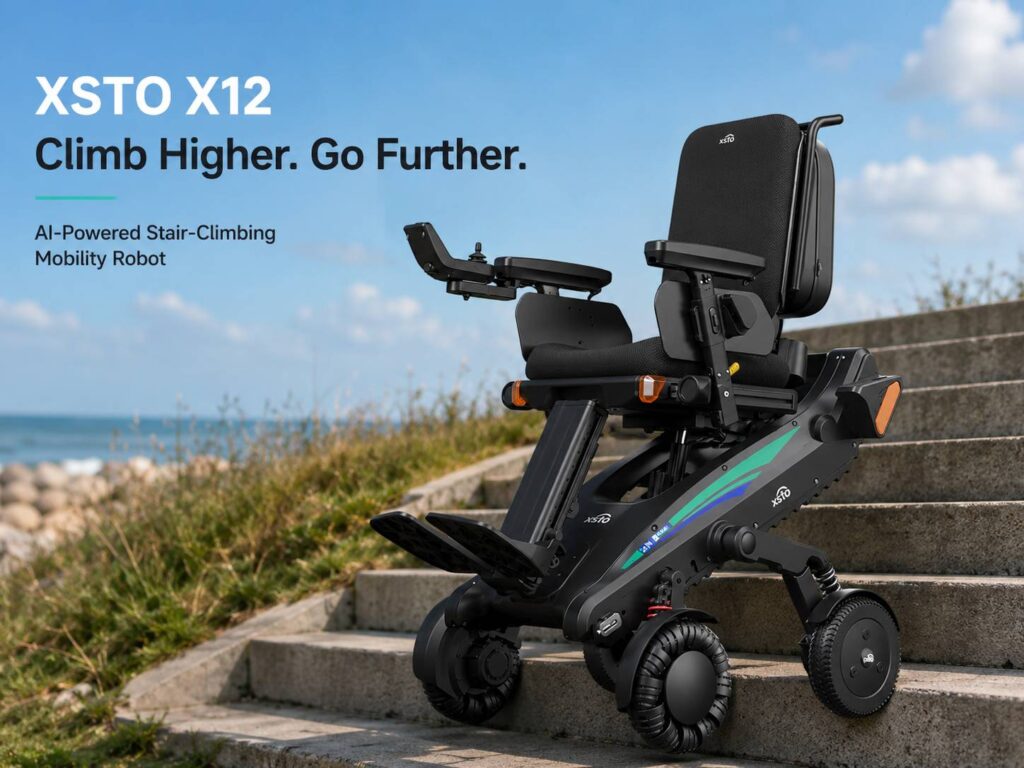
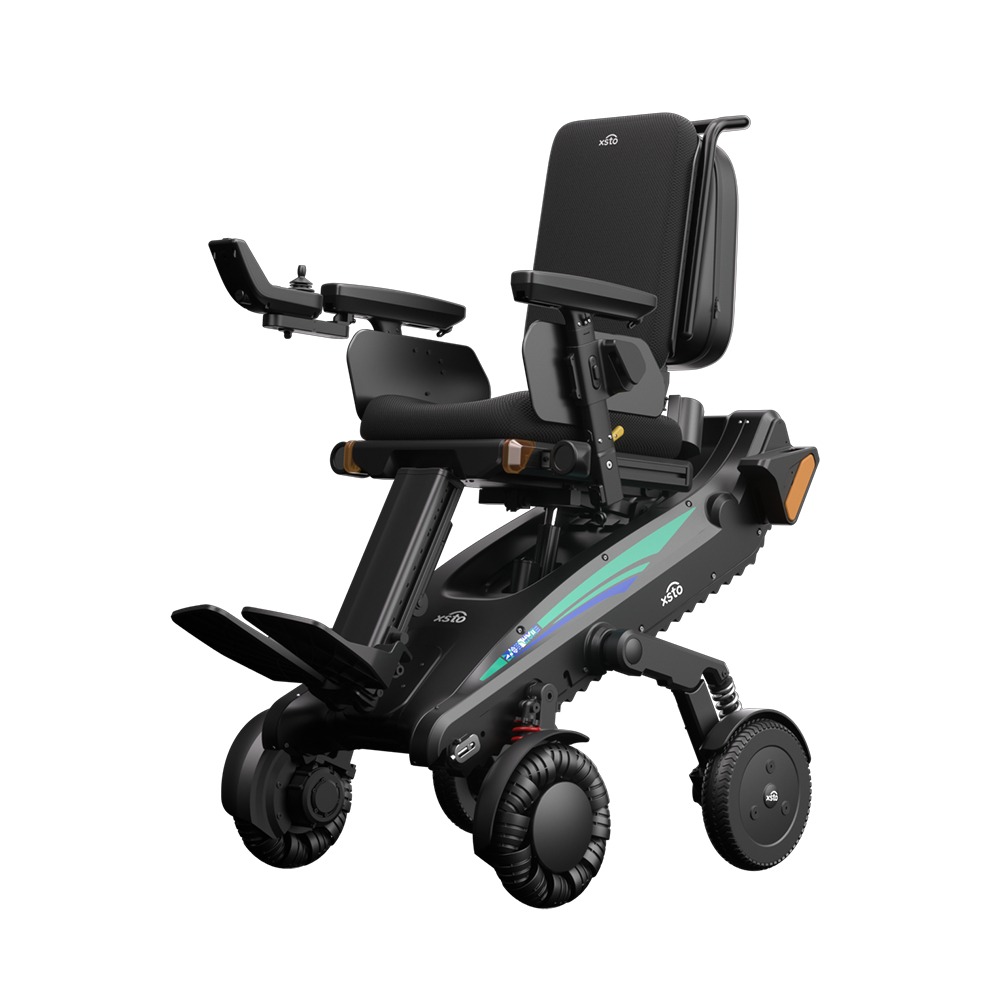
The XSTO X12 Mobility Robot feels very different from a regular powered wheelchair. It looks more like a compact personal mobility machine made for stairs, curbs, gravel, grass, ramps, and rough paths. For many people, that difference matters every day.
A standard electric wheelchair handles smooth floors well. It can work nicely in malls, hospitals, offices, and modern homes. Yet real life rarely stays that smooth. Older buildings still have stairs. Pavements crack. Driveways slope. Parks, yards, and gravel paths can turn a simple trip into a challenge.
The XSTO X12 tries to solve that problem with AI control, a wheel-track drive system, smart leveling, and terrain detection. It does not just roll forward. It adjusts how it moves based on the surface under it.
That makes the X12 one of the more interesting mobility devices in the all-terrain wheelchair space. It is not for everyone, and it should not be treated like a small scooter. Still, for users who face stairs and rough ground often, it brings a more serious answer to a very real access problem.
Why the XSTO X12 Mobility Robot Stands Out
The main difference starts with the drive system. Most powered wheelchairs use wheels only. Wheels feel smooth indoors, but they can lose grip on stairs, loose gravel, mud, grass, or uneven stone.
The XSTO X12 uses both wheels and tracks. That gives it more ways to handle different surfaces. On flat indoor floors, it can move in a regular wheel mode. On stairs, curbs, or harder ground, the tracks give it more contact with the surface.
XSTO designed the X12 with three movement modes:
- Quad-wheel mode for flat floors, ramps, grass, gravel, and daily travel
- Hybrid wheel-track mode for stairs, curbs, and harder transitions
- Dual-track mode for wider gaps, rougher ground, and more demanding terrain
This design gives the X12 more flexibility than a basic mobility scooter or standard electric wheelchair. It can act like a smooth chair in normal spaces, then switch to a more capable tracked system when the route gets harder.
In my view, this is the most useful part of the X12. The AI features sound impressive, but the real value comes from how the hardware and software work together. The sensors can read the terrain, but the tracks, motors, and leveling system do the physical work.
AI Helps the X12 Read the Ground
XSTO markets the X12 as an AI-powered mobility robot. In practical terms, that means the chair uses sensors and control software to read surface changes and adjust movement.
This helps most on stairs and rough terrain. The chair needs to control balance, power, speed, and seat angle at the same time. A simple motor system cannot do that well. The X12 uses multi-sensor control to manage those changes in real time.
For example, the robot can detect stairs and shift into the correct mode. Then it adjusts movement as it climbs or descends. This reduces the need for constant manual control from the user.
That matters. A mobility device should not make the rider feel like a machine operator. The user needs confidence, comfort, and predictable movement. Smart control can help with all three.
Stair Climbing Is the Big Feature
The XSTO X12 gets attention mainly for one reason: it can climb stairs. That feature gives it a clear role in homes, older buildings, small businesses, and places where ramps or lifts do not exist.
XSTO lists stair-climbing speeds of up to 25 steps per minute when going up and up to 30 steps per minute when going down. The chair works with step heights under 200 mm and stair angles under 35 degrees.
Those numbers show that XSTO built the X12 around stair access, not just occasional curb handling. It aims to deal with a barrier that many wheelchair users still face every day.
Still, buyers should measure carefully. Not every staircase will work. Tight landings, narrow corners, uneven steps, and sharp turns can create problems for any stair-climbing mobility device. A demo in a controlled space does not always match a real home.
So the smart move is simple: measure the stairs, check the landing space, and ask for a proper compatibility check before buying.
Rough Terrain Makes the X12 More Useful Outdoors
The X12 does more than climb stairs. It also targets outdoor movement across surfaces that many powered wheelchairs avoid.
XSTO says the X12 can handle grass, gravel, ramps, curbs, uneven roads, and rugged paths. The track system helps here, since tracks spread weight over a larger contact area. That can improve grip on loose or broken surfaces.
The chair also uses independent wheel suspension, which should make daily travel more comfortable. That matters on sidewalks, driveways, and outdoor routes where small bumps quickly become tiring.
XSTO lists a wheeled climbing ability of 15 degrees and a tracked climbing ability of 40 degrees. It also lists front obstacle clearance at 100 mm and rear obstacle clearance at 220 mm. In wheeled mode, it can cross ditches under 180 mm. In tracked mode, that figure rises to under 300 mm.
Those specs place the X12 in a higher-capability category than a normal powered wheelchair. For users who move between indoor spaces and rough outdoor areas, that wider terrain support may be the main selling point.
There is a useful comparison here with home cleaning tech. A robot vacuum and a cordless vacuum solve different cleaning problems, even though both clean floors. A similar idea applies to mobility devices. A basic powered wheelchair and an all-terrain stair-climbing robot do not serve the same user need. For a simple look at that kind of product-choice logic, see this guide on robot vacuum vs cordless vacuum.
Comfort Matters More Than Raw Speed
The XSTO X12 can travel from 0 to 12 km/h, which sounds quick for a mobility device. Still, speed should not be the main reason to care about it.
Comfort and stability matter more. A stair-climbing chair needs to feel calm, not dramatic. The rider should not feel thrown forward, tilted back too sharply, or shaken every time the surface changes.
XSTO says the X12 uses 360-degree dynamic leveling to keep the rider more balanced. The chair also offers a recline angle from 90 to 121 degrees and a lifting range from 490 mm to 762 mm.
These features make the X12 feel more complete as a daily mobility tool. It does not only aim to move over hard surfaces. It also tries to keep the seated position controlled during that movement.
The maximum load capacity reaches 136 kg. The X12 weighs 115 kg without the battery, and the X12 Pro weighs 116 kg without the battery. That weight makes sense for a tracked mobility robot, but it also affects storage, transport, and daily handling.
Battery Life and Real-World Range
XSTO lists up to 35 km of range on flat ground. That number sounds strong, but real-world range will change based on rider weight, slope, speed, terrain, stair use, temperature, and battery condition.
The X12 uses two lithium batteries rated at 25.2V and 25.6Ah. XSTO lists charge time at 6.5 hours for each battery.
For indoor users, that range may feel generous. For outdoor users, it needs more thought. Tracks and stair climbing use more energy than smooth rolling on flat ground. A user who plans longer daily trips should test the chair on normal routes before trusting the top range figure.
A full-day mobility device needs more than a good spec sheet. It needs predictable battery behavior, easy charging, clear battery alerts, and strong service support.
Who Should Look at the XSTO X12?
The XSTO X12 makes the most sense for users who often face barriers that a regular powered wheelchair cannot handle. That includes stairs, rough pavements, grass, gravel, steep outdoor paths, curbs, and older buildings.
It may suit:
- People who need stair access at home or work
- Users who travel across mixed indoor and outdoor surfaces
- Caregivers who need a more capable powered mobility device
- People living in older homes with poor accessibility
- Buyers who want a premium all-terrain powered wheelchair
- Users who need more independence across difficult routes
It will not fit every buyer. Some people will get better value from a lighter electric wheelchair, a ramp, a home stair lift, or a normal mobility scooter. The X12 targets a harder problem, so it comes with more size, weight, cost, and setup demands.
What Buyers Should Check Before Choosing It
The XSTO X12 looks powerful, but buyers should still be practical. Mobility devices need to match real spaces, not just product videos.
Before buying, check these points:
- Stair width and step height
- Landing space at the top and bottom of the stairs
- Turns on L-shaped or U-shaped staircases
- Doorway width
- Storage space
- Transport needs
- Service options in your area
- Warranty coverage
- Battery replacement cost
- Training needs for the user and caregiver
A test ride matters, too. The rider should feel safe during stair climbing, turning, stopping, and outdoor travel. Comfort is personal, and the best spec sheet cannot replace real use.
Final Thoughts on the XSTO X12 Mobility Robot
The XSTO X12 Mobility Robot brings AI control, tracks, wheels, smart leveling, and strong terrain support into one high-end mobility device. It targets a serious problem: many places still block wheelchair users with stairs, uneven ground, and poor access design.
Its biggest strength is clear. It gives users a way to handle routes that standard powered wheelchairs often cannot manage. The stair-climbing system, all-terrain drive modes, and leveling features make it far more capable than a basic chair.
Its biggest concern is also clear. It is a large, complex, premium device, so buyers need careful measurements, real testing, and local support before making a decision.
For the right user, the XSTO X12 could offer more than convenience. It could give back access to homes, paths, buildings, and daily routes that once felt too hard to use.