
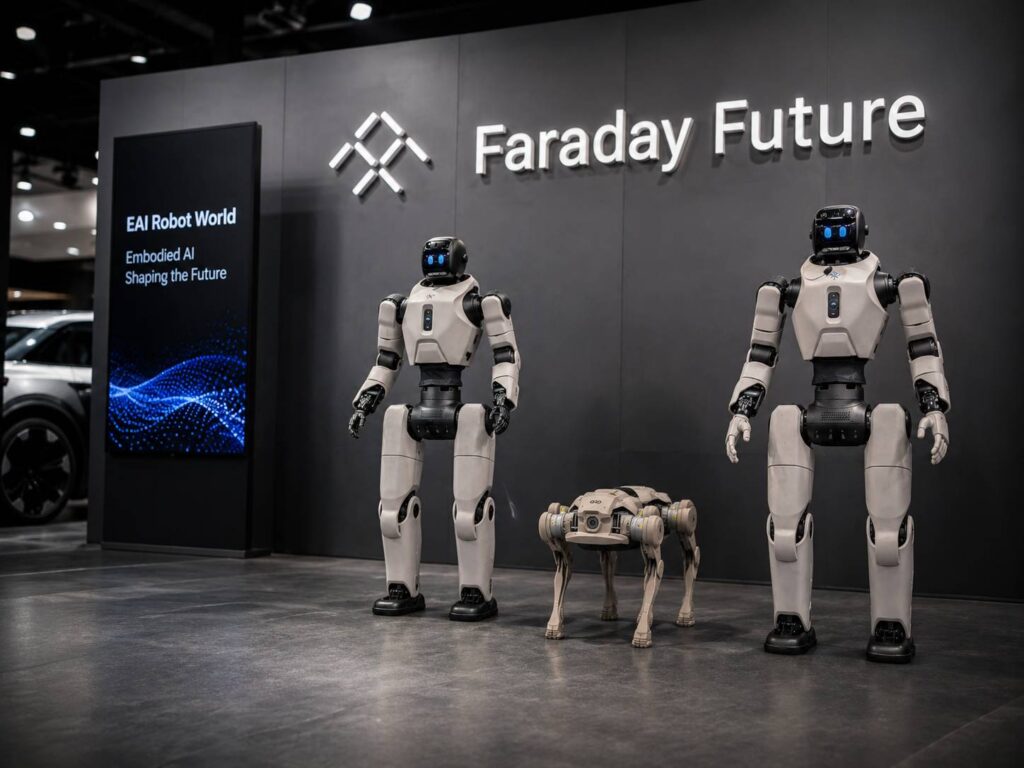
The Faraday Future robotics initiative is giving the company a new story beyond electric vehicles. For years, Faraday Future was tied mostly to the FF 91, luxury EV plans, and big promises around intelligent mobility. Now, the company is trying to step into a much wider space: robots powered by Embodied AI.
That shift is worth watching. Faraday Future is not only showing one robot for attention. Instead, it has presented a larger robotics plan built around humanoid robots, quadruped robots, mobile manipulators, education products, industrial tasks, and a shared AI platform. So, the message is clear: FF wants to be seen as a physical AI company, not just an EV brand.
The plan sounds ambitious, and yes, it still needs proof. Still, the idea behind it makes sense. Robots need hardware, software, real-world data, and a reason to exist. Faraday Future says its EAI robotics strategy brings those pieces together through different robot forms and one wider ecosystem.
For buyers, investors, and tech fans, the real question is simple. Can FF turn robot concepts into reliable products that people actually use every day?
What Is the Faraday Future Robotics Initiative?
The Faraday Future robotics initiative is based on the idea of Embodied AI, often called EAI. Put simply, this means AI inside machines that can move, sense, react, and perform physical tasks.
Instead of keeping AI trapped inside apps and screens, EAI puts it into robots. These robots can walk, roll, inspect areas, carry items, interact with people, or help with learning and training. That is where Faraday Future sees its next growth area.
The company has placed its robotics products under the FF EAI Robotics plan. This includes several robot types, such as full-size humanoids, smaller humanoids, robot dogs, and mobile robots with arms. Each one appears to target a different need.
For example, a humanoid robot can work well for teaching, research, reception, or guided interaction. A quadruped robot can handle patrol, movement practice, coding lessons, and companion-style tasks. A mobile manipulator can support warehouses, factories, inspections, and material handling.
So, FF is not betting on just one robot shape. It is trying to create a family of machines that can share software, data, and skills across different jobs.
FF EAI Robot World: The Product Lineup Explained
Faraday Future calls its wider robot lineup FF EAI Robot World. The name sounds bold, but the structure is fairly easy to understand. FF is grouping its robot products into several series, each built for a different user.
The main robot families include:
- FF Futurist, a full-size professional humanoid robot
- FF Master, an athletic humanoid robot
- FF Nova, a smaller entry-level humanoid robot
- FX Aegis, a quadruped robot for security and companion tasks
- FX Navi, a learning-focused quadruped robot
- FF Faber, a mobile manipulator for industrial work
At first glance, this may feel like too many products. Yet, there is a logic behind it. Education buyers do not need the same machine as a warehouse team. A family that wants a coding robot will not buy the same product as a factory looking for a mobile robot arm.
That separation gives FF more room to test the market. It can target schools with smaller and more affordable robots, then target companies with larger machines built for work. Plus, the company can use feedback from one group to improve the wider platform.
Still, product variety can become a problem if support falls behind. Spare parts, manuals, service, repairs, software updates, training, and pricing all need to be clear. Without that, a large product lineup can confuse buyers instead of helping them.
Why Education Could Be FF’s First Real Robotics Opportunity
Education looks like one of the strongest early use cases for Faraday Future robotics. The FX Navi robot dog is a clear example. It is positioned as a learning robot with visual programming, lesson support, a Skill Store, and room for secondary development.
That matters for schools, robotics clubs, and parents who want more than a toy. A good education robot should teach real skills. It should help students understand coding logic, sensors, movement, AI behavior, basic mechanics, and problem solving.
For example, students can learn how a robot reacts to commands. Then, they can adjust movement, test simple programs, and see the result in the real world. That hands-on feedback makes robotics easier to understand than a screen-only lesson.
This is where FF has a practical opening. Many families and schools want AI learning tools, but they do not want a complicated research robot that costs too much and needs expert setup. A smaller robot with guided lessons can feel more approachable.
Even so, the product must stay useful after the first week. A robot that only walks around the room will lose attention fast. For that reason, the software platform, lesson library, and update schedule matter as much as the hardware.
Industrial Robots May Be the Bigger Business
The education side is easy to understand, but the industrial side may become more valuable. FF Faber is the product to watch here. It is a mobile manipulator, which means it can move and use robotic arms.
That combination is useful. A fixed robot arm can repeat precise movements, but it stays in one place. A basic mobile robot can move goods, but it often cannot grasp or handle objects. A mobile manipulator sits between those two categories.
FF has discussed use cases such as factory support, warehouse movement, loading, unloading, security patrol, inspection, maintenance help, and data collection. Those jobs may sound boring, but that is exactly why robots can fit well there.
Many industrial tasks repeat every day. Some are tiring. Some are unsafe. Some take workers away from higher-value work. So, a robot that can handle part of that load has a clearer business case than a general home robot.
This connects nicely with other manufacturing trends too. Smaller companies are already looking at automation, compact production tools, and systems such as industrial 3D printing for smaller workspaces. In that context, FF’s industrial robots fit into a wider push toward smarter, more flexible production.
My view is that FF Faber sounds more practical than a home companion robot. Homes are messy, unpredictable, and price-sensitive. Factories and warehouses can define tasks more clearly. That gives robots a better chance to prove their value.
How Robotics Connects to Faraday Future’s EV Plans
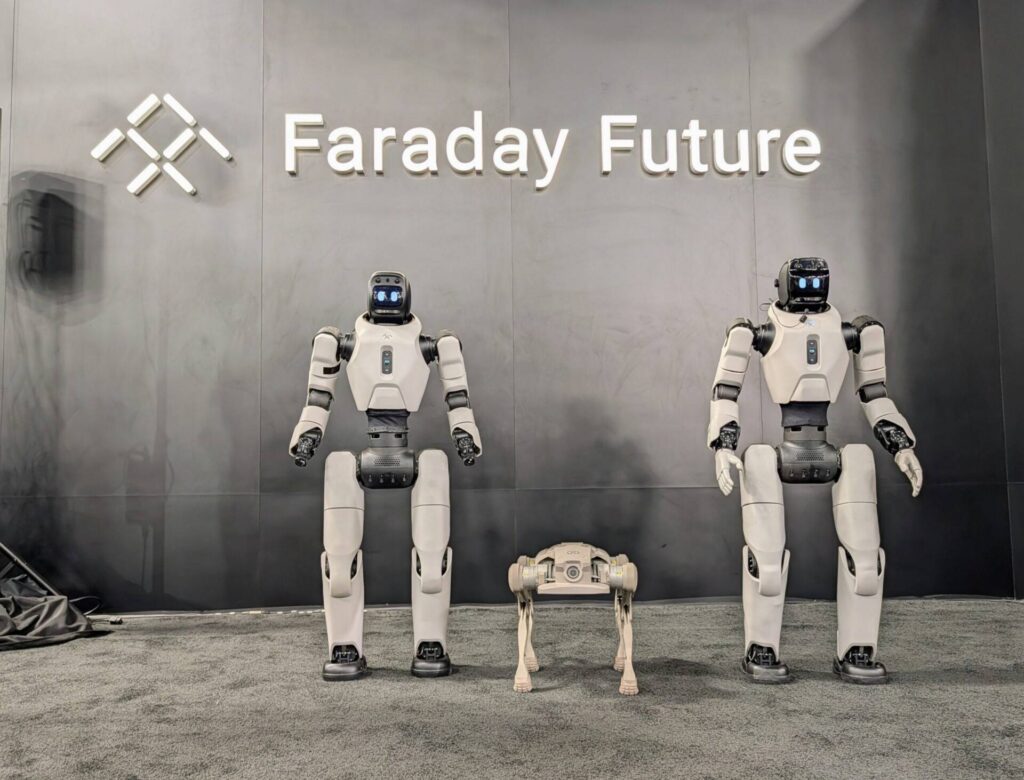
Faraday Future is still tied to electric vehicles, but the robotics initiative gives it a broader identity. The company appears to be connecting its EV knowledge with robotics through software, sensing, motion control, AI, and user interaction.
That crossover can make sense. Electric vehicles already depend on cameras, sensors, control systems, batteries, software updates, and smart interfaces. Robots use many related ideas, just in a different body.
For example, a robot needs to understand its surroundings. It needs to move safely. It needs to process commands. It needs power management. It needs regular updates. In those areas, an EV company can carry over part of its technical experience.
At the same time, robotics is not just “cars with legs” or “cars with arms.” It is a different field with different safety rules, repair needs, customer habits, and cost pressures. So, FF must prove that it can do more than adapt its EV language to a new market.
The company’s biggest advantage may be its brand story around intelligent mobility. The biggest risk is spreading itself across too many ideas before each one becomes stable.
What Buyers Should Watch Before Getting Excited
The Faraday Future robotics initiative sounds interesting, but buyers should look for clear proof before getting too excited. Launches are easy to talk about. Long-term product support is much harder.
Here are the points worth watching:
- Actual robot deliveries, not only announcements
- Clear pricing for each product
- Real customer use cases
- Repair and warranty terms
- Software update history
- School adoption for education robots
- Developer interest in the open platform
- Industrial testing with real companies
- Safety features and operating limits
- Long-term support for parts and accessories
These details matter more than bold product names. A useful robot should solve a real problem, work reliably, and be easy to maintain.
For education buyers, the lesson content should be clear. For industrial buyers, the robot should save time, reduce manual effort, or improve safety. For developers, the platform should be open enough to build useful tools. Without those pieces, the hardware alone will not be enough.
Why This Robotics Push Matters in 2026
Robotics is moving quickly in 2026. Humanoid robots, robot dogs, AI assistants, warehouse robots, and mobile manipulators are all getting more attention. At the same time, buyers are becoming more careful. They want products that work, not just demos that look good on stage.
That makes Faraday Future’s timing interesting. The company is entering a market with strong demand, but it is also entering a market with tough competition. Companies with deep robotics experience already have working platforms, partnerships, and customer trust.
Still, FF has one thing that helps: it is not trying to sell only one robot. The wider EAI plan gives it more chances to find a real market fit. Education robots could bring early visibility. Industrial robots could bring stronger business value. Humanoids could help with branding, research, and future use cases.
For now, the initiative should be treated as promising but unproven. The next stage needs shipped products, user feedback, and real-world performance.
Final Thoughts on the Faraday Future Robotics Initiative
The Faraday Future robotics initiative is one of the more interesting moves from an EV company this year. It shows that FF wants to move beyond luxury electric cars and into physical AI, education technology, and industrial automation.
The idea has potential. The product range is broad. The focus on education gives the company a friendly starting point, and the industrial robots could bring stronger long-term value. Plus, the shared EAI platform gives the strategy a clearer structure than a one-off robot launch.
Still, Faraday Future needs to earn trust with results. The robotics market will not reward big claims for long. Buyers will look for reliable hardware, useful software, fair pricing, real support, and proof that these robots can handle daily tasks.
So, the Faraday Future robotics initiative is worth following closely. It may become a fresh direction for the company, but the next step is simple: FF needs to show that its robots can move from announcements to real work.