
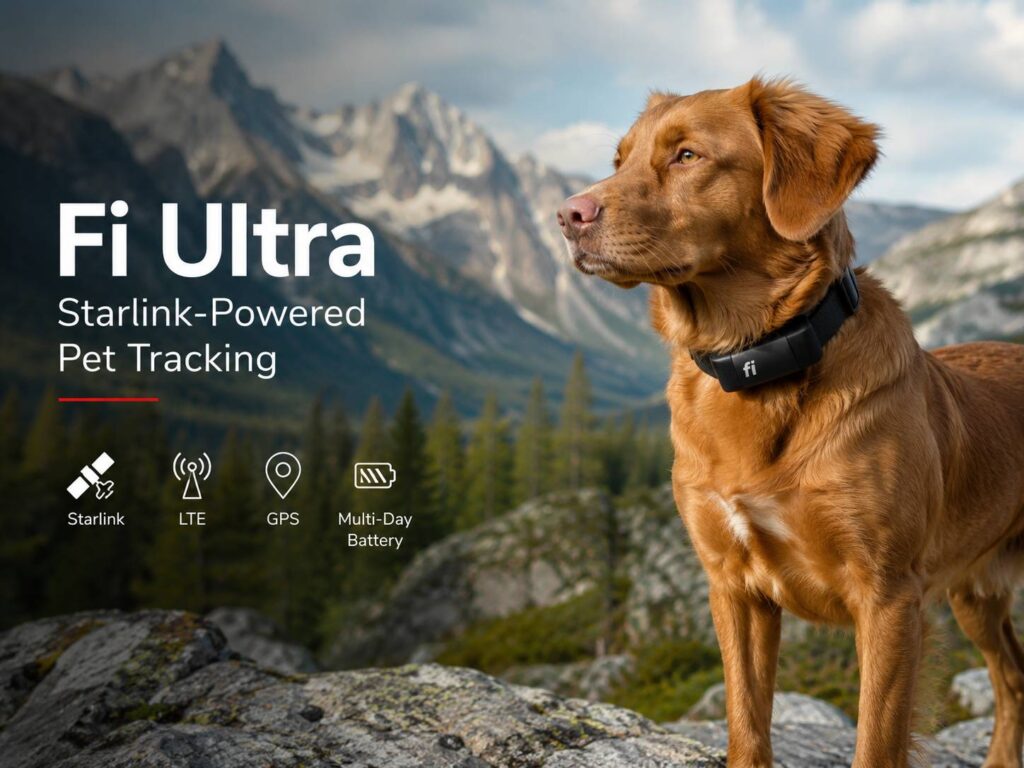
Fi Ultra feels like a smart dog collar made for a real problem, not just another pet gadget with a bigger feature list. Most GPS dog trackers work well in towns, suburbs, parks, and busy neighborhoods. The trouble starts when your dog gets beyond strong LTE coverage.
That is where Fi Ultra gets interesting. The collar uses T-Mobile T-Satellite with Starlink as a fallback connection when regular cellular service disappears. For dog owners who hike, camp, live in rural areas, or deal with weak signal at home, that extra connection layer could matter a lot.
A tracker can have accurate GPS and still fail at the worst moment. GPS helps the collar find the dog’s location. LTE sends that location to your phone. Once LTE drops, many trackers lose their biggest advantage. Fi Ultra tries to reduce that risk by giving the collar another way to send location data.
Why Fi Ultra Stands Out
Fi Ultra combines GPS, LTE, Wi-Fi, Bluetooth, and satellite connectivity in one collar system. That mix gives it more flexibility than a basic tracker.
The main feature is automatic switching. Fi Ultra can move from LTE to satellite fallback without the owner changing settings. During a stressful lost-dog moment, that matters. Nobody wants to dig through app menus while their dog runs toward a road, field, or wooded area.
The collar also uses dual-band GPS, which should help with more accurate positioning than older single-band GPS systems. That does not mean it will work perfectly in every spot. Trees, terrain, buildings, and battery level can still affect tracking. Even so, the hardware points in the right direction for owners who want more reliable coverage outside normal cell zones.
How Starlink Helps a Dog Tracker
Starlink does not turn Fi Ultra into home satellite internet on a collar. The device uses T-Mobile T-Satellite, powered by Starlink’s direct-to-cell network. In simple terms, Fi Ultra can fall back to satellite coverage when LTE service is not available.
That sounds technical, but the benefit is easy to understand. If your dog runs off in a place with poor cellular service, the collar has a better chance of sending location updates back to your phone.
This works best outdoors with a clear view of the sky. Thick tree cover, indoor areas, deep valleys, and blocked sky views can still cause issues. Satellite fallback is not magic, and owners should not treat it like a perfect live map in every situation.
Still, it is a meaningful upgrade over LTE-only tracking. Dogs often get lost in messy places, not in areas with perfect signal and easy roads.
Who Should Care About Fi Ultra?
Fi Ultra makes the most sense for owners who take dogs beyond the usual neighborhood walk.
It fits people who:
- Hike or camp with their dogs
- Live in rural areas with weak LTE coverage
- Own cabins, farms, or large properties
- Have dogs that chase wildlife
- Travel through remote roads or trails
- Want a stronger backup for escape alerts
For city owners, Fi Ultra may feel like more than they need. A standard GPS collar can still work well in strong LTE areas. If your dog spends most of its time near home, in a fenced yard, or on short walks, a cheaper tracker may do the job.
Still, Fi Ultra makes more sense once your dog’s world gets bigger. A collar with satellite fallback gives active owners more peace of mind, especially in places where phone bars disappear.
Fi Ultra Price and Membership
Fi Ultra sits in the premium pet tracker category. New members pay $199 for the tracker, then $189 per year for the membership. Existing Fi members can buy it for $299.
That price will not suit everyone. It costs much more than a Bluetooth tag, and the yearly membership adds to the long-term cost. The higher price makes the most sense for owners who need real GPS tracking, escape alerts, and better coverage outside LTE areas.
My opinion: Fi Ultra is easier to justify for dogs that spend time off the beaten path. For a small dog that only walks around a city block, it may be overkill. For an energetic dog that hikes, runs, or lives near open land, the added safety net feels far more practical.
Fi Callback Adds a Useful Training Cue
Fi Ultra also includes Fi Callback, a sound and vibration feature meant to help owners call their dog back. Fi says the feature does not use static electric shock.
This can help when owners train it properly. A sound or vibration cue should pair with rewards, repetition, and normal recall training. It should not replace basic training, and it will not fix poor recall overnight.
Used well, Fi Callback gives owners another way to communicate with their dog. Used randomly, it can confuse the dog. Short practice sessions and clear rewards will make the feature more useful.
Battery Life Still Matters
Fi says Ultra offers multi-day battery life. That sounds good for a collar with GPS, LTE, Wi-Fi, Bluetooth, and satellite fallback.
Real-world battery life will depend on use. A collar that stays near home Wi-Fi should use less power. A collar that tracks a lost dog through GPS and satellite fallback will drain faster. That is normal for this type of device.
Owners should charge the collar before hikes, camping trips, long drives, or off-leash outdoor days. A tracker only helps if it has power when the dog gets loose.
Fi Ultra vs AirTag for Dogs
Many pet owners compare GPS dog collars with AirTags, but the two products serve different needs.
An AirTag does not have built-in GPS, LTE, or satellite pet tracking. It relies on nearby Apple devices to help report location. That can work well in busy places with lots of iPhones nearby. It works much less well in empty fields, rural areas, forests, or campsites.
Fi Ultra works more like a true pet tracker. It uses GPS to find your dog and network connections to send that location to your phone. That explains the higher price and yearly membership.
AirTags can still help as a low-cost backup tag. Fi Ultra aims at owners who want active tracking and better coverage when their dog moves beyond normal cellular service.
Where Fi Ultra Fits in a Pet-Friendly Home
Fi Ultra focuses on outdoor safety, but pet owners often deal with indoor problems too. Shedding, muddy paws, and daily messes can make the house harder to manage, especially with active dogs. If pet hair is a bigger daily issue than tracking, a strong cleaning setup may matter just as much. For that side of pet care, this guide to the best robot vacuums for pet hair can help you compare better options for homes with dogs and cats.
That connection may sound small, but it matters. Pet tech works best when it solves real daily problems. Fi Ultra helps when a dog gets away. A good robot vacuum helps with the mess that comes with owning one.
What to Know Before Buying
Fi Ultra brings a strong feature set, but buyers should keep expectations realistic.
Satellite fallback works best outdoors. It can face delays or gaps. LTE still matters for normal daily tracking. Battery life will change based on how often the collar reports location. The membership fee also becomes part of the real cost.
Fit matters too. A tracker needs to sit comfortably on the dog’s collar or harness. It should not rub, bounce, or feel too bulky. Owners of smaller dogs should check the size and weight before buying.
The best pet tracker is not always the most advanced one. It is the one that matches your dog’s habits, your local coverage, and your own comfort level with ongoing costs.
Why Fi Ultra Matters
Fi Ultra points to where premium dog trackers are going next. GPS alone is not enough. LTE alone can fail in remote places. A better tracker needs several connection options, then it needs to switch between them without extra work from the owner.
That is the biggest reason Fi Ultra feels useful. The Starlink name will get attention, but the real value comes from the fallback system. If the collar can keep sending location data after LTE drops, it solves a clear problem for active dog owners.
Fi Ultra will not replace microchips, ID tags, fences, leashes, and good recall training. It should sit beside them as one more safety layer. For rural homes and outdoor dogs, that layer could be worth paying for.
Bottom Line
Fi Ultra is one of the more practical pet tracker launches in recent memory. It uses Starlink through T-Mobile T-Satellite to help track dogs when LTE coverage fails, and that gives it a clear purpose.
This is not the best pick for every owner. The price and yearly plan make more sense for hikers, campers, rural families, off-leash training, large properties, and dogs with a history of wandering.
For owners who stay mostly in strong LTE areas, a standard GPS collar may be enough. For dogs that roam, hike, chase, or travel, Fi Ultra brings a stronger backup plan. That makes it a serious option for anyone who wants better pet tracking beyond the usual cell coverage map.