
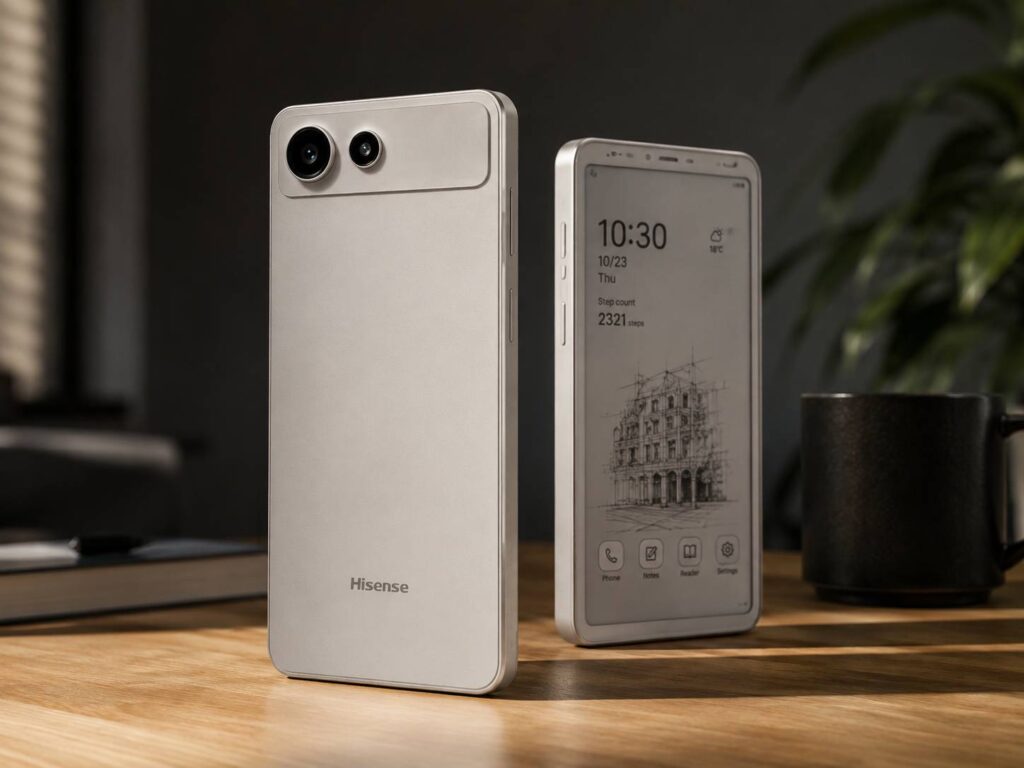
Hisense is returning to the E Ink phone market with a device that feels genuinely different. The new Hisense A10 places a 6.13-inch paper-like display on the front and adds a magnetic color LCD screen to the back.
The idea makes sense right away. The E Ink screen handles books, long articles, messages, notes, and documents. The detachable color screen steps in for photos, videos, comics, maps, and apps that need richer visuals.
This setup gives users two display types without forcing them to carry two separate devices. It keeps the calm reading experience of electronic paper, yet it still offers the familiar look and speed of a standard smartphone screen.
Hisense has not shared every technical detail yet. Still, the A10 already stands out as one of the most interesting E Ink phones announced in recent years.
The Hisense A10 Treats E Ink as the Main Display
Many dual-screen phones use E Ink as a small secondary panel. Hisense takes the opposite route. The 6.13-inch monochrome display sits on the front and acts as the phone’s main screen.
That choice tells us who this phone is for. The A10 targets people who spend more time reading, writing, browsing, or checking messages than watching videos or playing games.
Electronic paper works well in bright sunlight. It reflects nearby light instead of producing its own strong glow. Static pages need very little power, which can help during long reading sessions.
The experience may feel easier on the eyes for some users, mainly during long periods of text reading. It can also make the phone feel less distracting. Social media feeds, bright thumbnails, and colorful app icons lose some of their pull on a monochrome display.
Still, E Ink has clear limits. Scrolling can feel slower. Fast animations may leave faint traces behind. Video playback rarely looks smooth. Hisense addresses those problems with the removable screen on the back.
The Snap-On Color Screen Is the Most Interesting Part
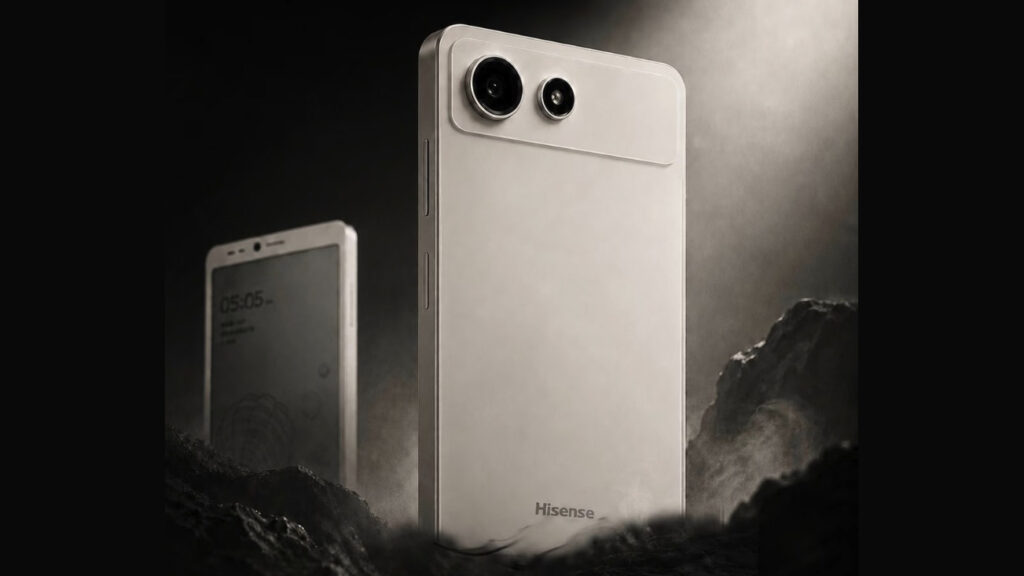
The detachable LCD is the feature that gives the Hisense A10 its identity. Users can attach it when they need a standard color display and remove it during reading or focused work.
That sounds simple, but it changes how the phone can be used throughout the day.
A student may use the front screen for textbooks and notes. Later, the color panel can display charts, slides, or educational videos. A commuter can read a novel on the train, then attach the LCD to view maps or photos. A professional can review documents on E Ink and switch screens for presentations or dashboards.
The magnetic design may keep the phone lighter during basic use. A permanent second display adds weight, thickness, and another piece of exposed glass. The A10 only carries those compromises when the accessory is attached.
This is the smartest part of the concept. Hisense does not pretend that electronic paper can match LCD technology in every task. It gives users a second screen for the moments when E Ink starts to feel restrictive.
The idea has some similarities to the way people choose different monitors for different needs. A Mini-LED display, for example, serves a very different purpose from an E Ink panel. Readers curious about those differences can read our guide to Mini-LED monitors and how the technology works.
Confirmed Hisense A10 Features
Hisense has revealed several core details about the phone:
- 6.13-inch monochrome paper-like display
- Magnetic detachable color LCD screen
- 4nm octa-core Qualcomm processor
- Android 16
- 5G mobile connectivity
- Wi-Fi 6 support
- A version sold without the color screen
The exact Qualcomm processor remains unknown. Hisense has not confirmed the amount of RAM, storage options, battery capacity, camera sensors, screen resolution, weight, or dimensions.
Pricing is still unclear too. Some early reports mention a possible starting price near CNY 3,999, but Hisense has not confirmed that figure. The price of the detachable screen remains unknown.
Those missing details matter. A clever design can lose much of its appeal when the accessory costs too much or the phone feels heavy with both displays attached.
Android 16 Gives the Phone More Freedom
The Hisense A10 runs Android 16, which makes it far more flexible than a basic e-reader. It can support calling, messaging, navigation, web browsing, productivity apps, reading platforms, and other Android software.
The main benefit comes from using the same apps across both screens. A user can read an article on the front display, then move to the rear screen for images or video. Files and accounts stay on the same device.
Software quality will play a major role here. Apps designed for OLED and LCD screens do not always look good on E Ink. Small animations, dark themes, transparent menus, and fast transitions can create visual problems.
Hisense has experience in this area. The company has released several E Ink phones in the past, including the Hisense A9. That model used a 6.1-inch display, a Snapdragon 662 processor, and 4G connectivity.
The A10 brings a newer processor platform, 5G, Wi-Fi 6, and Android 16. On paper, that makes it a major step forward.
Google Play support has not been confirmed for every region. Buyers interested in importing the Chinese model should check app compatibility, network bands, language support, and mobile payment access before buying.
Who Is the Hisense A10 Made For?
The A10 suits people who read more than they watch. It may appeal to ebook fans, writers, students, researchers, journalists, commuters, and office workers who spend hours with text.
It may attract people trying to reduce screen distractions too. A monochrome display can make the phone feel more like a tool and less like an entertainment device.
That does not mean the A10 is a basic phone. The color screen keeps modern apps within reach. Users can still view social media, photos, streaming apps, shopping pages, and video calls when needed.
The design seems less suitable for mobile gamers, frequent video editors, or people who place camera quality above reading comfort. Hisense has not presented the A10 as a flagship media phone.
Its strongest audience may be people who already carry both a smartphone and an e-reader. The A10 tries to combine those roles in one pocket.
The Detachable Display Creates New Questions
The rear screen solves several E Ink problems, but it creates a few new ones.
Users may forget the accessory at home. It could become damaged or lost. The magnetic connection needs to feel secure. The screen must respond quickly and switch between apps without awkward delays.
Battery use is another concern. Hisense has not said whether the LCD draws power directly from the phone or contains its own battery. Each design brings trade-offs.
A screen powered by the phone may reduce battery life quickly. A separate battery adds charging work and more weight. Hisense needs to make the process feel simple.
Cases may present another problem. A standard protective case could block the magnetic connection. Accessory makers may need to create special cases that support both display modes.
The phone may require users to flip it over each time they move between E Ink and color. That sounds fine for occasional changes, but frequent switching may become annoying.
These details will decide whether the A10 feels clever or clumsy in daily use.
Why Not Use a Color E Ink Screen?
A color E Ink display sounds like the obvious answer, but current versions still involve compromises.
Colors often look muted compared with LCD or OLED. Color resolution can be lower than black-and-white resolution. Motion remains slower, and video still looks rough.
Hisense has sold color E Ink phones before. The A10 takes a different path. It keeps a sharp monochrome screen for text and uses a separate LCD for content that needs better color and faster movement.
That division may deliver better results than asking one panel to handle everything. Text remains crisp and calm. Photos and videos get a proper color screen.
The trade-off is extra hardware. Two displays mean more parts, more software work, and more chances for something to feel unfinished.
Can the Hisense A10 Replace a Kindle and a Smartphone?
For some people, it may replace both. The A10 has cellular service, Android apps, a compact shape, and a display made for reading.
A dedicated e-reader still has advantages. Many models offer larger screens, waterproof designs, mature book stores, longer standby time, and simpler controls.
The A10 has to work as a phone first. Call quality, notifications, navigation, app support, cameras, and battery life still matter. A good reading screen will not make up for weak smartphone performance.
The A10 may work best as a focused smartphone rather than a complete Kindle replacement. It can reduce visual clutter during the day, then regain a familiar color interface when needed.
That balance feels more realistic than trying to make an E Ink screen perform like a normal phone display all the time.
Hisense A10 Price and Release Date
Hisense first teased the A10 in June 2026 and revealed more details in July 2026. The first launch information focuses on China.
The company has not announced a confirmed global release date. International pricing is unknown, and there is no confirmed list of supported markets.
Hisense still needs to reveal:
- Exact processor model
- RAM and storage choices
- Battery capacity
- Camera specifications
- Display resolution and refresh modes
- Magnetic screen price
- Supported mobile bands
- Software update policy
- International release plans
Until those details arrive, the A10 remains an exciting concept with several unanswered questions.
The core idea still feels strong. Users do not need to choose permanently between a calm E Ink display and a fast color screen. They can carry both and attach the second one only when it serves a real purpose.
That makes the Hisense A10 more than another unusual phone. It presents a practical direction for electronic paper devices, one that respects the strengths and weaknesses of each screen type.