
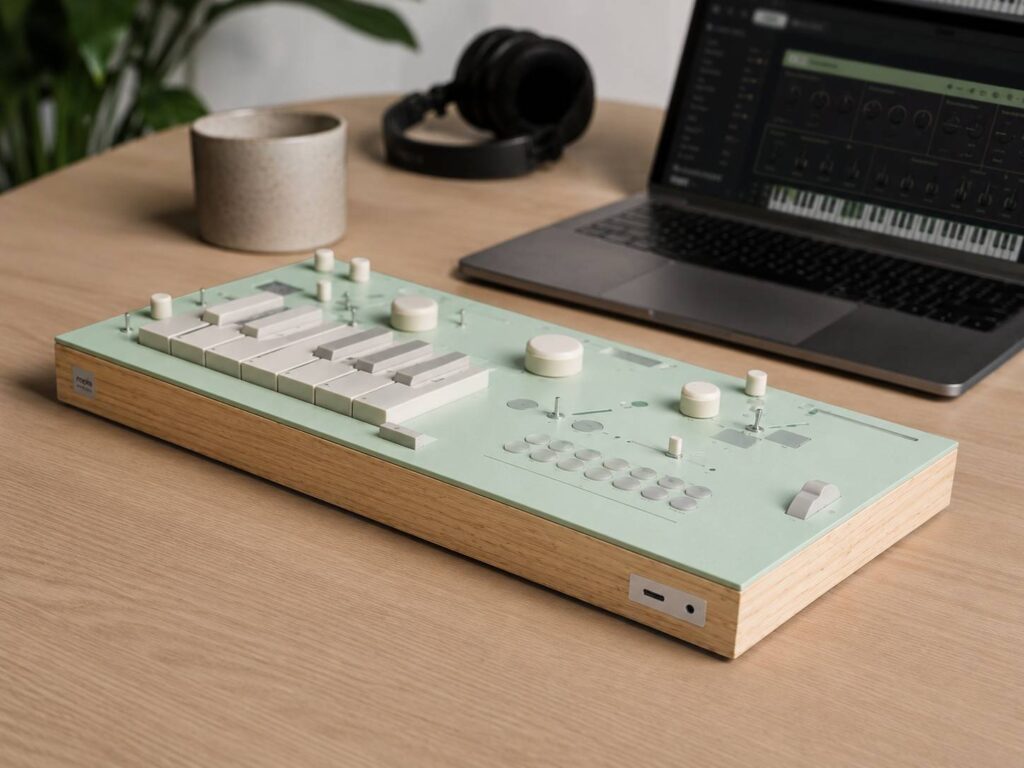
Nopia first grabbed attention in 2023 with a short prototype video, a soft pastel control panel, and a fresh idea. The instrument promised to make complex harmony feel direct, playful, and physical. Soon after, the clip spread across social media and pushed the project far beyond its original design contest roots.
Now, three years later, the Nopia MK1 appears close to release. Creators Martin Grieco and Rocío Gal have completed the main development work and moved the instrument through extended testing. A public demonstration in July 2026 offered the clearest look yet at the finished hardware, sound engine, performance controls, and planned price range.
Still, Nopia is not a regular keyboard synthesizer. Instead, it works like a dedicated harmony machine that combines chord creation, sound design, arrangement, and MIDI control in one compact device. That unusual mix explains why producers, live performers, and curious music makers have followed the project for so long.
What Is the Nopia MK1 Synth?
The Nopia MK1 is a semi-modular MIDI chord generator with a built-in sound engine. At its core, the workflow feels simple. A player selects a tonal center, builds a chord, changes its character, and sends the musical data to several sound sections at once.
The instrument separates its internal engine into four modules:
- Keys
- Bass
- Arp
- Pad
Each module handles a different part of the same harmonic idea. For example, one chord can create a keyboard layer, a bass line, an arpeggio, and a wide pad at the same time. So, instead of programming every part from scratch, the player can build the foundation of a track through a few direct controls.
That setup places Nopia somewhere between a synthesizer, a chord generator, a MIDI controller, and a drumless groovebox. It will not replace a full workstation or a complete DAW. Still, it gives harmony a dedicated physical interface, and that is the part that makes it feel different.
Why the First Nopia Prototype Went Viral
The original Nopia video gained close to three million views in roughly one week. At first, the visual design did much of the work. Its soft colors, compact body, and clear controls looked very different from the dark panels and crowded menus found on much music hardware.
Then, viewers noticed the workflow. Many chord tools depend on screens, software menus, or fixed progression presets. Nopia turned harmony into a series of physical movements. Users could choose a key, trigger chords, add extensions, change voicings, and perform transitions without spending hours inside menu pages.
Yet, the prototype still needed years of engineering work. The team had to turn a viral concept into stable hardware that could handle studio sessions, live sets, transport, and daily use. That meant redesigning the electronics, developing the sound system, refining the controls, and testing the unit across many real situations.
The delay frustrated some early followers. Even so, the long development period makes sense for a small hardware team. Parts, firmware, manufacturing, repair access, and long-term reliability all require careful work. Nopia’s creators chose to refine the device instead of selling an unfinished product on the strength of early hype.
How Nopia Turns Music Theory Into Physical Controls
Nopia builds its workflow around three main control areas. The Chord Builder uses a one-octave keyboard layout, but each key represents a chord instead of a single note. Next, the Tonal Selector uses 12 buttons to set the key. Then, the Extensions Dial changes the color and complexity of the selected chord.
This layout keeps the same relative structure across every tonality. Once players learn where each musical function sits, they can use the same pattern in another key. As a result, chord progressions become easier to explore without constant mental translation.
The instrument still asks the player to make musical choices. It does not turn composition into a one-button process. Instead, it changes how the user reaches those choices. Beginners can discover progressions by ear, and experienced musicians can use functional harmony without entering every separate note.
A voicing control shifts chords across registers and changes their spacing. Meanwhile, a major and minor switch sets the broad tonal direction. From there, the Extensions Dial adds more character and tension. These controls can produce richer harmony without asking the user to rebuild each chord by hand.
For me, this remains the strongest part of the Nopia concept. Harmony becomes something the player can shape in real time. It no longer feels like a task reserved for editing after a performance.
A Hybrid Sound Engine With Four Musical Layers
The Nopia MK1 combines sample-based sounds with virtual analog synthesis. Its four internal modules share the selected harmony, yet each one keeps a separate musical role.
The Keys module handles the main chord voice. The Bass section creates a lower supporting part. Next, the Arp module breaks the harmony into a repeating pattern. The Pad section fills the remaining space with a longer, softer texture.
As a result, the multitimbral system can move from a simple idea to a fuller arrangement in seconds. A musician can mute, shape, or route each layer and build a performance around one harmonic structure.
The onboard effects include filtering, delay, reverb, saturation, tape-style processing, and beat repeat. So, users have enough control for live performance and quick drafting without connecting several external processors.
That balance feels right for this type of instrument. A harmony-first device needs fast sound shaping more than hundreds of hidden parameters. Too many screens and menus would weaken the direct workflow that made Nopia interesting in the first place.
The broader idea fits a growing interest in physical controls across home technology. Some products aim to replace apps with direct interaction, such as the Philips Hue wired wall switch modules. Nopia follows a similar principle in music. It gives familiar actions a tactile form instead of placing every function behind a screen.
Touch Controls Add Strumming and Chord Bends
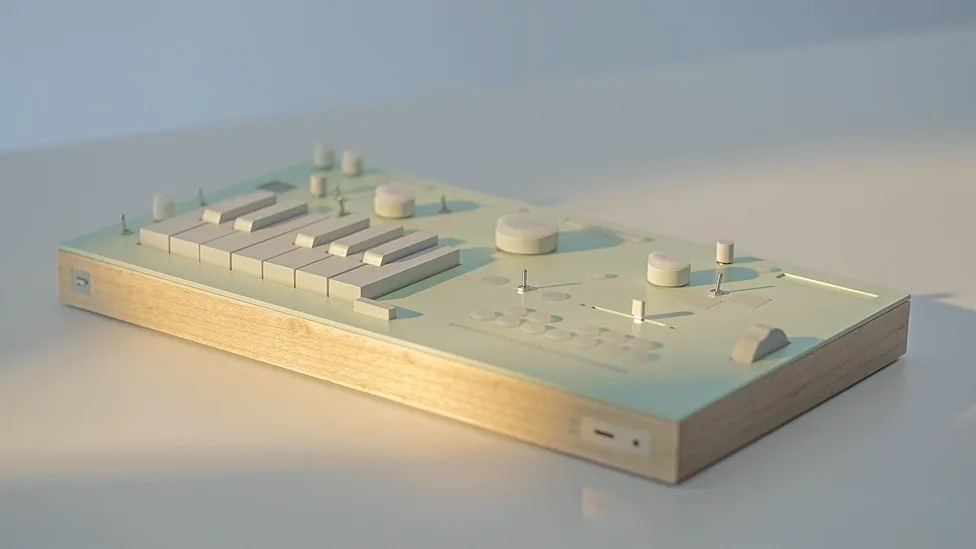
Nopia uses multitouch capacitive sensors for two expressive controls. First, the strum surface lets a player trigger individual notes from the active chord. That can turn a held block chord into a picked pattern, a rhythmic phrase, or a loose melodic texture.
The second touch control handles pitch. It supports chromatic and microtonal gestures, and it can bend a full chord rather than one isolated note. That opens the door to transitions that take far more setup on a standard MIDI keyboard.
Touch surfaces can feel less precise than mechanical controls. For that reason, the final calibration will matter. Still, the idea suits the instrument. Nopia focuses on fluid harmonic movement, and touch input supports that goal better than a row of tiny buttons.
An OLED screen shows chord information and parameter feedback. So, the player receives useful visual confirmation without relying on a menu-heavy interface.
MIDI Connectivity Expands the Nopia MK1
Nopia can operate as its own sound source, but its MIDI routing may become one of its strongest features. The MK1 has four dedicated TRS MIDI outputs, with one output for each internal module.
For example, the Keys output can control a polyphonic synthesizer. The Bass output can drive an analog monosynth. The Arp output can feed a digital sound module. Meanwhile, the Pad output can control a sampler or a software instrument.
That setup turns Nopia into the harmonic center of a wider music rig. The unit includes MIDI input, USB MIDI, clock input and output, and a sustain pedal connection. So, it can work inside a DAW setup, a desktop system, or a hardware-only live rig.
The audio section includes a quarter-inch master output and a one-eighth-inch auxiliary output with a dedicated metronome feed. USB-C provides 5V power and carries MIDI data.
The device measures 41.5 by 23 by 3.5 centimeters. As a result, it offers enough space for a clear control layout, yet it remains slim enough for a backpack or a smaller studio desk.
Nopia MK1 Price and Expected Release Window
Nopia has not posted a final sale date on its official website. The product page still says the team plans to release the instrument after testing and durability work are complete.
During the July 2026 demonstration, the creators said the synthesizer was nearly finished and targeted a launch within a couple of months. They placed the expected price near £550. Still, the final retail price can change before official orders open.
The company has warned buyers not to trust unofficial sales pages or purchase links. At this stage, the safest option is the official Nopia waitlist and beta program. No confirmed retailer list or final regional pricing has appeared yet.
At around £550, Nopia would cost more than many compact MIDI chord controllers. Yet, it would remain below several premium performance synthesizers. Its real value will rest on build quality, sound design, firmware stability, and the depth of its MIDI features.
Who Is the Nopia MK1 Made For?
Nopia seems best suited to musicians who think in progressions, texture, and arrangement. It can serve several types of users:
- Producers who want to sketch chord progressions away from a computer
- Keyboard players who want a new performance layout
- Guitarists and vocalists who need quick harmonic backing
- Electronic musicians with several MIDI sound modules
- Beginners who want to learn harmony through listening and repetition
- Live performers who want linked bass, chord, arp, and pad parts
Still, it will not fit every player. Pianists who need a full keyboard may find the one-octave layout restrictive. Sound designers who want deep modulation systems may prefer a traditional synthesizer. Beat makers who need drums and sampling inside one box will need extra gear.
Yet, that narrow focus may become one of Nopia’s best qualities. It does not try to cover every part of music production. Instead, it gives harmony a carefully designed physical home.
Why Nopia Still Matters After Years of Hype
Many viral hardware concepts disappear once the first wave of attention fades. Nopia took a different path. The project moved from a striking prototype to a near-finished instrument with a clear role, a defined interface, and broad MIDI support.
The finished MK1 keeps the original visual identity. Still, the deeper story sits in its workflow. It asks musicians to shape harmony with their hands, ears, and instinct. That idea feels fresh in a market filled with compact grooveboxes and software-focused controllers.
Some questions remain. Buyers still need a firm launch date, a final price, warranty details, regional shipping information, and long-term support plans. The team has not confirmed those points yet.
Even so, Nopia MK1 now looks much closer to a real product than a viral design experiment. Its success will not come from pastel colors alone. Instead, it will depend on how quickly musicians can turn a simple chord idea into a complete and expressive performance.