Buying an air purifier sounds easy at first. Then you start comparing models, filter types, room coverage, CADR ratings, noise levels, and smart features. Very quickly, every product page starts to sound almost the same.
The good news is that you do not need to chase the most expensive model. You need the right model for your room, your air problem, and your daily routine.
A good air purifier can reduce airborne dust, pollen, pet dander, smoke particles, and some odors. Still, it does not replace regular cleaning, proper ventilation, or good habits. For example, it can help with cooking smells, but it will not replace a working range hood. It can reduce pet dander in the air, but it will not clean fur from your sofa.
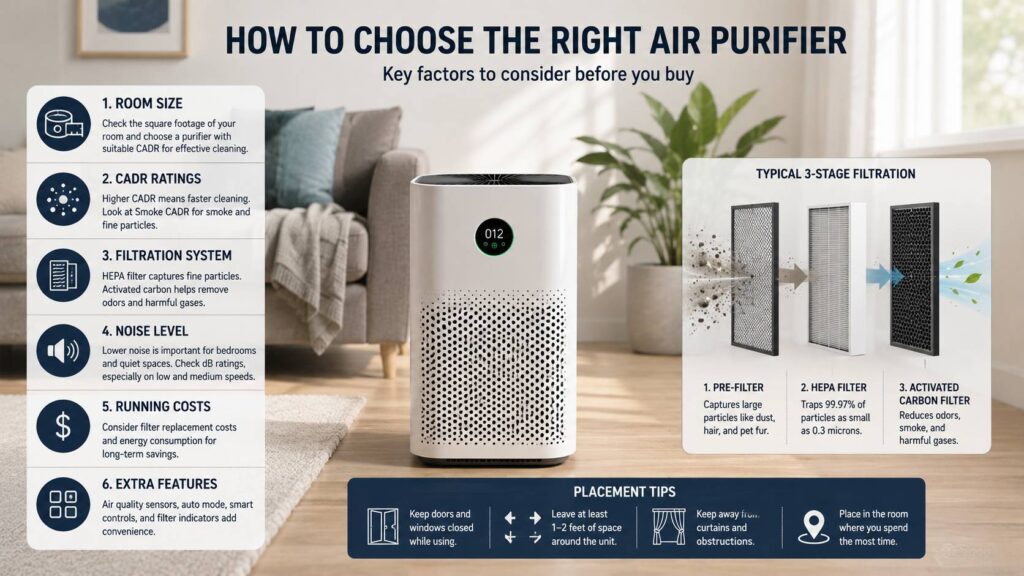
So, how do you choose the right air purifier without getting lost in marketing claims? Start with the basics: room size, CADR, filter type, noise, and replacement filter cost.
Start With the Air Problem You Want to Fix
Before you compare brands, think about the reason you want an air purifier. This step matters more than the design, app, or display.
For allergies, focus on strong particle filtration. Dust, pollen, mold spores, and pet dander are the main targets. A True HEPA filter is usually the best starting point.
For pets, look for a model with a good pre-filter, a HEPA filter, and an activated carbon layer. The pre-filter helps catch fur. The HEPA filter helps reduce dander. Then, the carbon layer helps with pet smells, litter box odor, and other household odors.
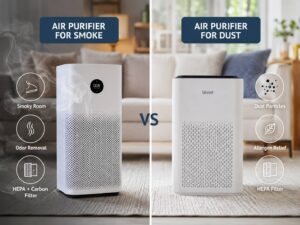
For smoke, choose a purifier with a higher smoke CADR and a proper carbon filter. Smoke contains tiny particles and odor compounds, so weak filters struggle fast.
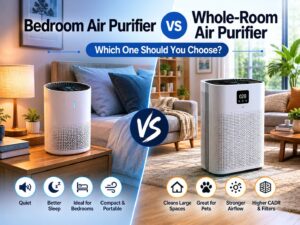
For bedrooms, noise matters a lot. A loud purifier can clean well but still become annoying at night. So, pick a model that can clean your room on low or medium speed, not only on its highest setting.
For open living rooms, airflow matters more than smart features. A small purifier in a large open space will usually work too slowly to make a clear difference.
Measure Your Room Before You Buy
Room size is one of the biggest buying mistakes. Put a compact purifier in a large living room and the results come slowly. The machine runs, the lights glow, and the air still feels the same.
Measure the room first. Multiply the length by the width to get the square footage.
For example:
12 ft x 15 ft = 180 sq ft
Ceiling height matters too. Most room ratings assume a normal ceiling height of around 8 feet. A room with high ceilings has more air to clean, so the purifier needs more power.
Open spaces need extra care. A living room connected to a kitchen and hallway is not the same as a closed bedroom. In that case, size up. A purifier rated for a small bedroom will not handle a larger open area well.
In real use, I would rather choose a purifier that is slightly stronger than needed. That way, it can run at a lower speed, make less noise, and still clean the room well.
Understand CADR Before You Trust Room Coverage Claims
CADR stands for Clean Air Delivery Rate. It tells you how much clean air the purifier can deliver. A higher CADR usually means faster cleaning.
Many purifiers list CADR for smoke, dust, and pollen. Smoke CADR is especially useful since smoke particles are very small. If a purifier has a weak smoke CADR, it may not be the best choice for wildfire smoke, cigarette smoke, or heavy cooking smoke.
A simple rule helps here: choose a purifier with a CADR that is at least two-thirds of your room size in square feet. For a 180 sq ft room, a smoke CADR of around 120 or higher is a good target.
Still, do not rely only on room coverage claims. Some brands advertise very large coverage numbers based on low air changes per hour. That can look impressive, but it may not clean the air fast enough for allergies, smoke, or pet dander.
Instead, check the CADR. It gives you a clearer idea of real cleaning power.
Choose the Right Filter Type
Most good air purifiers use more than one filter layer. Each layer has a different job.
A pre-filter catches larger particles like dust, hair, lint, and pet fur. This layer helps protect the main filter. In homes with pets, a washable or vacuumable pre-filter is very useful.
A True HEPA filter captures small airborne particles such as pollen, dust, mold spores, and pet dander. This is the filter you need for allergy relief and everyday air cleaning.
An activated carbon filter helps reduce odors and some gases. It is helpful for pet smells, cooking odors, smoke, and stale indoor air. Thin carbon sheets can help a little. Thicker carbon filters usually work better.
Some models add UV-C lights, ionizers, plasma features, or other extras. Treat those as secondary features. Your main buying decision should still come down to airflow, filter quality, room size, noise, and filter cost.
Avoid ozone generators for normal home use. Ozone is not something you want to breathe indoors. Some ionizer features can produce ozone too, so check the details before you buy.
Check Filter Replacement Costs Early
The purchase price is only part of the story. Replacement filters can make a cheap air purifier expensive over time.
Before you buy, check these points:
- Replacement filter price
- Filter life estimate
- Filter availability in your country
- Generic filter options
- Combined filter cost
- Separate pre-filter, HEPA, and carbon filter costs
Some brands sell low-cost purifiers but expensive filters. Others cost more upfront but use filters that last longer. After two or three years, the more expensive model can become the better deal.
This is one of the most common real-world issues. The purifier works well at first, then the filter replacement price becomes annoying. People delay replacing the filter, and performance drops.
A dirty filter blocks airflow. It can make the purifier louder too. For that reason, pick a model with filters you can afford to replace on schedule.
Think About Noise in Real Use
Check the noise level too. A purifier can have great specs and still be unpleasant to use.
Most brands advertise the quietest sleep mode number. That number looks good, but sleep mode often moves very little air. So, check noise levels at medium speed if the brand provides them.
For bedrooms, choose a purifier that can clean the room well without running on high all night. For living rooms, noise still matters during TV time, work calls, or quiet evenings.
Look for these features:
- Quiet low and medium fan speeds
- Sleep mode
- Display-off mode
- No loud beeping
- Smooth fan sound
- No rattling from the body
- Stable airflow
A soft fan sound is usually easy to live with. A high-pitched motor sound gets irritating fast.
Look at Energy Use Too
Air purifiers often run for many hours per day. During allergy season, wildfire smoke, or dusty periods, you may run one almost all day. So, power use matters.
A more energy-friendly purifier can save money over time. Larger models can use more power on high speed, but they may clean faster and then run lower.
Auto mode can help, but it is not perfect. Some sensors react quickly to smoke, cooking particles, or dust. Others keep the fan too low. For allergy season or bad outdoor air days, manual medium speed often works better than auto mode.
This is another reason to size up slightly. A stronger purifier running at medium speed can feel quieter and more useful than a small purifier running at full speed.
Do Not Overpay for Smart Features
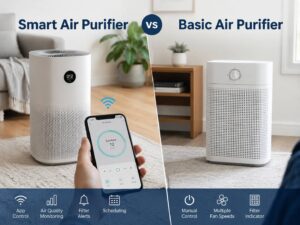
Smart features can be convenient. App control, filter tracking, schedules, and air quality readings can make daily use easier. Still, they do not clean the air by themselves.
A purifier with strong CADR, good filters, low noise, and fair filter prices is better than a flashy smart model with weak airflow.
Useful smart features include:
- Filter life tracking
- Fan speed schedules
- Real-time particle sensor
- Auto mode
- Display dimming
- Child lock
- App control that still leaves buttons on the unit
Less useful features include vague air quality lights, app-only controls, unclear sensor readings, and aggressive filter reminders.
At the same time, smart controls can help in a home office or bedroom. For example, you can schedule the purifier to run before sleep or before work. If you are building a cleaner desk setup, comfort matters in many small ways, from air quality to the gear you use every day, such as choosing between a gaming keyboard vs office keyboard.
Best Air Purifier for Allergies
For allergies, the goal is to reduce airborne particles. Choose a purifier with a True HEPA filter, strong CADR, and a sealed design that keeps air from leaking around the filter.
The bedroom is often the best place to start. You spend many hours there, and cleaner air during sleep can make a real difference for sensitive users.
Good habits help too:
- Keep windows closed on high pollen days
- Wash bedding often
- Vacuum regularly
- Keep pets away from pillows
- Replace filters on time
- Run the purifier before bedtime
If allergies are your main concern, you can compare more targeted models in this guide to the best air purifiers for allergies in 2026.
Still, no purifier removes allergens stuck inside carpets, curtains, mattresses, or fabric furniture. It works best on particles floating in the air. So, pair the purifier with regular cleaning for better results.
Best Air Purifier for Pets
Pet owners need strong airflow and easy maintenance. Fur and dander can clog filters faster than expected.
Choose a purifier with a washable or easy-clean pre-filter. This helps catch fur before it reaches the main HEPA filter. Then, look for an activated carbon filter for odors.
Placement matters here too. Put the purifier near the area where your pet spends the most time, but do not block the intake. Keep it away from walls, curtains, and furniture.
For pet homes, I would not go too small. Tiny desktop purifiers fill up quickly and rarely move enough air in a busy room. A larger model with a cleanable pre-filter is usually the better long-term choice.
Best Air Purifier for Smoke and Odors
Smoke is one of the hardest indoor air problems. It contains fine particles and odor compounds. A basic HEPA filter can help with particles, but odor needs carbon.
For wildfire smoke, cigarette smoke, or heavy cooking smoke, look for:
- High smoke CADR
- True HEPA filtration
- Activated carbon filter
- Strong fan performance
- Easy filter replacement
- Good seal around the filter
Thin carbon layers can reduce light smells. For stronger odors, more carbon usually works better. Product pages do not always list carbon weight, so compare reviews and filter size when possible.
Do not expect an air purifier to make indoor smoking safe. It can reduce some pollution, but it cannot remove every harmful compound from the air.
Place the Air Purifier in the Right Spot
A good purifier can perform badly in the wrong spot. Do not hide it behind a sofa, under a desk, or tight against a wall. The intake and outlet need open space.
Use these placement tips:
- Place it in the room where you need cleaner air most
- Keep doors and windows closed during use
- Leave open space around the intake
- Keep curtains away from the airflow path
- Avoid tight corners
- Move it closer during cooking or smoke events
- Keep it on a stable surface
For bedrooms, place it a few feet from the bed if the airflow feels too strong. For living rooms, place it near the main activity area rather than in a hidden corner.
Good placement makes the purifier work faster and keeps the fan from struggling.
Watch Out for Misleading Claims
Air purifier marketing can be confusing. Some claims are useful. Others are mostly there to sound impressive.
Be careful with huge room coverage numbers on small units. A compact purifier that claims to cover a very large space may clean that space too slowly.
Be careful with “HEPA-like” or “HEPA-type” wording. These terms are not the same as True HEPA.
Be careful with washable HEPA claims too. A washable pre-filter is useful. A washable main filter needs closer inspection.
Fragrance features are another thing to question. Adding scent is not the same as cleaning the air. For sensitive users, fragrance can make the room feel worse.
Instead of trusting bold claims, check CADR, filter type, filter price, and user reviews.
Features Worth Paying For
Some features are worth the extra money.
Look for:
- Strong CADR for your room size
- True HEPA filter
- Activated carbon filter
- Washable pre-filter
- Low noise on medium speed
- Fair replacement filter cost
- Filter replacement indicator
- Display-off mode
- Energy-friendly operation
- Clear warranty
- Easy filter access
Features that matter less:
- Decorative lights
- Oversized app dashboards
- Vague air quality colors
- Tiny scent pads
- UV lights with unclear value
- Brand-specific marketing terms
A good purifier should be easy to live with. You should not need to adjust it all day.
Common Buying Mistakes to Avoid
A buyer can go wrong in a few ways.
They buy one purifier for the whole home. Portable air purifiers work best in the room where they are placed.
They choose a model that is too small. It runs quietly, but it does not clean enough air.
They ignore filter prices. Then, after a few months, replacement filters feel too expensive.
They run sleep mode all day. The unit stays quiet, but airflow drops.
They place the purifier in a blocked corner. Air cannot move through the unit properly.
They trust room coverage claims without checking CADR.
They buy ozone generators for indoor air cleaning. That is not a good choice for occupied rooms.
They forget to remove the plastic wrapping from the filter before first use. This sounds silly, but it happens more often than you think.
Quick Buying Checklist
Before you buy an air purifier, check these points:
- Room size in square feet
- Smoke CADR, dust CADR, and pollen CADR
- True HEPA filter
- Activated carbon filter
- Washable or cleanable pre-filter
- Filter replacement price
- Filter availability
- Noise level on medium speed
- Energy use
- Display-off mode
- No ozone generator
- Warranty and return policy
This simple checklist can save you from most bad purchases.
Final Verdict: How to Choose the Right Air Purifier
The right air purifier should match your room, your main air problem, and your budget for replacement filters.
For allergies, choose a True HEPA purifier with enough airflow for the room. For pets, look for a strong pre-filter and carbon filter. For smoke, focus on high smoke CADR and better carbon filtration. For bedrooms, choose a model that cleans well without forcing you to use the loudest speed.
The best air purifier is not always the one with the biggest screen, the flashiest app, or the longest feature list. It is the one that moves enough clean air, runs quietly enough for daily use, and uses filters you can replace without stress.
Buy for the room you actually use most. Check the real cleaning power. Then, look at noise and filter cost before you press buy. That simple order will lead you to a much better choice.