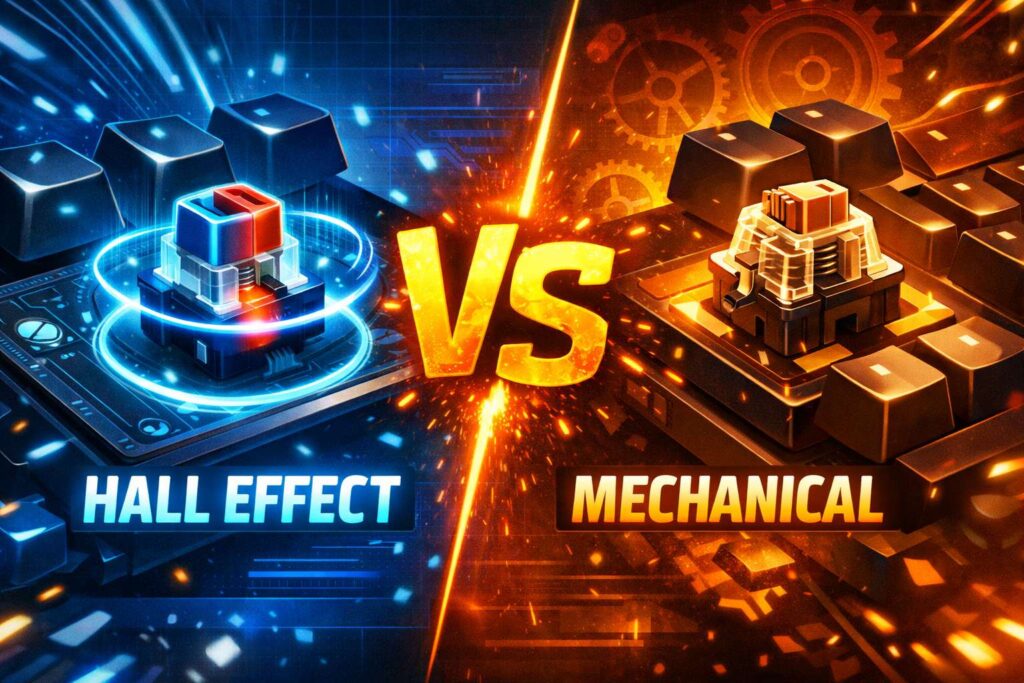
A lot of keyboard guides make this topic sound more complicated than it is. The truth is pretty simple. Hall effect keyboards focus on speed, control, and tuning. Mechanical keyboards focus on feel, variety, and long-term choice.
That is why this comparison matters so much right now. More people search for terms like rapid trigger keyboard, magnetic switch keyboard, adjustable actuation keyboard, best keyboard for FPS games, and best keyboard for typing. They want to know what these boards actually feel like in real use, not just what brands say on a spec sheet.
So, which one is better? That depends on what you do at your desk most days.
A competitive gamer will not judge a keyboard the same way as a writer, programmer, or office worker. A board that feels amazing in Valorant or Counter-Strike may feel less special in email, documents, and spreadsheets. At the same time, a keyboard with a great typing feel may not give a fast player the speed and control they want.
Let’s break it down in a clear way.
What a Hall Effect keyboard is
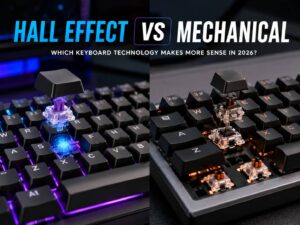
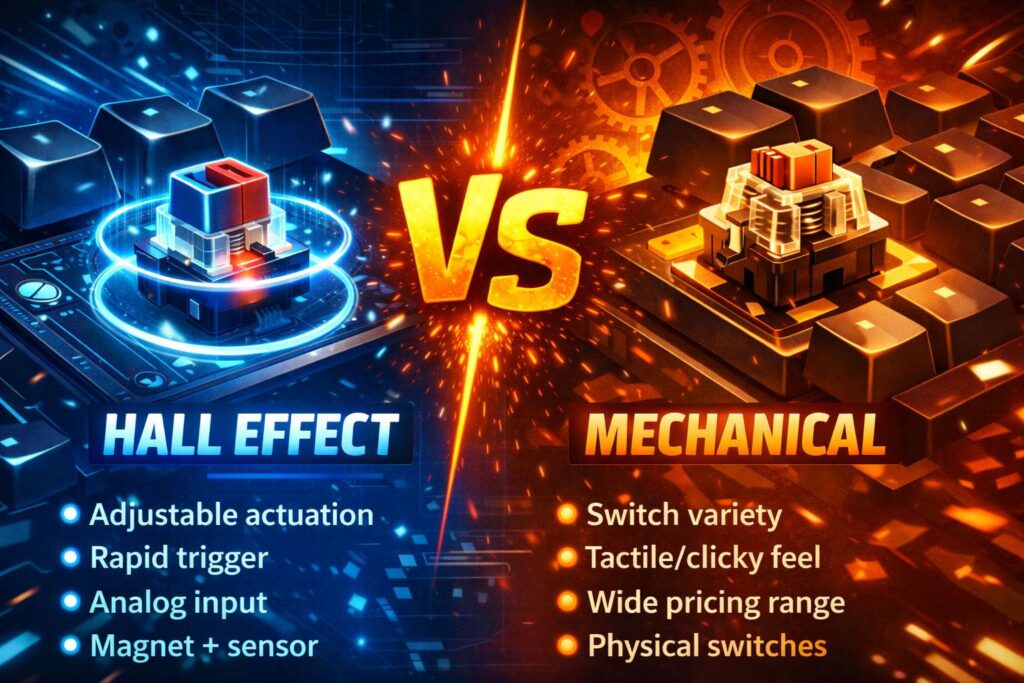
A Hall effect keyboard uses magnetic sensing to detect key movement. That is the big difference. A standard mechanical keyboard uses physical contact inside the switch. A Hall effect switch reads movement through magnets and sensors.
This gives the keyboard a few extra tricks that standard mechanical boards do not have in the same way.
The biggest one is adjustable actuation. You can set a key to trigger very early, or much deeper in the press. On some boards, you can fine-tune that point for each key. That means your movement keys, spacebar, and modifier keys do not need to behave the same way.
The next big feature is rapid trigger. This is one of the main reasons Hall effect boards exploded in popularity with competitive players. The key resets the moment you start to lift your finger. It does not need to return to one fixed reset point first. That can make repeated inputs feel faster and sharper.
Some Hall effect keyboards even support analog-style input. That means the board can read how far a key moves, not just whether it is pressed or not. That feature matters more in some games than others, but it is still part of the appeal.
In simple terms, Hall effect keyboards are built for people who want more control over how keys respond.
What a mechanical keyboard is
A mechanical keyboard uses a physical switch under each key. This style has been popular for years, and for good reason. It gives people a wide range of switch types, sound profiles, and key feels.
Most mechanical switches fall into three main groups: linear, tactile, and clicky.
Linear switches feel smooth from top to bottom. They are popular for gaming and for users who like a clean, light keypress. Tactile switches give a small bump during the press, so they feel more defined. Clicky switches add a sharp sound and stronger feedback.
That variety is the biggest strength of a mechanical keyboard. You can pick a soft and quiet board, a deep and thocky board, or a loud clicky one that feels old-school in the best way. You get a lot more choice in feel and sound.
Mechanical keyboards still make up the larger market, and that matters. You get more sizes, more price points, more switch brands, more aftermarket parts, and more keycap sets. For many buyers, that wide choice is a huge advantage.
Hall Effect vs mechanical keyboard for gaming
This is where Hall effect usually pulls ahead.
Fast shooters reward quick movement changes. Rapid trigger helps with that. Adjustable actuation helps too. You can set movement keys to trigger almost instantly, then set other keys deeper so they do not fire by accident. That kind of control feels genuinely useful in games that rely on fast strafing and tight timing.
This is why Hall effect keyboards have become so popular with serious FPS players. They are not just buying into hype. The feature set lines up with what they need.
That said, mechanical keyboards still work very well for gaming. A good linear mechanical switch can feel quick, smooth, and dependable.
So the better question is not “Can a mechanical keyboard game well?” It absolutely can.
The real question is this: do you want fixed key behavior, or do you want to tune how each key acts? That is where Hall effect has the edge.
For gaming first, Hall effect wins for most buyers.
Hall Effect vs mechanical keyboard for typing
Typing is a different story.
If you care more about comfort, rhythm, and feedback than raw speed, mechanical keyboards stay strong. Tactile and clicky switches still offer a distinct typing feel. A well-built mechanical board can feel more natural, more satisfying, and more personal during long writing sessions.
Hall effect keyboards can still feel very good for typing. Some sound great. Some feel smooth and premium. Some even beat cheaper mechanical boards with ease. But the category still leans heavily toward gaming features. Mechanical keyboards still offer more depth for people who care most about feel.
That matters for writers, coders, students, and office users. A keyboard is something you live with every day. Sound, resistance, and rhythm matter.
So, for typing first, mechanical usually feels like the safer and more rewarding choice.
Feel, sound, and daily comfort
This part often gets ignored, yet it shapes your experience every single day.
Mechanical keyboards give you a wider menu of sound and feel. You can chase a soft muted sound, a deep poppy sound, or a sharper click. You can go light or heavy. You can go smooth or tactile. That freedom is a big reason keyboard fans stay loyal to mechanical boards.
Hall effect boards are getting better here. A lot better, honestly. Some new magnetic boards feel excellent. Still, the category is younger, and the switch ecosystem is not as broad. You simply get fewer feel options right now.
Daily comfort matters too. A board that fires at a very shallow point can feel fast, but it can lead to more accidental presses until you adjust. Some users love that instant feel. Others find it twitchy during work.
That is why your best keyboard on paper is not always your favorite keyboard on the desk.
Customization and software
Hall effect keyboards shine here.
A lot of magnetic boards let you change actuation, rapid trigger behavior, profiles, and per-key settings through software. That is a real advantage, not a gimmick. You can shape the board around your habits and your games.
Mechanical keyboards are customizable too, but in a different way. You can swap switches on many boards. You can change keycaps, foam, stabilizers, plates, and cases. You can turn one board into something that feels almost custom-built for you.
So the split is pretty clear.
Hall effect gives you deeper digital tuning.
Mechanical gives you deeper physical choice.
Neither one is weak here. They just aim at different kinds of users.
Compatibility and upgrade path
This is one area where mechanical still feels easier.
A lot of mechanical boards use familiar switch formats and standard keycap support. That makes upgrades simpler. The market is huge, and parts are everywhere.
Hall effect boards need more care. Not every magnetic switch works in every magnetic keyboard. Some boards only support certain switches from certain brands. That means you need to read the details more closely before you buy extra parts.
This is not a deal breaker, but it is worth knowing early. Mechanical keyboards still feel more open and less restrictive for hobbyists and tinkerers.
Price and value
Hall effect keyboards often cost more, especially the models people actually want. You are paying for magnetic sensing, gaming-focused features, and deeper software control.
That extra cost makes sense for buyers who will use rapid trigger and actuation tuning every day. It makes less sense for someone who mainly writes, browses, and works.
Mechanical keyboards cover more of the market. You can get a decent entry-level model for a fair price. You can move into mid-range boards with better cases and switches. You can even go full custom later. There is more room to grow at different budgets.
That makes mechanical the better value pick for many people.
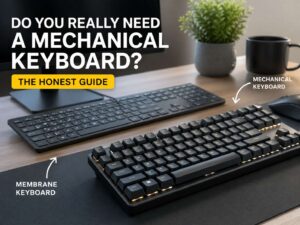
And if you are still comparing classic keyboard types before you jump into magnetic boards, this guide on mechanical vs membrane keyboard is worth reading too.
Which keyboard should you buy?
Buy a Hall effect keyboard if gaming sits at the top of your list. It is the better fit for fast shooters, quick movement, and users who want to control actuation and reset behavior in detail. It feels modern, fast, and highly tunable.
Buy a mechanical keyboard if you care more about typing feel, switch variety, sound, easier upgrades, and stronger value across more price ranges. It still makes more sense for many desks, especially mixed-use setups.
So there is no single winner for every person.
Hall effect is better for speed and tuning.
Mechanical is better for feel, variety, and broader long-term choice.
That is the real answer, and it is a lot more useful than pretending one type crushes the other in every situation.
Final verdict
Hall effect keyboards deserve the attention they get. The best ones deliver real benefits in gaming, and rapid trigger is more than a buzzword. You can feel the difference.
Mechanical keyboards still hold their ground very well. They offer more switch personalities, more sound options, more flexible pricing, and a familiar typing experience.
So the right pick comes down to your priority.
Pick Hall effect for competitive gaming and deep key tuning.
Pick mechanical for typing feel, daily comfort, and wider choice.
That is the practical answer.