

Buying noise cancelling headphones feels simple at first. Then the price range gets wild. One pair costs under $100. Another sits near $400. Then a luxury model climbs far past that. So the real question is not just what sounds best. It is what price gives you the best value for your life.
For most people, the sweet spot sits in the mid-range. A good pair of noise cancelling headphones usually costs enough to give you real Active Noise Cancellation, good comfort, stable Bluetooth, and battery life that lasts through work, travel, or study. Past that point, the gains get smaller. You often pay more for nicer materials, brand appeal, or extra features that do not change daily use in a big way.
That makes this guide useful for a lot of common searches. People look up best noise cancelling headphones under $200, are expensive ANC headphones worth it, how much to pay for wireless headphones, and best headphones for flights or office use. The answer stays close to the same. Spend based on how you will use them, not on hype.
Why prices vary so much
The wide price gap comes from a few things. First, not all noise cancelling is equal. Some pairs cut low engine hum, air conditioning noise, and train rumble very well. Others dull that sound a bit, but they do not create the same calm feeling. So two products can share the same feature name and still feel very different in daily use.
Comfort changes price too. Cheap headphones may sound fine for 30 minutes, then start to press too hard on your ears or head. A better pair often gives you softer pads, lower clamp force, and a frame that feels lighter over time. That matters a lot on flights, long workdays, or late study sessions.
Then there are the small details. App control, multipoint pairing, faster charging, better microphones for calls, and foldable travel design all add value. Still, those extras matter only if you will use them. A student who needs quiet for reading may not care about premium materials. A commuter who jumps between a laptop and a phone every day probably will.
The best budget for most buyers
Most buyers do not need flagship headphones. They need a pair that blocks enough noise, stays comfortable, and lasts a few years without drama. That is why the mid-range wins so often.
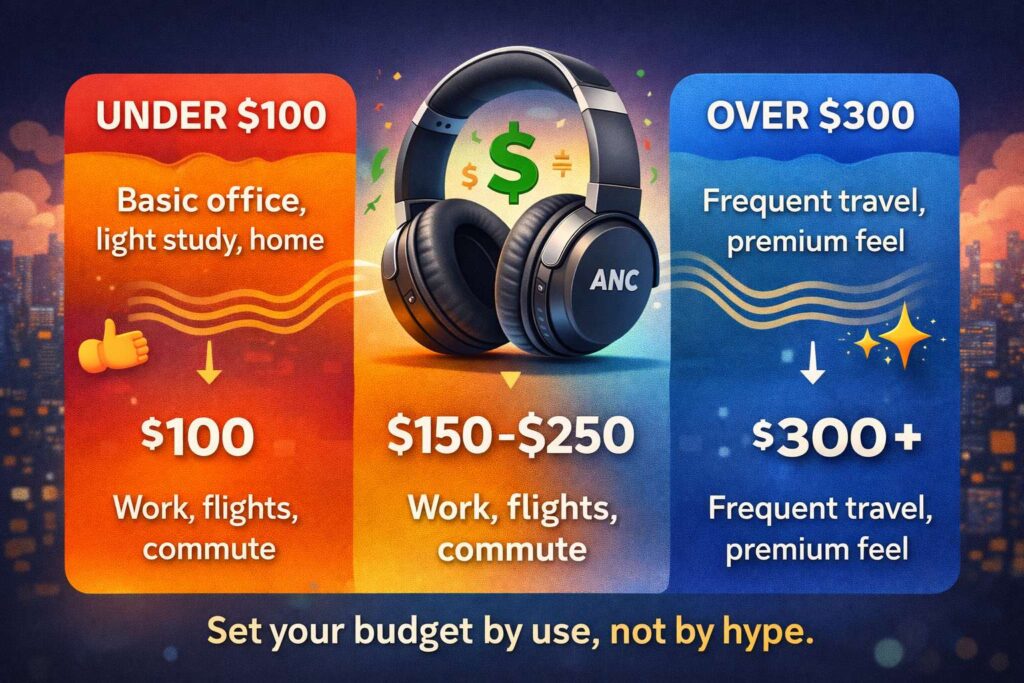
A budget of about $150 to $250 usually makes the most sense. That range often gives you the best balance of price and daily performance. You can expect real ANC, clean sound, long battery life, decent call quality, and an app with some control over sound or noise cancelling modes. The jump from very cheap headphones to this tier feels real. The jump from this tier to luxury pricing feels smaller.
This is the part many buyers miss. Expensive headphones are not always a bad buy, but they are rarely the smart default pick. Most people listen to music at work, on public transport, at home, or on a few trips each year. Mid-range models already handle that job very well. So spending more does not always make your day much better.
When under $100 is enough
Budget noise cancelling headphones have improved a lot. That matters if you want a pair for casual listening, podcasts, videos, and light office use. In that case, you do not need to chase the top shelf.
A price under $100 can work well if your expectations stay realistic. You will still get less powerful ANC, simpler materials, and weaker microphones in many cases. Yet for home use, study, and short commutes, that may be perfectly fine. You can save money and still enjoy a quieter space.
This budget fits students, light listeners, and anyone who wants a second pair for travel or backup use. It fits buyers who search best cheap noise cancelling headphones or affordable ANC headphones for work. The key is to avoid expecting luxury comfort or top-tier silence at entry pricing. If you stay honest about your needs, this tier can be a very smart buy.
When $150 to $250 is the sweet spot
Here is where value gets strong. In this range, brands usually stop cutting the most important corners. You get better padding, better tuning, better battery life, and better noise cancelling. You may not get every premium extra, but you get the parts that count most.
This price band makes sense for commuters, frequent office users, and travelers who take a few flights a year. It is a good fit for people who want one main pair and plan to use it almost every day. You get enough comfort for long sessions, enough ANC for trains and planes, and enough battery life that you are not always reaching for a charger.
There is another reason this range wins. Sales hit this category often. A headphone that launched at a higher price can drop into mid-range territory later. So if you wait for a deal, you can grab stronger value without stretching your budget. That makes patience part of the buying strategy.
When paying over $300 makes sense
There are cases where premium pricing is fair. You may want a luxury feel, stronger brand support, better case quality, or extra features tied to your phone or laptop setup. You may care a lot about design, premium finishes, or deeper app features. That is valid.
Still, this is where buyers need discipline. Once you move above $300, you are often paying for polish, not a giant leap in daily usefulness. The sound may be a bit better. The finish may look nicer. The controls may feel smoother. Yet the core experience, which is quiet, comfort, and solid wireless use, may not improve enough to justify the price for most people.
Premium models fit travelers who spend long hours in airports and cabins, people who wear headphones every weekday, and buyers who want the best feel and finish they can get. They can be worth it. Yet they are still a want for many people, not a need.
Spend based on where you use them
Your daily routine should set your budget. That is the cleanest way to avoid overspending.
If you work from home and mostly want to cut fan noise, street hum, or family noise in the next room, a budget or lower mid-range pair can do the job. If you commute on buses, trains, or planes, then comfort and stronger ANC matter more, so a mid-range pair makes more sense. If you travel every week and wear headphones for hours at a time, then a premium model starts to feel easier to justify.
The same logic applies to reading and desk setups. For a quiet study space, good headphones pair well with other gear choices that shape comfort and focus. If you are comparing screens for long reading sessions, this guide on Kindle vs iPad for reading in 2026 covers another part of that setup. Then, if your workday includes typing for hours, a keyboard choice matters too. This breakdown of mechanical vs membrane keyboard can help you build a desk that feels better from morning to evening.
The features worth paying for
Not every feature deserves extra money. Some matter a lot. Others look good in ads and do very little in daily life.
Comfort deserves a real share of your budget. Ear pads, headband pressure, and total weight shape the whole ownership experience. If a pair feels bad after an hour, it is a poor buy at any price.
Battery life matters too. Long battery life makes travel easier and reduces daily friction. So does fast charging. Multipoint pairing is another feature worth real money if you move between a phone and a laptop often. That feature saves time every day, and it feels useful from the first week.
Microphone quality matters if you take calls in busy places. Foldability matters if you travel. App support matters if you like to tune sound or switch ANC modes. Fancy audio modes and brand-only extras sit lower on the list for most people. They are nice. They just do not deserve top billing in a value-focused buy.
Signs you are about to overspend
There are a few clear warnings. One is buying a flagship model for simple home listening and podcasts. Another is paying full launch price when sales are common. A third is chasing premium features tied to one brand ecosystem when you will barely use them.
You are overspending if the expensive model solves problems you do not have. You are overspending if your budget jumps far past your actual use. You are overspending if you skip fit and comfort just to get the biggest name on the box.
A smart buyer stays focused on the basics. Good ANC. Real comfort. Strong battery life. Stable wireless use. A fair price. Everything else comes after that.
A simple spending rule that works
You do not need a complex formula here. A simple rule works well.
Stay under $100 if you want basic noise cancelling for home, school, or light office use.
Aim for $150 to $250 if you want the best balance of comfort, ANC, battery life, and long-term value.
Go past $300 only if you care a lot about premium finish, brand extras, or heavy travel use that makes top-tier comfort worth the jump.
That rule keeps your spending grounded. It stops impulse buys. It also matches how most people really use headphones day to day.
The bottom line
A good pair of noise cancelling headphones does not need to drain your wallet. Most people will get the best value in the mid-range, and that is where the smart money usually goes. Budget pairs still make sense for lighter use. Premium pairs still have a place. Yet they are not the automatic best choice just from being more expensive.
If you want the short version, here it is. Spend enough to get strong comfort, real ANC, and battery life you will actually enjoy. Then stop. For most buyers, that means staying around $150 to $250 and watching for a sale. That is where value, comfort, and daily use tend to meet in the right place.